High-intent keyword targeting focuses your budget on the specific phrases someone searches right before they call a contractor -- "emergency water heater repair [city]," "licensed roofer near me" -- while broad SEO builds general visibility and authority across many related terms, including ones that bring traffic but rarely bring a phone call. If you have to choose which to fund first on a limited budget, pay for high-intent keyword targeting first: it produces leads faster and gives you proof the channel works before you invest in the slower, broader authority-building that broad SEO requires.
High-intent keywords vs. broad SEO is the first budget fork most contractors never consciously choose -- their SEO spend just gets split evenly between both by default.
What's the Real Difference: High-Intent Keywords vs. Broad SEO?
Both are technically "SEO" -- they both involve ranking in Google's organic results -- but in the high-intent keywords vs broad SEO comparison, they optimize for different outcomes, and conflating them is how contractors end up paying for traffic that never converts.
High-Intent Keyword Targeting
This means identifying and building content specifically around phrases that signal someone is ready to hire, not just research. Service-plus-location terms ("AC repair [city]"), urgency phrases ("same day," "emergency," "24 hour"), and problem-specific searches ("water heater leaking won't stop") all fall into this bucket. The volume on any single phrase is often lower than a broad term, but the percentage of searchers who actually call is dramatically higher.
Broad SEO
This covers the wider program: technical health, site-wide authority, informational content that answers general questions ("how does a heat pump work"), and the accumulated trust signals that help every page on your site rank a little better over time. Broad SEO is what makes high-intent targeting work better over the long run, but on its own, a broad SEO program can quietly produce traffic and rankings for a year without moving your phone. Google's own guidance on keyword match types and intent is a useful neutral reference for how search platforms themselves think about this split, even though it is written for ad targeting rather than organic content.
For the fuller picture of what a high-intent program specifically includes, see our High-Intent Keyword Targeting service page.
A Simple Framework: Which Should You Fund First?
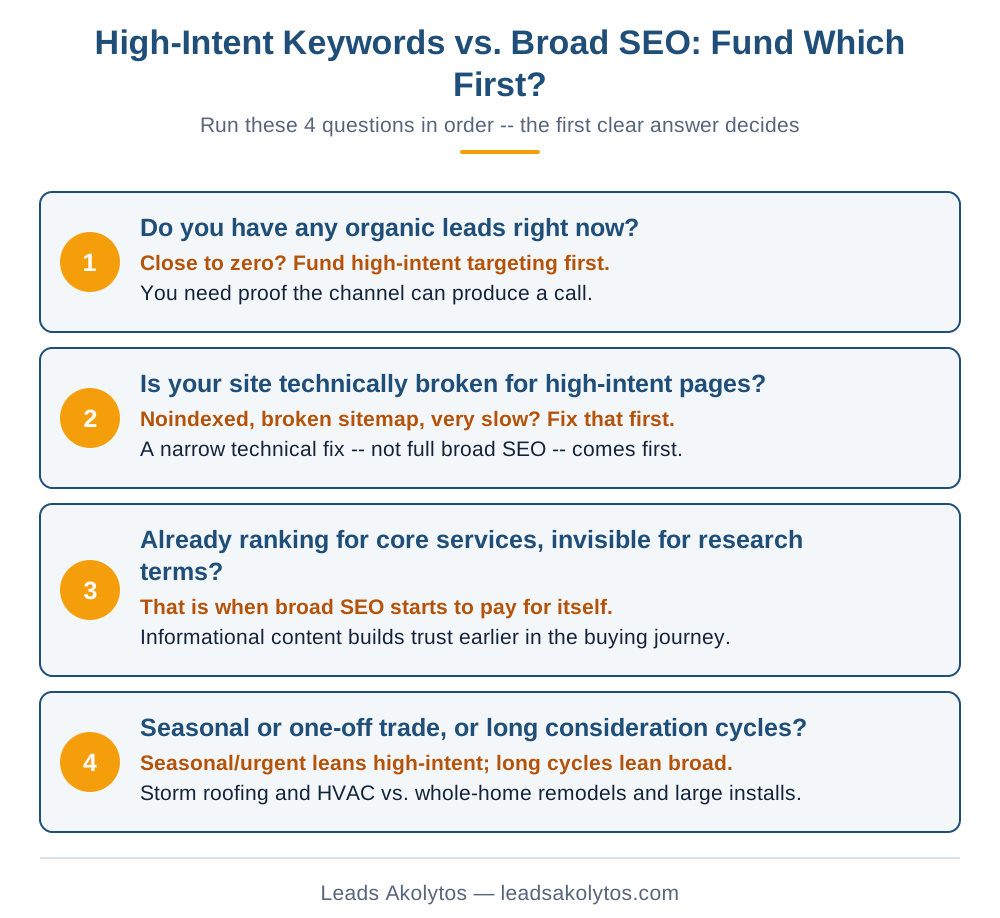
Run through these four questions in order. The first one that gives you a clear answer tells you where your next dollar should go.
- Do you have any organic leads right now? If the honest answer is close to zero, fund high-intent targeting first. You need proof the channel can produce a call before you justify a longer broad-SEO investment to anyone, including yourself.
- Is your site technically broken in a way that blocks high-intent pages from ranking at all? If a core service page is noindexed, has a broken sitemap, or loads so slowly that visitors bounce before it renders, no amount of high-intent keyword work will show results until that is fixed -- in that specific case, a narrow technical fix (not full broad SEO) comes first.
- Do you already rank reasonably well for your core services but get ignored for research-stage terms competitors own? If high-intent pages are already converting but you are invisible for the informational searches that build trust earlier in the buying journey, that is when broad SEO's content and authority work starts to pay for itself.
- Is your business seasonal or one-off, versus repeat/referral-driven? A highly seasonal trade (storm-driven roofing, HVAC) leans harder toward high-intent targeting because the buying window is short and urgent. A trade with longer consideration cycles and more research-stage searching (whole-home remodels, large installs) gets more return from broad SEO's informational content.
| Dimension | High-Intent Keyword Targeting | Broad SEO |
|---|---|---|
| Typical time to first lead | 4-8 weeks once content is live and indexed | 3-6+ months, often longer |
| Search volume per term | Lower, but tightly matched to buying intent | Higher, mixed intent (many researchers, few buyers) |
| Best for | Businesses needing proof of channel ROI fast, seasonal/urgent trades | Businesses with an established lead flow looking to compound authority over time |
| Risk if done alone, long-term | Can plateau once the obvious high-intent terms are claimed | Can produce traffic and rankings with no corresponding call volume |
Use this graphic
You're welcome to republish this graphic on your own site, as long as you credit Leads Akolytos with a link back to this article. Copy the code below:
<a href="https://leadsakolytos.com/blog/high-intent-keywords-vs-broad-seo/"><img src="https://leadsakolytos.com/blog/high-intent-keywords-vs-broad-seo-framework.png" alt="High-intent keywords vs broad SEO decision framework" width="1200" /></a><br>Source: <a href="https://leadsakolytos.com/blog/high-intent-keywords-vs-broad-seo/">Leads Akolytos</a>Why This Distinction Gets Lost in Most SEO Pitches
The high-intent keywords vs broad SEO split is rarely spelled out for you. Most SEO proposals quote a single monthly retainer and a single blended keyword list without separating which terms are there to produce a call this quarter and which are there to build authority over the next year. That is not necessarily dishonest -- a mature SEO program genuinely needs both -- but it means you, the buyer, have to ask the separating question yourself. For a checklist of what to ask any provider before you sign, see our breakdown of 7 signs your SEO company is chasing vanity keywords instead of high-intent ones, and our related diagnostic on 4 costly signs you're wasting budget on the wrong keywords.
Can You Prioritize This Yourself, Without Paying for Either Yet?
Yes, for a rough first pass at sorting high-intent keywords vs broad SEO terms. Pull your last 90 days of Search Console queries, flag anything with a service name plus a city or an urgency word as high-intent, and check whether those specific pages already exist and already rank. If they do not exist yet, that is your highest-leverage next move regardless of budget. For the fuller DIY-vs-pay comparison, including a realistic time estimate for doing this yourself, see our guide on whether you can do your own high-intent keyword research or need to pay for it, and for a sense of typical project pricing if you decide to hire it out, see our high-intent keyword targeting cost guide.
Get a Clear Answer for Your Specific Budget
When it comes to high-intent keywords vs broad SEO, there is no universally correct order -- the right first move depends on whether you currently have any organic leads, whether your site has a technical blocker, and how seasonal your business is. Schedule a free strategy call and we will walk through the four-question framework above against your actual Search Console data and tell you honestly which one deserves your next dollar.
Frequently Asked Questions
Can I run high-intent keyword targeting and broad SEO at the same time?
Yes, and most mature programs eventually do -- the question this guide answers is which to fund first when your budget is limited, not whether to eventually do both.
Will broad SEO content ever bring in leads on its own?
Occasionally, but indirectly -- an informational page that ranks well can introduce a reader to your brand well before they are ready to buy, and some of those readers return later through a direct search or a branded search once they are ready. It is a slower, less measurable path to a lead than high-intent targeting.
How do I know if a keyword is actually high-intent or just sounds like it?
A genuine high-intent keyword combines a service with either a location, an urgency signal ("emergency," "same day," "24 hour"), or a specific problem phrase ("won't turn on," "leaking"). A keyword that is just a service name alone, with no qualifier, usually pulls a mix of researchers and buyers rather than buyers specifically. Moz's overview of search intent breaks this down well if you want the deeper mechanics behind why intent, not just volume, determines whether a ranking actually produces a lead.
Does paying for high-intent targeting first mean I'm ignoring long-term SEO health?
No -- fixing severe technical blockers (per question 2 in the framework above) always comes first regardless of which you fund next, and a competent high-intent program still includes basic on-page and technical hygiene for the pages it builds. It simply sequences the broader authority-building work for later, once the faster channel has proven itself.
Want this handled for you?
We do this work for home service contractors every day, month-to-month, with no contracts. Book a free 30-minute call and we'll show you where you stand on Google.
Book my free call