The Short Answer
You can do basic high-intent keyword research yourself with free tools like Google’s Keyword Planner, and for a single service page it’s worth trying. Where DIY keyword research typically falls short isn’t finding one good keyword — it’s what happens after: matching that keyword to genuine buyer intent, mapping it against dozens of competing variations, and keeping the whole thing current as search behavior shifts. That ongoing work is usually where paying for High-Intent Keyword Targeting starts to make sense. Most contractors who try high-intent keyword research on their own get the first part right and stall on the second — which is exactly the gap this guide walks through below.
What “High-Intent Keyword Targeting” Actually Means
High-intent keyword targeting isn’t just picking words people search for — it’s picking the specific phrases someone types right before they’re ready to call a contractor, and building pages that answer exactly that question. “Furnace repair” gets searched by people who are simply curious. “Furnace repair cost same day” gets searched by someone with a cold house and a phone in their hand. The keyword volume might look similar in a free tool. The buyer intent behind them is completely different, and that difference is most of what this work actually is. That’s the core skill real high-intent keyword research is built on, and it’s harder to fake than most free tools let on.
The Iceberg Problem: Why One Good Keyword Isn’t Enough
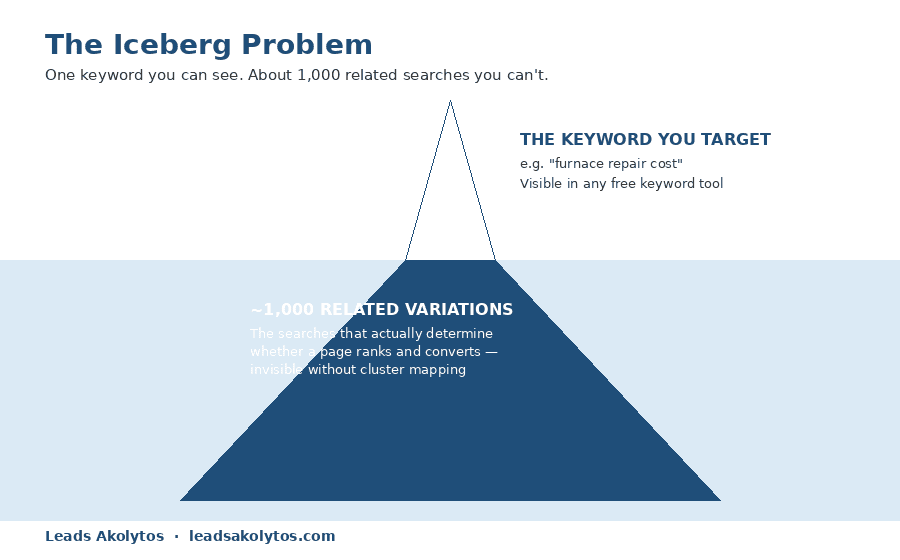
Here’s the part most DIY keyword research misses entirely. A page rarely ranks for just the one keyword you targeted — Ahrefs’ own research found that a typical ranking page picks up traffic from roughly 1,000 closely related keyword variations, not one. That same research found two keywords with almost identical reported search volume (450 vs. 400 monthly searches) sent wildly different amounts of real traffic to the top-ranking pages — 3,100 visits versus 667 — because the surrounding cluster of variations behaved completely differently for each one. This is exactly the gap that separates surface-level keyword lists from real high-intent keyword research.
This is the iceberg problem: the keyword you can see in a free tool is the tip. The part that actually determines whether a page generates leads is the mass of related searches underneath it, which a spreadsheet of 20 keywords never captures. It’s also why the same research found that 90.63% of pages in its study got zero organic traffic at all — most keyword research finds a keyword, not a real opportunity.
What You Can Genuinely Do Yourself
DIY keyword research is realistic for a specific, bounded job: picking a focus keyword for a single new page you’re about to write. Google’s own Keyword Planner is free, shows real (if rounded) search volume ranges, and is good enough to confirm that a phrase you’re considering actually gets searched before you build a page around it. Pair it with typing your own likely search phrase into Google and reading the “People also ask” box and the autocomplete suggestions — that alone will surface 5-10 genuine variations most contractors never think to target.
Where this breaks down is scale and maintenance. One page, one afternoon, is a reasonable DIY project. Mapping high-intent keywords across every service and every service area, then revisiting that map as competitors change and search behavior shifts season to season, is a different job entirely — closer to ongoing account management than a one-time task.
What You’re Actually Paying For With High-Intent Keyword Targeting
A paid High-Intent Keyword Targeting service isn’t selling you a longer keyword list. It’s selling three things a free tool doesn’t do: intent classification (separating “curious” searches from “ready to call” searches at scale), cluster mapping (identifying that iceberg of related variations so one page can capture all of them instead of just one), and ongoing recalibration as what people search for shifts. If your current pages already target reasonable keywords but still aren’t converting, the paid work worth checking first is whether the intent behind those keywords was ever correctly identified — see our related piece on signs you’re wasting budget on the wrong keywords.
DIY vs. Paid, Side by Side
| What’s Involved | Doing It Yourself | Paying for It |
|---|---|---|
| Finding a keyword for one page | Realistic with free tools | Also handled, but overkill alone |
| Classifying buyer intent (curious vs. ready-to-call) | Hard to judge objectively about your own business | Core part of the service |
| Mapping the ~1,000-keyword cluster around each target | Not realistic without paid tools and time | Standard part of the process |
| Covering every service and service area | Very time-consuming past 3-4 pages | Scales without extra hours from you |
| Revisiting quarterly as behavior shifts | Usually the first thing that gets skipped | Built into an ongoing engagement |
A Quick Self-Check Before You Decide
- Do you have one clear underperforming page, or a whole site’s worth of pages to plan? One page leans DIY. A full sitemap of service and location pages leans paid.
- Can you tell the difference between “curious” and “ready to buy” searches for your trade? If every keyword idea you have looks equally generic, that’s the actual skill gap a paid service closes.
- Do you have time to revisit this quarterly, not just once? Search behavior shifts with seasons and competitors. A one-time DIY pass goes stale; ongoing targeting doesn’t.
- Are you already getting traffic but not calls? That’s usually an intent-mismatch problem, not a missing-keyword problem, and it’s worth diagnosing before spending on more keyword research of any kind. Run through all four checks honestly before you pay anyone for high-intent keyword research — a real DIY-vs-hire decision should survive this quick test either way.
What It Typically Costs Either Way
DIY costs your own time — realistically a few focused hours per page if you’re doing it properly with intent-checking, not just volume-checking. For real numbers on what a professional High-Intent Keyword Targeting engagement runs, see our pricing guide, which breaks down cost by scope rather than a single number that doesn’t account for how many pages and locations you’re actually targeting.
Use This Graphic
Feel free to republish The Iceberg Problem on your own site, free of charge, with credit and a link back to this article. Embed code:
<img src="https://leadsakolytos.com/blog/iceberg-graphic.png" alt="The Iceberg Problem in high-intent keyword research" /><br><a href="https://leadsakolytos.com/blog/diy-high-intent-keyword-research-or-pay/">The Iceberg Problem via Leads Akolytos</a>Frequently Asked Questions
Can I do my own high-intent keyword research, or do I need to pay for it?
You can do it yourself for a single page using free tools like Google’s Keyword Planner and “People also ask.” Paying makes more sense when you need this done across many pages, correctly classified by buyer intent, and kept current over time. Below one page, DIY high-intent keyword research is a reasonable way to start.
What’s the difference between a keyword and a high-intent keyword?
A keyword is any phrase people search. A high-intent keyword is one searched by someone actively close to a buying decision — the difference is in the searcher’s intent, not the word count or volume, and it’s usually invisible in a basic keyword-volume tool.
Why isn’t my website ranking for keywords I already picked?
Often the keyword itself is fine but the intent behind it was misjudged, or the page never captured the cluster of related variations that actually drive traffic to a ranking page. Ranking for one exact phrase rarely moves the needle on its own.
Is Google’s Keyword Planner good enough for a contractor business?
It’s a solid free starting point for volume ranges and initial ideas, especially for a single page. It doesn’t classify buyer intent or map keyword clusters, which is where most of the real work in high-intent targeting actually happens.
How often should high-intent keywords be revisited?
At least quarterly for an active program — search behavior shifts seasonally and competitors change what they target, so a keyword map built once and never revisited tends to go stale within a year.
If you want a straight read on whether your current keywords are actually matched to buyer intent — not just a longer list — book a free strategy call. We’ll look at what you’re currently targeting and tell you plainly where the gap is.
Want this handled for you?
We do this work for home service contractors every day, month-to-month, with no contracts. Book a free 30-minute call and we'll show you where you stand on Google.
Book my free call