How Much Does High-Intent Keyword Targeting Cost for a Contractor Business?
High-intent keyword targeting cost for a contractor business typically runs $300-$1,200/month as part of a broader SEO retainer, or $200-$1,500 as a one-time research and mapping project if you hire it out separately, with most single-location trades landing toward the lower half of that range. It is rarely sold as its own standalone line item — almost every agency bundles it into SEO, content, or PPC setup — which is exactly why so many contractors have no idea whether they are being overcharged for it or not getting it at all.
That is the gap this guide fills. Search “keyword research cost” and almost everything that ranks is written for freelancers deciding what to charge, not for a contractor trying to sanity-check what a vendor is billing them. Below is a breakdown of real 2026 pricing data, translated into what it should mean for your invoice. If you want the fuller picture of what this service actually involves, see our High-Intent Keyword Targeting service page.
High-Intent Keyword Targeting Pricing by Tier: What Each Range Actually Buys
| Tier | Typical Range | What’s Typically Included |
|---|---|---|
| Bundled Into SEO Retainer | $0 extra (folded into $500-$2,000/mo SEO) | Ongoing keyword tracking, gap analysis, and re-prioritization as part of a broader SEO program — most contractors are already paying for this without seeing it itemized |
| Standalone Project, Small Business | $200-$500 | A one-time list of 20-30 prioritized, service-plus-location keywords with a short call to walk through priorities |
| Standalone Project, Growing Business | $650-$1,500 | Fuller keyword mapping across multiple service pages and cities, competitor gap analysis, search-intent tagging |
| Hourly / Ongoing | $50-$150/hour | Month-to-month keyword monitoring and re-prioritization without a fixed retainer, billed as work happens |
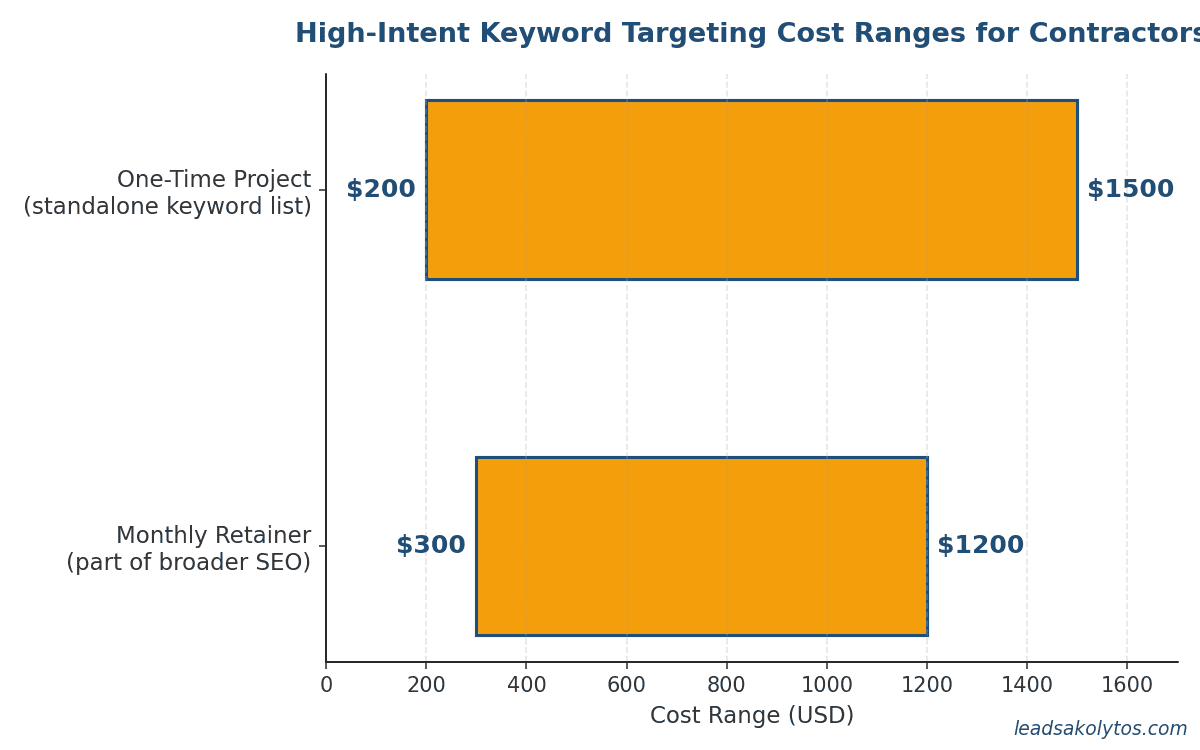
These figures come from 2026 freelance and consultant pricing data, not agency rate cards, because that is where the most transparent numbers exist — a solo freelancer serving small local businesses like plumbers or dentists charges $200-$500 for a project-based keyword research package, and $650-$1,500 for a growing service business with more pages and more competitors to map. Agencies typically price similarly or somewhat higher once account management and reporting are layered on top. If you want to see how search intent categories are actually defined before you pay someone to sort keywords by them, Google’s own guidance on using Keyword Planner is a useful free starting point for understanding what a paid provider should be doing with more rigor.
DIY vs. Hiring: What Actually Changes
Basic keyword generation is close to free now. Paste your services and city into any AI tool or the free version of a keyword planner and you will get a list of 100 candidate phrases in under a minute. That part of the job is no longer worth paying for on its own.
What is still worth paying for is judgment: knowing which of those 100 phrases a contractor with your specific budget, crew size, and content capacity should chase first, which ones look tempting on volume but will never produce a call, and which gap your competitors have not noticed yet. That judgment is the actual service, whether you build it yourself over a few focused evenings or pay someone who already knows what “high-intent” looks like for your trade.
A rough gut-check: if you can set aside 3-5 hours to pull your current rankings, sort them by buying intent, and flag which pages need new content, DIY is realistic. If your calendar is already full of estimates and job sites, that task is usually the first thing that gets pushed to “next week” indefinitely — and a vendor charging for it is buying back your time, not selling you a spreadsheet.
For a closer look at exactly where that DIY line falls, see our related breakdown on whether you can do your own high-intent keyword research or need to pay for it.
5 Signs You’re Paying for Keywords That Will Never Ring the Phone
For the fuller diagnostic version of this checklist, see our guide to 4 costly signs you’re wasting budget on the wrong keywords. The short version relevant to cost specifically:
- The report only shows volume and rankings. If nobody can tell you which tracked keywords are actually high-intent versus informational, you cannot tell whether the spend is producing calls or just a nicer-looking traffic chart.
- Every keyword looks the same. A real high-intent keyword list should show a mix of service-plus-location and urgency phrases (“emergency,” “cost,” “same day”), not a wall of generic single-word terms.
- No mention of search intent grouping. Sorting keywords by informational versus transactional intent is the actual analysis step. A flat spreadsheet of terms and volumes skips it entirely.
- The list never changes. Search behavior shifts and new competitors show up. A keyword list handed to you once in month one and never revisited is a report, not an ongoing service.
- You’re billed the same whether you get a report or a strategy call. A walkthrough of what to prioritize and why is where the real value sits — if that conversation never happens, you are paying for a data dump.
What Drives High-Intent Keyword Targeting Cost Up or Down
- Number of services and cities. A single-location electrician mapping five services costs far less to research than a five-city HVAC company mapping fifteen services across each town.
- Competitive density. A trade with a dozen established competitors in a mid-size metro requires deeper gap analysis than a niche specialty with two or three real competitors.
- Whether it is bundled or itemized. Folded into a broader SEO or content retainer, keyword targeting rarely shows up as its own cost. Sold standalone, it carries the full price of the analyst’s time.
- Tool overhead. Professional keyword and competitor-gap tools run roughly $100-$200/month per seat, a cost that gets spread across a provider’s client base rather than billed to you directly, but it does factor into pricing floors.
Is Paying for High-Intent Keyword Targeting Worth It, or Should You DIY It?
It depends on what you are actually deciding between. If your current SEO or content provider already includes keyword strategy in your retainer, the honest question is not “should I pay for this” — you likely already are — it is “am I actually seeing the intent-sorted priority list this should produce, or just a pile of rankings.” If you are running your own SEO with no help, a focused DIY afternoon using free tools and the four-signal check (service, location, urgency word, problem-specific phrasing) covers 80% of the value for most single-location trades.
Where hiring out earns its cost is competitive gap analysis across multiple cities or services — work that takes a specialist a few focused hours but would take a business owner a full weekend to do thoroughly, and that most owners never actually get to.
What to Ask Before You Pay for Keyword Targeting
- Is this billed separately, or already inside my retainer? If it is already included, ask to see the deliverable specifically, not folded silently into a general “SEO strategy” line.
- What percentage of the keywords you’re targeting are high-intent versus informational? A provider doing this properly can answer with a real number in under a minute.
- How often does the list get revisited? A one-time list from six months ago is stale. Ask for the cadence.
- Will I own the research? Make sure the keyword list and mapping are yours to keep if you switch providers later.
How High-Intent Keyword Targeting Cost Compares to Other Contractor Marketing Spend
Against a full SEO engagement running $500-$2,000/month, a standalone keyword research project at $200-$1,500 one time is a small fraction of the overall budget — which is exactly why it is usually bundled rather than itemized. The bigger cost is not the research itself; it is what happens when it is skipped: content and ad spend aimed at the wrong phrases for months at a time, producing traffic that was never going to convert. Getting the targeting right once tends to save far more than the research itself costs, because every dollar spent afterward on content or ads points at the right phrases instead of the wrong ones.
A Worked Example: Two Contractors, Two Different Keyword Targeting Costs
Here is how this plays out for two real-world contractor profiles. A single-location plumber who has never had a keyword strategy done, ranking mostly for informational terms like “how does a water heater work,” needs a fuller standalone project: pulling current rankings, scoring every keyword against the four intent signals, and mapping the high-intent gaps to new or existing pages. That is closer to the $650-$1,500 tier, because the starting point requires real triage work, not just a fresh list.
A five-town HVAC company that already has a content provider producing blog posts and service pages, but has never confirmed whether those pages target buying-intent phrases or just traffic phrases, needs something narrower: an audit of what is already being targeted, not a from-scratch keyword list. That audit typically runs closer to the $200-$500 tier, or gets folded into the existing retainer as a one-time deliverable, because the research legwork (services, cities, competitors) is already partly done.
Same underlying service, different cost, because the starting point and the depth of triage needed are different — which is exactly why any keyword targeting quote should explain what condition your current content is in, not just hand you a flat number.
A Realistic Timeline for Getting High-Intent Keyword Targeting Right
- Week 1: Pull your last 90 days of ranking queries (from Search Console or a provider’s report) and score each one against the four intent signals — service, location, urgency word, problem-specific phrasing.
- Week 2: Sort the list into a short priority set — the keywords hitting two or more signals — and map each one to an existing page or flag it as needing new content.
- Weeks 3-6: Rework or build the highest-priority pages first, rather than spreading thin effort across the entire list at once.
- Ongoing, monthly or quarterly: Re-check the list as new competitors appear or seasonal demand shifts — a keyword list from a year ago is a snapshot, not a strategy.
This same sequence works whether you are doing it yourself over a couple of evenings or paying someone to run it — the cost difference is in whose time it takes, not in the steps themselves.
Frequently Asked Questions
Is keyword research worth paying for as its own service?
On its own, less than it used to be — AI tools have made basic keyword generation close to free. What is still worth paying for is the judgment layer: prioritizing which of those keywords a specific business with a specific budget should chase first.
How much should a small contractor expect to pay for keyword targeting?
Most single-location trades see it folded into a $500-$2,000/month SEO retainer at no separate line-item cost, or pay $200-$500 for a standalone project-based keyword list if buying it alone.
Can I do high-intent keyword targeting myself?
Yes, for a single-location business. Pull your current rankings, score each keyword against four signals (service, location, urgency word, problem-specific phrasing), and prioritize the ones that hit two or more. It typically takes a focused afternoon.
Why do keyword targeting quotes vary so much between providers?
Because it is almost never sold as a clean, identical service. Some quotes bundle it invisibly into a retainer, others sell a one-time report, and the depth of competitor gap analysis included varies enormously between providers.
The Bottom Line on High-Intent Keyword Targeting Cost
High-intent keyword targeting rarely deserves its own line item, but it deserves your attention regardless of how it is billed. Whether you are paying $0 extra because it is bundled into a broader SEO plan, $200-$500 for a small standalone project, or handling it yourself in an afternoon, the real cost of getting it wrong is months of content and ad spend aimed at phrases nobody was ever going to call from.
Book a free 20-minute strategy call and we will pull your current keyword targeting — whether it is coming from us, another provider, or nobody yet — and show you exactly which phrases in your market are worth chasing first. No contracts, plans start at $1200/month.
Want this handled for you?
We do this work for home service contractors every day, month-to-month, with no contracts. Book a free 30-minute call and we'll show you where you stand on Google.
Book my free call