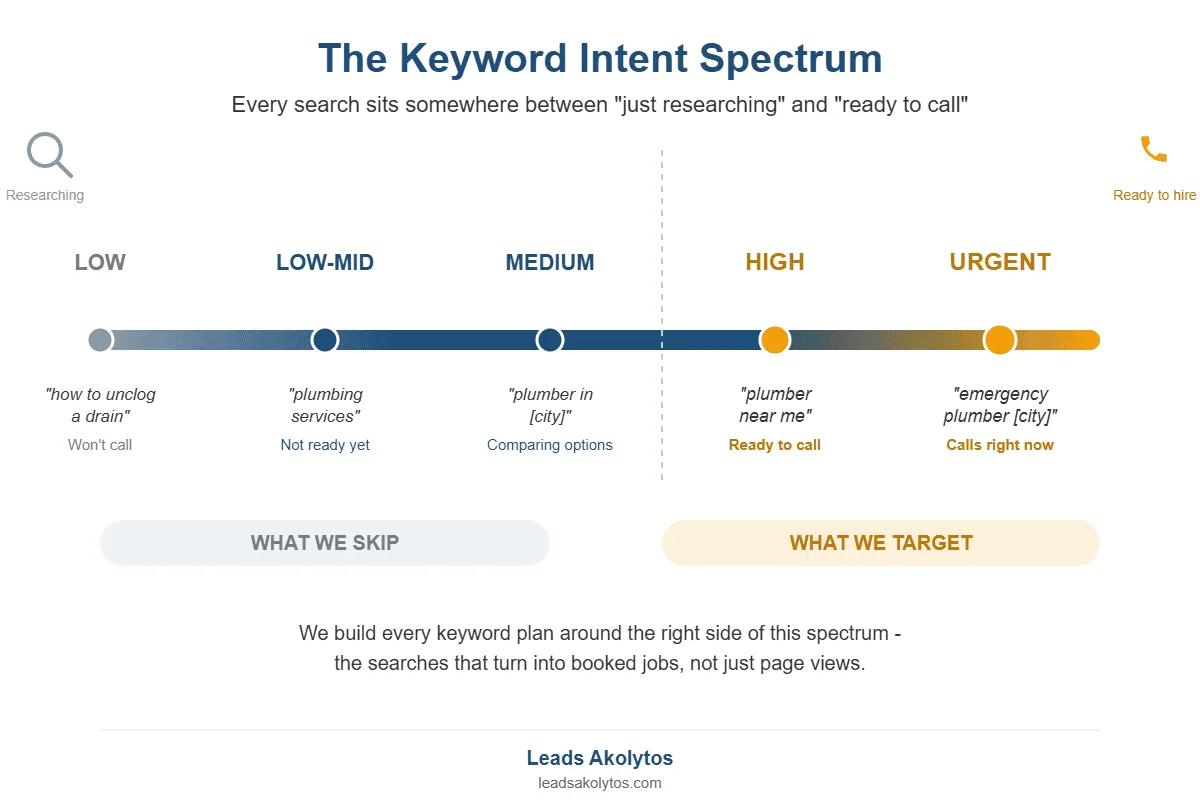
If your website gets traffic but the phone still isn’t ringing, the problem is often not how much you rank for, it’s what you rank for. High-intent keywords are the search phrases someone types right before they’re ready to call a contractor — “emergency plumber [city],” “roof replacement cost near me,” “licensed electrician same day.” Low-intent keywords are the ones that bring traffic without buyers behind them — “how does a water heater work,” “types of roofing shingles.” A site that ranks well for the second group and ignores the first can look successful in a traffic report while producing almost no leads.
The Short Answer
A high-intent keyword is a search phrase that signals someone is close to hiring, not just researching — it usually includes a service, a location, and an urgency or transaction word (“near me,” “cost,” “same day,” “emergency,” “quote”). If your SEO reporting only shows overall traffic and keyword rankings without breaking out how many of those keywords are actually high-intent, you can’t tell whether your SEO spend is producing leads or just producing visits. The fix is to audit your current keyword list, sort it by buying intent, and re-weight new content and optimization work toward the high-intent half.
Why Traffic Can Go Up While Leads Stay Flat
Google Search Console and most rank trackers report on volume and position, not on intent. A blog post that explains “how long does a roof last” can pull in thousands of monthly visitors who are nowhere near hiring anyone — homeowners doing general research, students, competitors’ own content teams. That traffic is not worthless (some of it builds authority and some readers do eventually convert), but if it’s the majority of what an SEO engagement is producing, the reporting can look like progress while the phone stays quiet.
This is one of the most common gaps we find auditing contractor sites: informational content ranks well because it’s easier to rank for and easier to write, while the handful of keywords that actually drive calls get thin or outdated pages.
How to Tell If You Are Targeting High-Intent Keywords
The fastest gut-check: pull your last 90 days of ranking queries and sort by which ones actually sound like someone ready to hire, not someone still researching. That split is the whole game — targeting high-intent keywords consistently is what separates traffic that converts from traffic that just pads a report.
You don’t need expensive software to sort this out. Pull your current keyword list (from Search Console, your SEO provider’s report, or a free tool) and score each phrase against these four signals:
- Service + location together. “Water heater repair Springfield” beats “water heater repair” alone — it signals someone ready to hire locally, not researching in general.
- Urgency or transaction language. Words like “emergency,” “same day,” “cost,” “price,” “quote,” “near me,” and “hire” all correlate with someone close to a decision.
- Problem-specific phrasing. “AC not cooling” or “burst pipe” beats a generic “HVAC services” or “plumbing services” phrase, because it matches the exact moment someone searches.
- Comparison or vetting language. “Best roofer near me,” “roofing company reviews,” and “how much does a new roof cost” all sit closer to a buying decision than “roofing materials explained.”
A keyword that hits two or more of these is worth prioritizing. A keyword that hits none of them is probably a traffic keyword, not a lead keyword — fine to have on the site, but not something that should be eating the bulk of your SEO budget.
Sorting your list this way is the entire point of targeting high-intent keywords in the first place: it tells you which rankings are actually worth defending and which ones are just filling a traffic report.
A Quick Audit You Can Run Yourself
Export your top 25-50 ranking keywords from Search Console (Performance report, filter to the last 3 months). For each one, mark whether it includes a service, a location, and an urgency/transaction word. Add up how many hit at least two of the three. If it’s under a third of your list, most of your visible SEO “wins” are not the kind that produce calls, and that’s worth raising directly with whoever manages your SEO. If you want a fuller diagnostic before that conversation, our 7-sign vanity-keyword checklist walks through the report-level red flags to look for.
A Real Example of Low-Intent vs. High-Intent Keywords
Side by side, the difference is obvious once you know what to look for — one phrase is someone browsing, the other is someone with a job and a budget. Auditing for high-intent keywords means asking, for every term you rank for, “would the person typing this actually book a job this week?”
Picture two roofing pages on the same site. One targets “how long does a roof last,” a genuinely useful informational phrase that pulls steady traffic from homeowners years away from replacing anything. The other targets “roof replacement cost [city],” a high-intent keyword aimed at someone who already knows they need work done and is pricing it out.
Both can rank well. Only one of them is likely to produce a call this month. Neither page is wrong to have — the mistake is not knowing which one is which, or spending equal optimization effort on both when one is doing most of the commercial work.
What to Ask an SEO Provider About Keyword Targeting
If you pay someone for SEO or keyword targeting, this is a fair and specific question to ask them directly: “Of the keywords you’re currently targeting or ranking for, how many are high-intent versus informational, and can you show me the split?” A provider doing this work properly should be able to answer in under a minute with a real list. A vague answer, or a report that only shows overall traffic and average position, is a signal worth following up on. It is one of several questions worth working through in our full guide to auditing a contractor SEO company before you sign a contract.
This is different from picking your own keywords from scratch, which is a DIY research process. This is specifically about auditing what’s already being targeted on your behalf and catching a mismatch before another quarter of budget goes toward traffic that was never going to call.
Should You Handle This Yourself or Have Someone Audit It?
The audit itself — pulling your top keywords and scoring them against the four signals above — takes most business owners 30-60 minutes and doesn’t require hiring anyone. Do that part yourself; there’s no reason to pay for a task that short.
Where it gets harder to DIY is what comes after: rewriting or restructuring pages to actually rank for the high-intent phrases you’re missing, without losing the rankings you already have on the informational side. That’s ongoing keyword research, on-page optimization, and content work, not a one-time audit — and it’s the part most contractors don’t have the spare hours to keep up every month. If you’d rather have someone else run the audit and fix what it finds, book a free 30-minute strategy call and we’ll walk through your current keyword mix with you, no pressure to sign anything.
Targeting high-intent keywords consistently, month after month, is what separates SEO that produces calls from SEO that only produces a nicer-looking traffic chart.
Not sure whether to run that audit yourself or pay for it? See our related breakdown on whether you can do your own high-intent keyword research or need to pay for it.
Once you have fixed the vanity-keyword problem, the next budget question is sequencing: see our breakdown of high-intent keyword targeting vs. broad SEO and which to fund first for a framework on where your next dollar should go.
Frequently Asked Questions
What counts as a high-intent keyword for a contractor?
Generally a phrase combining a specific service with a location, urgency, or transaction word — “emergency plumber Springfield” or “roof replacement cost near me” — rather than a general informational phrase like “how plumbing works.”
Is informational content a waste of time for a contractor’s SEO?
No — it still builds topical authority and can convert some readers, and Google’s own guidance on creating helpful content rewards sites that serve a range of genuine reader questions. The issue is only when it crowds out the smaller number of high-intent pages that actually produce calls.
How do I check what keywords my site currently ranks for?
Google Search Console’s free Performance report shows the exact queries your site ranks for and gets clicks on, filterable by date range — Google’s own guide to that report walks through how to read it.
How much does it cost to have high-intent keyword targeting done for you?
Ongoing keyword targeting is typically part of a broader SEO engagement rather than sold alone. Our plans start at $1200/month with no contract See our breakdown of what $500/month vs. $2,000/month actually buys you for more context on where keyword targeting fits into a broader SEO budget. — book a free strategy call for a specific number based on your market and current site.
Where the Best Ones Usually Hide
The best high-intent keywords rarely show up in a generic keyword-volume tool sorted by search count alone — they show up in your own sales calls and estimate requests. Ask your office staff or yourself what exact phrases customers use right before they book: “emergency,” “same day,” “cost,” and a specific problem name are common signals. Those phrases, not the highest-volume generic terms, are usually your real high-intent keywords.
A Fast Gut-Check for Your Own Keyword List
Pull your last 20 blog titles or landing page targets and ask: would a homeowner or business owner searching that phrase be ready to call, or just researching? If more than half are pure research terms, you’re likely light on high-intent keywords and heavy on traffic that won’t convert. Reworking even 3-4 pages a month toward genuinely high-intent keywords usually moves the needle faster than publishing more low-intent content.
For the full breakdown of what this service should actually cost and how pricing varies by project size, see our 2026 pricing guide to high-intent keyword targeting.
Want this handled for you?
We do this work for home service contractors every day, month-to-month, with no contracts. Book a free 30-minute call and we'll show you where you stand on Google.
Book my free call