Vanity keywords vs high-intent keywords: that’s the real difference between an SEO report that looks good and one that actually books jobs. If your monthly SEO report is full of ranking screenshots and traffic graphs but your phone still isn’t ringing, there’s a good chance your agency is optimizing for the wrong thing. This is the single most common complaint we hear from contractors switching agencies: everything on paper looks fine, and the leads still aren’t showing up.
The Short Answer
A vanity keyword is a broad, impressive-looking term (“plumber,” “HVAC company,” “roofing contractor”) that’s expensive or slow to rank for and rarely reflects someone ready to hire. A high-intent keyword is narrower and less flattering on a slide (“emergency water heater repair [city],” “[service] cost,” “same-day AC repair near me”) but it is what someone types right before they pick up the phone — the same pattern covered in our 4 costly signs you’re wasting budget on the wrong keywords.
If your reports celebrate rankings for the first type and never mention the second, your agency is very likely chasing vanity metrics instead of high-intent keyword targeting. This is the core vanity keywords vs high-intent keywords gap to watch for.
What “High-Intent Keyword Targeting” Actually Means for a Contractor
Understanding vanity keywords vs high-intent keywords is really about understanding buying stage, not keyword length.
High-intent keyword targeting is not a fancier name for “more keywords.” It is the practice of choosing search terms based on how close the searcher is to hiring someone, then building or optimizing a specific page for each one. In practice that means transactional modifiers (“cost,” “price,” “near me,” “emergency,” “same-day”), a real service area (a city, county, or neighborhood, not just your state), and a clear line from the keyword to a specific service you sell. Broad category terms still have a place in a content and authority strategy, but they should never be the majority of what your agency reports as “wins.”
Google’s own guidance on keyword matching and intent makes a similar distinction: broader match types reach more searches, but narrower, more specific terms are what typically align with someone ready to act.
7 Signs Your SEO Company Is Chasing Vanity Keywords
These vanity keywords vs high-intent keywords warning signs, on their own, are not proof of a bad agency — but if you recognize three or more, it’s worth a direct conversation before your next invoice.
1. The keyword list is all broad industry terms
If the keywords your agency reports on read like a dictionary of your trade (“HVAC,” “plumbing,” “roofing”) with no city, no service type, and no buying stage attached, that’s the first flag. These terms are also usually the hardest and slowest to rank for, which means a lot of effort goes toward a scoreboard number that was never likely to move the phone.
2. Rankings climb, but call volume doesn’t
This is the one that should end the conversation on its own. If a keyword has climbed from position 40 to position 8 over three months and your call tracking shows no corresponding lift, the keyword was probably never one your customers search when they’re ready to hire.
3. One page is trying to rank for 20-30 unrelated keywords
Real high-intent targeting maps a small, tightly related group of keywords to each page — usually one service plus one location. A single generic services page stuffed with dozens of loosely related terms is a sign no real page-to-keyword mapping exercise ever happened.
4. No local or transactional modifiers anywhere
“Near me,” a real neighborhood or city name, “cost,” “emergency,” “same-day” — these show up constantly in real local-service search behavior. Their total absence from a keyword report for a locally-bound trade business is a red flag.
5. Your agency can’t explain why a specific keyword was chosen
Ask directly: “why this keyword, and not a more specific version of it?” A real answer references search volume, local competition, and how it connects to a service you actually sell. “It’s a good keyword for your industry” is not an answer.
6. The report only shows rankings and traffic, never calls or bookings
Rankings and sessions are inputs. Calls, form fills, and booked jobs are outcomes. If a report never ties a specific keyword or page back to a lead or a booked job, there’s no way to know whether the keyword strategy is actually working.
7. Educational, “how-to” queries dominate the keyword list
Informational content has a real role in a broader SEO and authority strategy, and building genuine expertise content is valuable on its own. But if “how to” and “what is” queries make up the majority of the keywords your agency is targeting for your MONEY pages, rather than your blog, that’s education dressed up as lead generation.
Vanity Report vs. Real Report, Side by Side
Here’s a simple way to hold your next report up against what a genuine high-intent keyword strategy should look like.
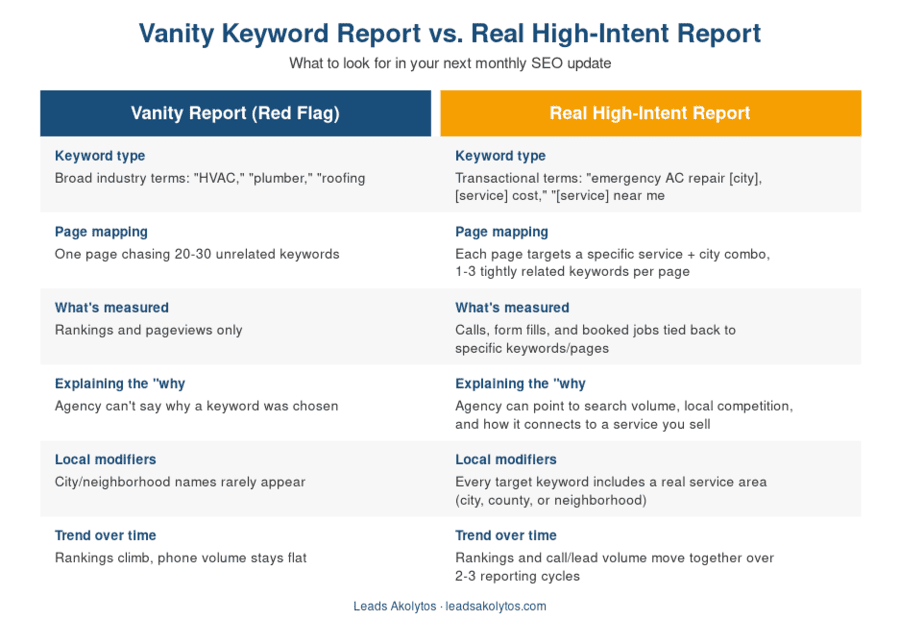
Use this graphic: feel free to republish this chart on your own site or share it with other contractors, with attribution and a link back to this article. Embed code:
<a href="https://leadsakolytos.com/blog/vanity-keywords-vs-high-intent-keywords/"><img src="https://leadsakolytos.com/blog/vanity-vs-high-intent-keyword-report.png" alt="Vanity Keyword Report vs. Real High-Intent Report" style="max-width:100%;"></a> Chart via Leads Akolytos
Can You Check This Yourself, or Do You Need to Hire It Out?
Checking vanity keywords vs high-intent keywords yourself is possible: you can do a rough version of this audit in about 20 minutes: pull your last 2-3 monthly reports, list every keyword mentioned, and mark each one as either a broad category term or a specific, local, transactional term. If the list is mostly the former, you already have your answer.
What’s genuinely harder to do without help is the fix — rebuilding a page structure around the right keyword-to-page map, and setting up call tracking that actually attributes a booked job back to a keyword or page. That part is where most contractors find it’s worth paying an agency, specifically one that will show you the keyword-to-page map and the call attribution, not just the rankings. Search Engine Land and other established SEO trade publications have covered this shift toward outcome-based reporting extensively over the last few years.
What To Do If You Recognize These Signs
Start with the direct conversation: ask your current agency for the keyword-to-page map and the call/lead attribution for the last quarter. A good agency will have this ready. If they don’t, or the answer is defensive rather than specific, it may be time to look elsewhere — and switching SEO agencies without losing your rankings is more straightforward than most contractors expect. If you’re building a keyword strategy from scratch, our own High-Intent Keyword Targeting service is built around exactly this map-to-page, track-the-call approach.
Quick Self-Audit: 3 Numbers to Pull From Your Own Analytics
You do not have to wait for your SEO company’s next report to spot vanity keywords vs high-intent keywords on your own site. Three numbers, all available in free tools you likely already have connected, tell most of the story on their own.
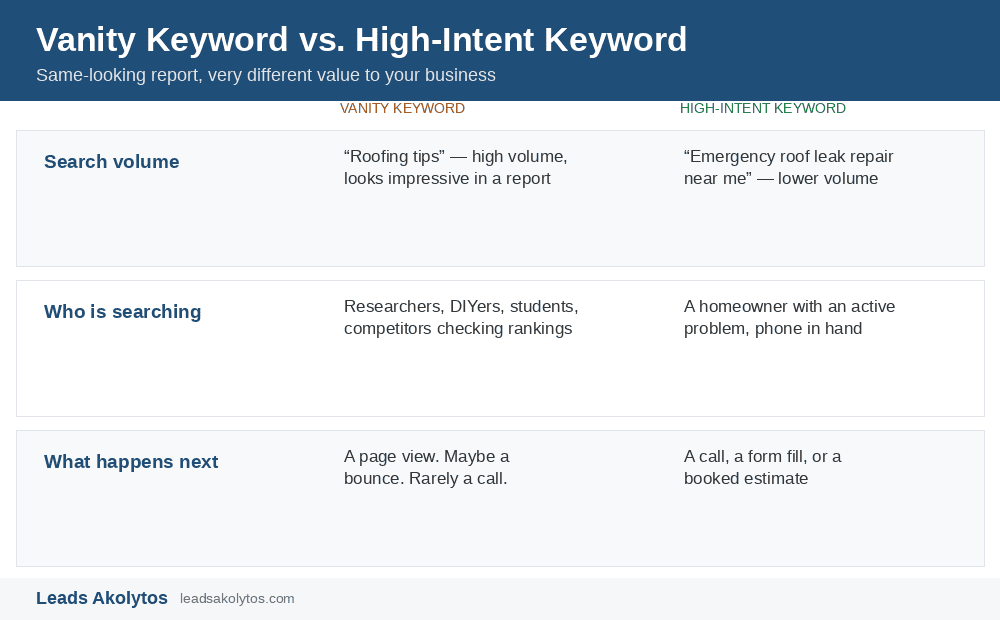
Use this graphic: feel free to republish this comparison on your own site or in a newsletter, with attribution and a link back to this article. Embed code: <a href="https://leadsakolytos.com/blog/vanity-keywords-vs-high-intent-keywords/"><img src="https://leadsakolytos.com/blog/vanity-vs-high-intent-keyword.png" alt="Vanity Keyword vs. High-Intent Keyword, via Leads Akolytos" /></a>
1. Organic traffic vs. organic conversions, side by side. In Google Analytics, pull organic traffic and organic goal completions (calls, form fills, chat starts) over the same three-month window. If traffic is climbing and conversions are flat, that gap is the vanity-keyword pattern showing up in your own numbers, not just in a report someone hands you.
2. Top Search Console queries vs. your actual lead volume. In Search Console, sort queries by impressions for the last three months. If the top queries are broad, informational phrases with no location or buying language in them, and your call/form volume has not moved with your rankings, the keywords being tracked are not the ones driving business.
3. Bounce rate and time on page for your highest-traffic pages. A page pulling real search volume with a bounce rate above 85-90% and an average time on page under 30 seconds is usually ranking for a question the page does not actually answer for that visitor — a classic sign the page was built around a keyword that looks good, not one a ready buyer searches.
None of these three checks require a paid tool, and all three work whether you are sorting out vanity keywords vs high-intent keywords for the first time or double-checking a report you already have. If your current SEO company resists giving you access to your own Google Analytics and Search Console accounts to run them, that resistance is itself worth treating as an eighth sign alongside the seven above.
Frequently Asked Questions
More on vanity keywords vs high-intent keywords below, including how many of each a typical contractor site actually needs.
What’s an example of vanity keywords vs high-intent keywords?
“Plumber” is a vanity keyword: broad, hard to rank for, and not tied to a specific buying moment. “Emergency plumber [city] same day” is high-intent: specific, local, and describes someone actively trying to hire.
Should my agency ever target broad keywords at all?
Some broad-term content can support topical authority and long-term brand visibility, but it should be a minority of the strategy, clearly labeled as an authority play rather than a lead-generation play, and never the majority of what gets reported as a “win.”
How many high-intent keywords does a typical contractor business need?
It depends on how many services and service areas you cover, but most single-location contractors do well with a focused list mapped to each core service times each city or neighborhood they serve — often 10-30 total, rather than hundreds of loosely related terms.
Can I ask my agency for this keyword-to-page map directly?
Yes, and you should. A transparent agency will walk you through exactly which page targets which keywords and why, along with how each is performing on calls and bookings, not just rankings.
What should I do if my agency can’t produce this information?
Ask for it in writing with a specific deadline. If it still isn’t provided, that is itself useful information about how the account is being managed, and a good moment to schedule a free strategy call to get a second opinion on your current keyword strategy at no cost.
Want this handled for you?
We do this work for home service contractors every day, month-to-month, with no contracts. Book a free 30-minute call and we'll show you where you stand on Google.
Book my free call