The Short Answer
To audit a contractor SEO company before you sign, start here: ask a prospective SEO company for three things: a live example of a client site they currently rank (not a screenshot), a plain-English explanation of what they’ll actually do month to month, and a written cancellation term that doesn’t lock you into more than 30-90 days’ notice. If they hesitate on any of the three, or can’t name specific tasks beyond “we do SEO,” that’s your answer before you’ve spent a dollar.
Why Most Contractors Get This Wrong
Home service business owners are good at vetting subcontractors and suppliers because there’s a physical thing to inspect: a finished job, a material sample, a truck showing up on time. SEO doesn’t work that way — the “product” is a set of promises about something that happens on Google’s servers, months from now. That gap is exactly where vague proposals, recycled case studies, and 12-month contracts with no exit ramp slip through. An audit checklist closes that gap by giving you something concrete to check before you sign, not after you’ve already paid three invoices.
It also works the other direction: most contractors don’t sit down and vet an SEO company the way they’d vet a subcontractor bidding on a job, because the sales conversation is often the first and only exposure they get to how that company actually operates. Treating that conversation as the audit itself — not just a pricing call — is what turns a vague pitch into a decision you can defend later.
The 7-Point Checklist to Audit a Contractor SEO Company
Work through these before you sign — this is the same kind of due diligence the Federal Trade Commission recommends before signing any ongoing service contract. Each one is something a legitimate SEO company can answer specifically, on the spot, without dodging when you audit a contractor SEO company this way.
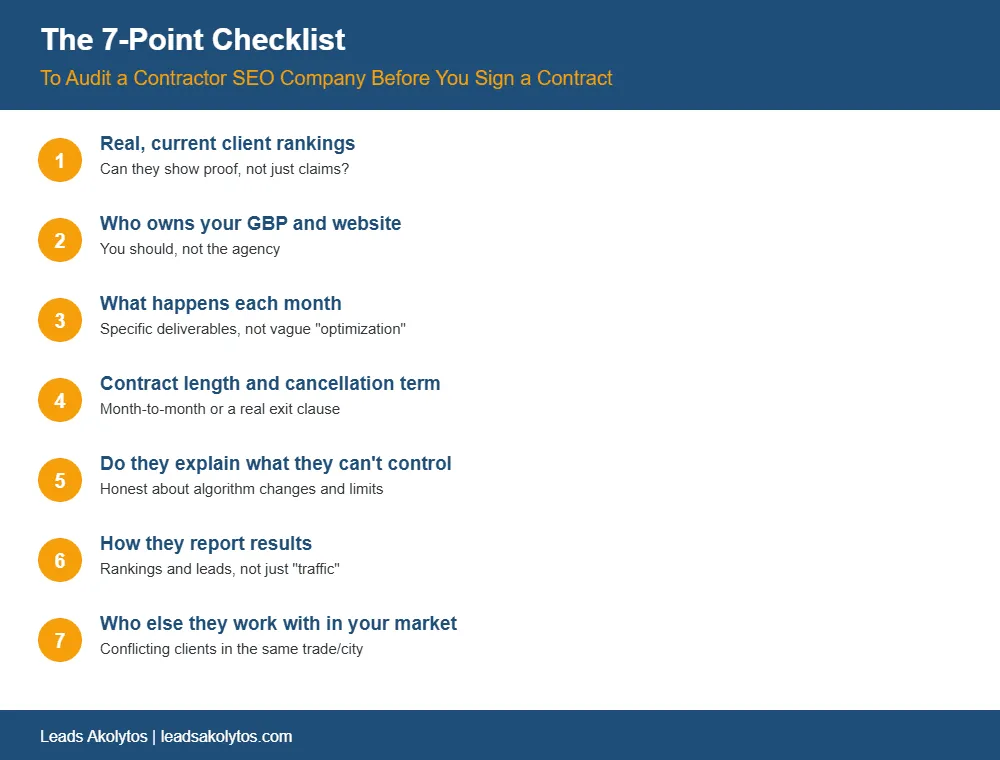
Use This Graphic
Feel free to republish this checklist on your own site or share it with other contractors, as long as you credit Leads Akolytos with a link back to this article. Here’s a ready-to-paste embed code:
<a href="https://leadsakolytos.com/blog/audit-a-contractor-seo-company/"><img src="https://leadsakolytos.com/blog/audit-a-contractor-seo-company-7-point-checklist.png" alt="7-point checklist to audit a contractor SEO company before you sign a contract" style="max-width:100%;"></a> Infographic by <a href="https://leadsakolytos.com/">Leads Akolytos</a>
1. Can they show you real, current client rankings?
Ask for 2-3 client websites in your industry (or an adjacent one) that they currently manage, and check those sites’ rankings yourself in an incognito browser window for a real service-plus-location search. A company that’s actually doing the work will have this ready in minutes. A company that stalls, or only offers “results screenshots” from a slide deck, is the biggest red flag on this list.
A good answer looks like this: they pull up an incognito browser window on the spot and show you two or three sites currently ranking in different service areas, along with roughly how long each has been a client.
A red flag answer looks like this: a slide deck of screenshots with client names blurred out, or a claim that “client confidentiality” prevents showing you anything specific — a legitimate agency can show you a live, working site without naming a contact to call for a reference.
2. Do they own your Google Business Profile and website, or do you?
This is a legal and practical question, not a technicality. Some agencies set up your Google Business Profile, website, or tracking accounts under their own login credentials instead of yours. If they ever go out of business, get bought out, or you have a falling-out, you can lose access to your own online presence overnight. Insist on being the verified owner of every account, with the agency added as a manager, never the reverse.
Worked example: a contractor who signs up without checking this often finds out the hard way — the agency built the Google Business Profile and the website under the agency’s own accounts, and when the contractor later wants to switch providers, getting the login handed back takes weeks of back-and-forth instead of minutes.
Ask directly: “If I stopped paying you tomorrow, could I log into my own Google Business Profile and website hosting account today?” If the honest answer is no, that risk is already sitting in the arrangement whether or not it has caused a problem yet.
3. What specifically happens each month?
“We optimize your SEO” is not an answer. A legitimate month-to-month scope should name actual deliverables: X pieces of content, specific technical fixes, a certain number of citations or backlinks pursued, Google Business Profile posts, and a reporting cadence. If the proposal can’t get more specific than “ongoing optimization,” you have no way to know if you got what you paid for. A good answer sounds like: “This month we’re publishing two service-area pages, fixing four broken internal links from our technical audit, requesting reviews from your last fifteen completed jobs, and posting twice to your Google Business Profile.”
A red flag answer sounds like “we’re continuously optimizing and monitoring your rankings” — a sentence with no nouns you could actually check off a list at the end of the month.
4. What’s the contract length and cancellation term?
SEO is genuinely a multi-month process (see our guide on how long SEO actually takes to work for a contractor business), so some minimum commitment is reasonable and even a good sign that the company isn’t over-promising instant results. But a contract that locks you in for 12 months with no early-exit clause, regardless of performance, shifts all the risk onto you. Look for 30-90 day cancellation notice terms as the norm, not the exception.
Worked example: if a contract requires a 12-month commitment with no early-exit clause regardless of performance, and results still haven’t moved by month six, you’re locked into paying for six more months of work you already have reason to distrust. Compare that to a 90-day cancellation term — worst case, you lose three months, not nine.
5. Do they explain what they can’t control?
A trustworthy SEO company will tell you upfront that they can’t guarantee a #1 ranking or a specific number of leads, because no one controls Google’s algorithm. Anyone who guarantees rankings in a set timeframe is either inexperienced or being deliberately misleading — both are reasons to walk away. If a salesperson tells you “we guarantee page one in 90 days or your money back,” treat that as a marketing hook, not a technical promise — rankings depend on what competitors are doing too, not just what happens on your own site, and no reputable provider controls that variable.
6. How do they report results, and in what terms?
Ask to see a sample report before you sign. A useful report ties activity to outcomes you actually care about — calls, form submissions, ranking movement on the keywords that drive real jobs — not just “impressions” or vanity traffic numbers that don’t book a single job. A red-flag report is a PDF full of green up-arrows next to metrics like “organic sessions” or “keywords tracked,” with no call or form count anywhere on it.
A useful report is a monthly summary showing call volume from a tracked number, form submissions, and movement on the five to ten specific keywords tied to the services you actually sell.
7. Who else in your market do they already work with?
If an agency already represents a direct competitor in your exact service area, your work can end up in direct competition with their own client for the same rankings and, in the worst case, the same content strategy.
Ask directly whether they have an exclusivity policy by trade and territory. If you’re a roofer and the agency already manages a roofing company two towns over that regularly bids against you for the same jobs, a policy like “we don’t take two roofers in the same metro” is a far stronger answer than a vague reassurance that “we treat every client’s strategy independently.”
Legitimate Proposal vs. Sketchy Proposal, Side by Side
Running the 7-point checklist above tells you what to ask. This table shows what the answers tend to look like once you’ve asked — use it to sanity-check a proposal you already have in hand.
What You’re CheckingLegitimate ProposalRed Flag ProposalAccount accessYou own every account; the agency is added as a manager or user, in writingAgency creates and owns your Google Business Profile, website, or domainMonthly scopeNamed deliverables: page counts, fixes, posts, outreach”Ongoing optimization” with no countable tasksContract term30-90 day cancellation notice, regardless of contract length12-month lock-in with no early-exit optionResults languageExplains what they can’t control; frames timelines as rangesGuarantees a ranking position or lead count by a set dateReportingCalls, form submissions, and named-keyword movementImpressions, sessions, and other traffic vanity metrics onlyReferencesShows live, current client sites you can check yourselfScreenshots only, or “confidentiality” cited to avoid showing anything
None of these on their own automatically disqualify a proposal — a new agency with a short client list, for instance, might still be a fine choice. But a proposal landing mostly in the right-hand column across several rows at once is the pattern worth walking away from, not any single answer in isolation.
What to Do If Your Current Provider Fails This Audit
This same 7-point list works retroactively. If you’re already paying someone and can’t answer most of these questions about your own arrangement, that’s worth raising directly with them before you assume the problem is SEO itself rather than the vendor. See our guide on whether to hire an SEO contractor or handle it yourself if you’re reconsidering the arrangement entirely, and our breakdown of real cost-per-lead numbers for SEO vs. paid ads if you’re trying to judge whether what you’re paying is in a reasonable range.
Failing this audit is also a natural moment to ask a bigger question: would you be better off skipping outside vendors altogether? Our in-house marketing hire vs. SEO agency cost comparison breaks down the real numbers on both sides.
A short pre-contract checklist can make it much easier to audit a contractor SEO company before anything is signed. Ask for three things in writing: the exact keywords they plan to target, the specific deliverables due in month one, and a sample of reporting from a comparable existing client.
Any agency that hesitates to provide these when you audit a contractor SEO company is telling you something important before you have spent a dollar. The contractors who skip this step are the ones most likely to end up locked into a contract that never gets properly audited until it is already a problem.
Take the time to audit a contractor SEO company thoroughly now, and you avoid months of guessing later.
Frequently Asked Questions
How much should SEO cost for a contractor business?
Pricing varies widely by market size and scope of work, and any specific number quoted without knowing your market, trade, and competition is a guess. What matters more at the audit stage is whether the scope of deliverables justifies whatever price you’re quoted — see point 3 above.
Is a month-to-month contract always better than an annual one?
Not necessarily — it depends on the cancellation terms attached, not just the billing cycle. An annual contract with a fair 60-day exit clause can be safer than a “month-to-month” agreement that still requires 90 days’ notice to actually leave. Read the cancellation clause itself, not just the label on the contract.
What’s a reasonable timeline before I should expect to see movement?
Most legitimate SEO work shows early signals within a few months and clearer lead growth over a longer horizon — see our full timeline breakdown linked above. A provider promising results in weeks, or one who’s produced literally nothing measurable after 6+ months with no explanation, are both worth questioning.
Should I get more than one proposal before choosing?
Yes. Comparing at least two or three proposals against this same checklist makes it much easier to spot the ones that are vague, over-promising, or missing basic transparency — a single proposal in isolation is hard to judge on its own.
Before you sign, also compare the scope against typical contractor SEO pricing tiers so the price you’re quoted matches the work described.
If you’re already partway through vetting a new provider, see our guide on switching SEO agencies without losing your rankings for the account-ownership and handoff steps that protect what you’ve already built.
Already signed with someone and having second thoughts? See 7 signs your SEO company has gone quiet on deliverables to check whether the relationship is actually working before you consider switching.
Once you’ve decided to move forward with an agency, the next document to scrutinize closely is the contract itself — see our breakdown of what a good SEO contract for contractors should include before you sign anything.
Make Auditing a Habit, Not a One-Time Event
Learning how to audit a contractor SEO company shouldn’t be a skill you only use once, right before signing. Revisit the same process every 6 months with your current provider, even if things seem fine — the questions that matter when you first audit a contractor SEO company (real reporting, honest timelines, clear deliverables) are the same questions that catch a provider quietly coasting on autopilot a year in.
If you don’t have time to audit a contractor SEO company yourself every quarter, at minimum ask for the same three things every review cycle: a plain-language summary of what changed, which pages or queries improved, and what’s planned next. A provider that can’t answer those three questions clearly is telling you something, whether or not you formally audit a contractor SEO company on paper.
Who Should Actually Run This Audit
You don’t need to be technical to audit a contractor SEO company — you need a checklist and 30 focused minutes. If you’d rather not audit a contractor SEO company alone, loop in a business partner or office manager who can ask blunt questions without worrying about the relationship; a second, less-invested set of eyes often catches vague answers the owner talks themselves past. Whoever runs it, make sure the person who chose to audit a contractor SEO company actually writes down the answers, so next quarter’s review has something concrete to compare against.
In short: audit a contractor SEO company before you sign, and audit a contractor SEO company again every renewal. It takes half an hour and it’s the cheapest insurance policy against a wasted year of ad and marketing spend.
The same discipline applies beyond SEO. If you’re also evaluating vendors for a site rebuild, see our guide to vetting a website design agency for a parallel set of questions and red flags before you sign.
Want this handled for you?
We do this work for home service contractors every day, month-to-month, with no contracts. Book a free 30-minute call and we'll show you where you stand on Google.
Book my free call