Your website is the one piece of marketing every lead sees before they ever pick up the phone. So when a contractor decides to finally hire a website design agency instead of limping along on a template a nephew built in 2019, the stakes are real: a bad hire means months of back-and-forth, a site that still doesn’t convert, and money you can’t easily claw back. This guide walks through exactly how to vet a website design agency before you sign anything, using the same questions and red flags that separate agencies who deliver from ones who disappear after the deposit clears.
The Short Answer
To vet a website design agency, check three things before you sign: (1) they show you real, working examples of contractor or home-service sites they’ve built, not just mockups; (2) they put pricing, timeline, revision limits, and who owns the final files in writing; and (3) they can explain, in plain language, how the site will actually generate calls and form fills — not just how it will look.
Why Contractors Get Burned More Often Than Other Small Businesses
Contractors are a favorite target for weak web design shops for a simple reason: most owners are busy running jobs, not evaluating portfolios, and they tend to trust a friendly sales call over a hard look at past work. A designer who has only ever built restaurant menus or boutique e-commerce sites doesn’t know that a roofer’s site needs a mobile-first “Call Now” button above the fold, service-area pages for every city served, and a review widget that actually pulls live Google reviews.
Generic agencies build generic sites, and a generic site for a contractor usually means a slow-loading homepage, no service-area pages, and a contact form buried three scrolls down — all of which quietly cost you leads for years after the invoice is paid. This is exactly why you need to vet a website design agency carefully: a slow, hard-to-update site doesn’t just cost leads today, it also makes every future marketing dollar less effective, because paid ads and SEO traffic both land on a page that was never built to convert them in the first place.
7 Questions to Ask Every Website Design Agency Before You Sign
When you vet a website design agency, ask these questions directly on the first call. How an agency answers — not just what they answer — tells you almost everything you need to know.
- Can you show me 3 contractor or home-service sites you’ve built, with live links? Screenshots and mockups are not proof of finished, working, indexed sites.
- Who owns the domain, hosting account, and website files when the project is done? The correct answer is always you. If the agency keeps the login and charges to release it later, walk away.
- What’s included in the price, and what triggers an extra charge? Get service-area pages, a review integration, and mobile optimization spelled out as line items, not vague “custom design” language.
- What’s the realistic timeline, and what happens if it slips? A firm range (for example, 4 to 8 weeks) beats a vague “it depends” with no fallback plan.
- How many rounds of revisions are included? Two to three rounds is standard. Unlimited revisions sounds generous but often signals a design process without a real discovery phase up front.
- Will the site be built on a platform I can update myself, or am I locked into you for every future change? WordPress and similar open platforms let you leave later. Proprietary, closed-platform builders can trap you.
- Can you walk me through how this design turns a visitor into a phone call? If the answer is entirely about color palettes and fonts with nothing about calls-to-action, forms, or page speed, that’s a gap worth noting.
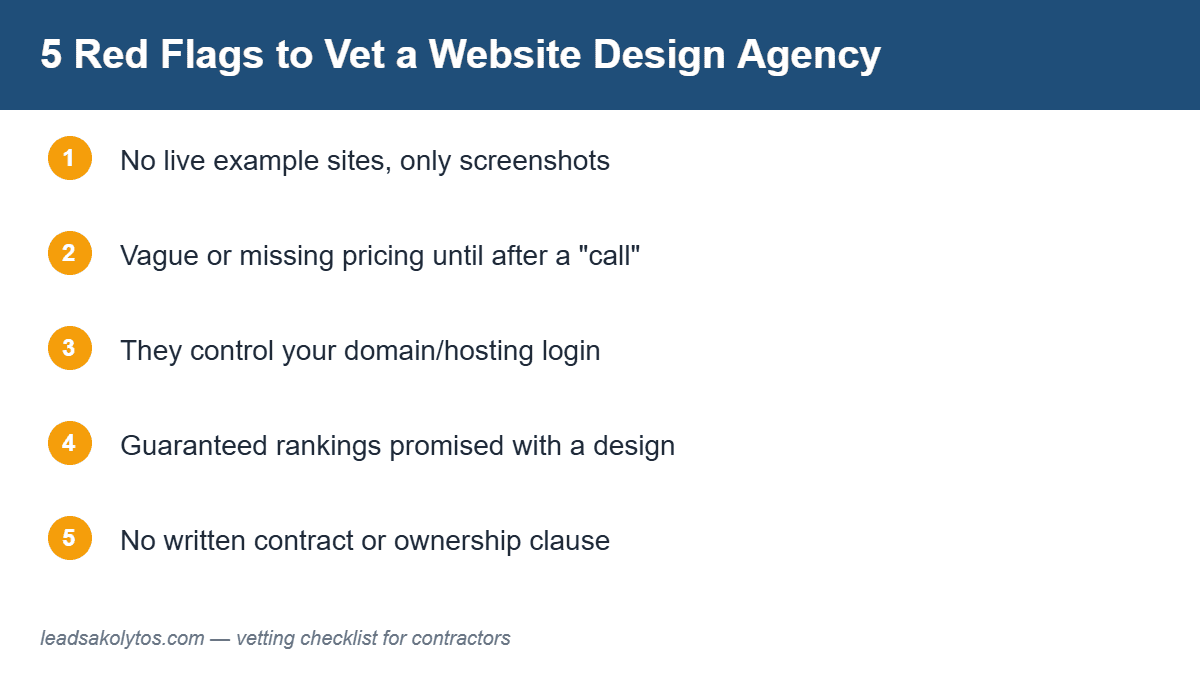
5 Red Flags That Should End the Conversation
- No live examples, only screenshots or “coming soon” links. A real agency has real, indexed sites you can visit today.
- Vague or missing pricing until after a “discovery call.” Ballpark ranges should be available up front; a refusal to discuss cost at all is a stalling tactic.
- They control the domain or hosting login and won’t hand it over on request. This is the single most common way contractors get held hostage by a former web designer.
- Promises of guaranteed rankings or “SEO included” with no specifics. Design and SEO are related but different disciplines; a designer promising page-one rankings as part of a design package is overselling.
- No contract, or a contract with no defined scope, timeline, or ownership clause. If it isn’t written down, it isn’t real once a dispute happens.
DIY Builder vs. Freelancer vs. Agency: What Each Option Actually Costs
Before you vet a website design agency, it helps to know which lane you’re even shopping in. Based on 2026 small-business web design pricing data reported across multiple independent industry guides, here’s how the three main paths compare:
| Option | Typical Cost | Timeline | Best Fit |
|---|---|---|---|
| DIY builder (Wix, Squarespace, etc.) | $10-$99/month, little to no upfront fee | Days to a few weeks | Very tight budgets, owner has time to build it themselves |
| Freelance designer | $1,500-$8,000 one-time for a 5-8 page site | 2-6 weeks | Custom look on a mid-size budget, owner can manage one point of contact |
| Web design agency | $5,000-$15,000+ for a 5-8 page site, more for full lead-gen builds | 1-3 months | Contractors who want service-area pages, review integration, ongoing support, and lead-gen strategy built in |
These are directional market ranges reported across multiple independent 2026 small-business web design pricing guides, not a quote specific to any one contractor’s project or to Leads Akolytos’s own pricing. For a deeper breakdown of what actually drives cost up or down for a contractor-specific rebuild, see our companion guide, How Much Should a Contractor Website Redesign Cost? It’s also worth remembering that “cheap now” and “cheap long-term” are not the same thing — a low upfront bid that locks you into a closed platform or an unclear ownership arrangement almost always costs more in the second and third year, once you need changes and discover you can’t make them without going back to the same agency on their terms.
How to Actually Review a Portfolio (Not Just Skim It)
Most owners glance at an agency’s portfolio page for thirty seconds when they should be taking real time to vet a website design agency, decide the sites “look nice,” and move on. That’s not enough to vet a website design agency properly. Instead, click into three live example sites and check them the way a customer would:
- Open each site on your phone first. The majority of contractor leads happen on mobile, so if the example site is clunky, slow, or hard to tap through on a phone, that’s exactly what your own site will look like.
- Time how long it takes to find the phone number or contact form. If it takes more than one scroll or one tap, that’s a conversion problem baked into the agency’s default approach, not a one-off mistake.
- Look for service-area pages, not just a single generic “Services” tab. A roofer or HVAC company that serves eight towns needs eight indexable pages, not one page mentioning all eight in a sentence.
- Check whether reviews are live and current, or a static screenshot from launch day. A live-pulling review widget signals the agency thought about trust signals; a frozen screenshot signals they didn’t.
- Run the site through a free page-speed checker. A beautiful site that loads in six seconds on mobile will bleed leads regardless of how good the design looks.
If an agency’s own example sites fail these checks, assume your site will fail them too — a design shop rarely builds noticeably better work for a new client than what’s sitting in their existing portfolio.
Comparing Multiple Proposals Without Getting Confused by Different Formats
Once you’ve got two or three proposals in hand, the real difficulty isn’t picking a winner — it’s that no two agencies format their quotes the same way, which makes true apples-to-apples comparison hard. Build a simple side-by-side sheet with these five rows for every proposal: total price, page count included, number of revision rounds, timeline in weeks, and who owns the domain/files at completion. Contractors who skip this step tend to anchor on whichever number is smallest, without noticing that the cheapest bid excludes service-area pages or caps revisions at one round.
It’s also worth asking each finalist the same follow-up question directly: “What happens if I want to make changes after launch — do I need to come back to you, or can I edit the site myself?” The answer tells you whether you’re buying a website or renting access to one. A written proposal that spells out post-launch editing rights, alongside the ownership clause covered above, is one of the clearest signals that an agency has done this professionally before and isn’t improvising the contract as they go.
What a Legitimate Contract Should Include
Once you’ve picked someone — the whole point of learning how to vet a website design agency is to get to this stage with confidence — get these five items in writing before any deposit changes hands:
- A clear scope: exact page count, features (booking forms, review widgets, service-area pages), and what’s explicitly excluded.
- A firm ownership clause stating you own the domain, hosting account, and all final files at project completion.
- A realistic timeline with milestone dates, not just a final delivery date.
- A defined number of revision rounds and what happens if you need more.
- Payment terms tied to milestones (for example, 30% deposit, 40% at design approval, 30% at launch) rather than 100% up front.
How Leads Akolytos Approaches Website Design
When you vet a website design agency, this is what you should be comparing it against: we build contractor websites the same way we’d want one built if we were hiring: transparent scope, contractor-specific pages (service areas, live reviews, mobile-first lead forms), and you keep full ownership of the finished site. If you’re using this guide to vet a website design agency and comparing us against another option, that’s exactly the point — a legitimate agency should welcome the scrutiny. See our website design service for what’s included, or schedule a call to talk through your specific project.
Already have an agency picked and just need the technical handoff done right? See our guide on how to switch web design agencies without losing your website, domain, or rankings.
Frequently Asked Questions
How long should it take to vet a website design agency?
Plan on one to two weeks: enough time for an initial call, a review of 2-3 live example sites, and a written proposal you can compare against at least one other agency or freelancer.
Should I ask for references, not just a portfolio?
Yes. A portfolio shows finished work; a reference call tells you whether the agency hit deadlines, communicated well, and handled revisions without friction — the things that actually determine whether the project is painful or smooth.
Is it a red flag if an agency won’t give a fixed price up front?
Not always — some scope genuinely needs a discovery call first. It becomes a red flag if they won’t give even a ballpark range, or if the final quote changes dramatically after that call with no clear reason.
Do I need to hire a separate SEO company, or does the web design agency handle that too?
Design and SEO are related but distinct. A good agency builds a technically sound, fast, mobile-friendly site that’s ready for SEO — but ongoing content, link building, and ranking work is typically a separate, ongoing service, not a one-time design deliverable.
What’s the biggest mistake contractors make when hiring a web designer?
Choosing based on price alone without confirming who owns the domain and files afterward. The cheapest bid that locks you into the agency’s platform can end up costing far more than a slightly higher bid with clean ownership terms.
Can I switch web design agencies later if I’m unhappy?
Yes, as long as you own your domain and hosting account. That’s exactly why confirming ownership terms before you sign matters — it’s what keeps switching an option instead of a hostage situation.
Sources on hiring questions and red flags: DesignRush, “8 Questions to Ask Before Hiring a Web Design Agency” and Robotics & Automation News, “8 Red Flags to Watch for When Hiring a Web Design Agency”. Cost ranges sourced from jim.com, “Small Business Website Cost: How to Budget”, cross-checked against multiple other 2026 small-business web design pricing guides.
Ready to talk through your project with a team that puts ownership terms and scope in writing from day one? Schedule a call with Leads Akolytos.
The same vetting logic applies if you are deciding between a professional content writer and writing your own blog content in-house.
Once you have picked an agency, get the paperwork right too — see our website redesign contract checklist for the ownership and exit terms worth confirming before you sign.
Want this handled for you?
We do this work for home service contractors every day, month-to-month, with no contracts. Book a free 30-minute call and we'll show you where you stand on Google.
Book my free call