Website redesign contract red flags cost contractors real money -- not in the invoice total, but in what gets left out of the paperwork. Most proposals contractors sign focus on the price and the launch date and say almost nothing about who owns the finished site, what happens if the web design agency disappears mid-project, or how many rounds of revisions you actually get. Here is exactly what a contractor website redesign contract should include, and what it means for you if any of it is missing.
The Short Answer: What a Website Redesign Contract Needs
A contractor website redesign contract should spell out seven things in writing: a detailed scope of work, who owns the domain and hosting accounts, who owns the final code and design files, how many revision rounds are included, a post-launch warranty period for bugs, a defined change-order process for anything outside scope, and clear exit terms if either side ends the project early. If a proposal is missing more than one or two of these, you are not buying a website -- you are renting access to one from whoever built it.
The Ownership Triangle: The 3 Things You Must Own, No Matter What
Strip away every clause in a typical web design contract and three things actually determine whether you own your website or your agency does. Call it the ownership triangle: the domain, the hosting and CMS login, and the source files. If any one of those three sits in the agency's name or on the agency's server instead of yours, you do not fully control your own business's front door -- no matter whose name is on the invoice.
- The domain. It should be registered under your business's name and email, in an account only you control. A surprising number of small-business sites are registered under the agency's reseller account, which means renewing your domain -- or leaving the agency -- means negotiating with them first.
- Hosting and CMS access. You should hold administrator-level login credentials to your hosting account and your website's backend (WordPress, or whatever CMS they use), not just viewer or editor access. Admin access is what lets you change providers without starting from zero.
- The source files. This means the actual theme code, custom functionality, original images, and a database export -- delivered to you, not just "available on request." A contract should name a delivery window (ten business days is a common standard) for handing these over after final payment.
If a proposal does not explicitly promise all three, ask for it in writing before you sign -- not after the relationship goes sideways. SCORE, the nonprofit small-business mentorship network, covers the same baseline principle in its own general guide to small-business contracts: get every material promise in writing before you sign, not as a follow-up after work has already started.
If you already have a proposal from a website design agency you are vetting, or you are deciding whether to switch agencies mid-project, run it against the checklist below before you sign anything.
The 7 Clauses to Check Before You Sign
| Clause | What It Protects | Red Flag If Missing |
|---|---|---|
| Detailed scope of work | Exactly which pages, features, and integrations are included -- and which are not | Vague language like "full website redesign" with no page count or feature list |
| Ownership transfer on final payment | Domain, hosting, code, and content become legally yours once you pay in full | No mention of when or how ownership transfers |
| Source file delivery | You receive editable files, not just a live site you cannot move or modify | No stated delivery window for files after launch |
| Revision rounds | A defined number of included feedback-and-revise cycles before "done" is "done" | Unlimited revisions promised verbally but not written down (usually means the opposite in practice) |
| Post-launch warranty | A 30-90 day window where launch bugs get fixed free, separate from new change requests | No warranty period, or "support" left undefined |
| Change-order process | Pre-agreed pricing for anything added after the scope is signed | No process, which is how a $4,000 project becomes a $9,000 project |
| Exit and termination terms | What you are owed -- files, access, a partial refund -- if either side ends the project early | Silence on what happens if the agency stops responding mid-project |
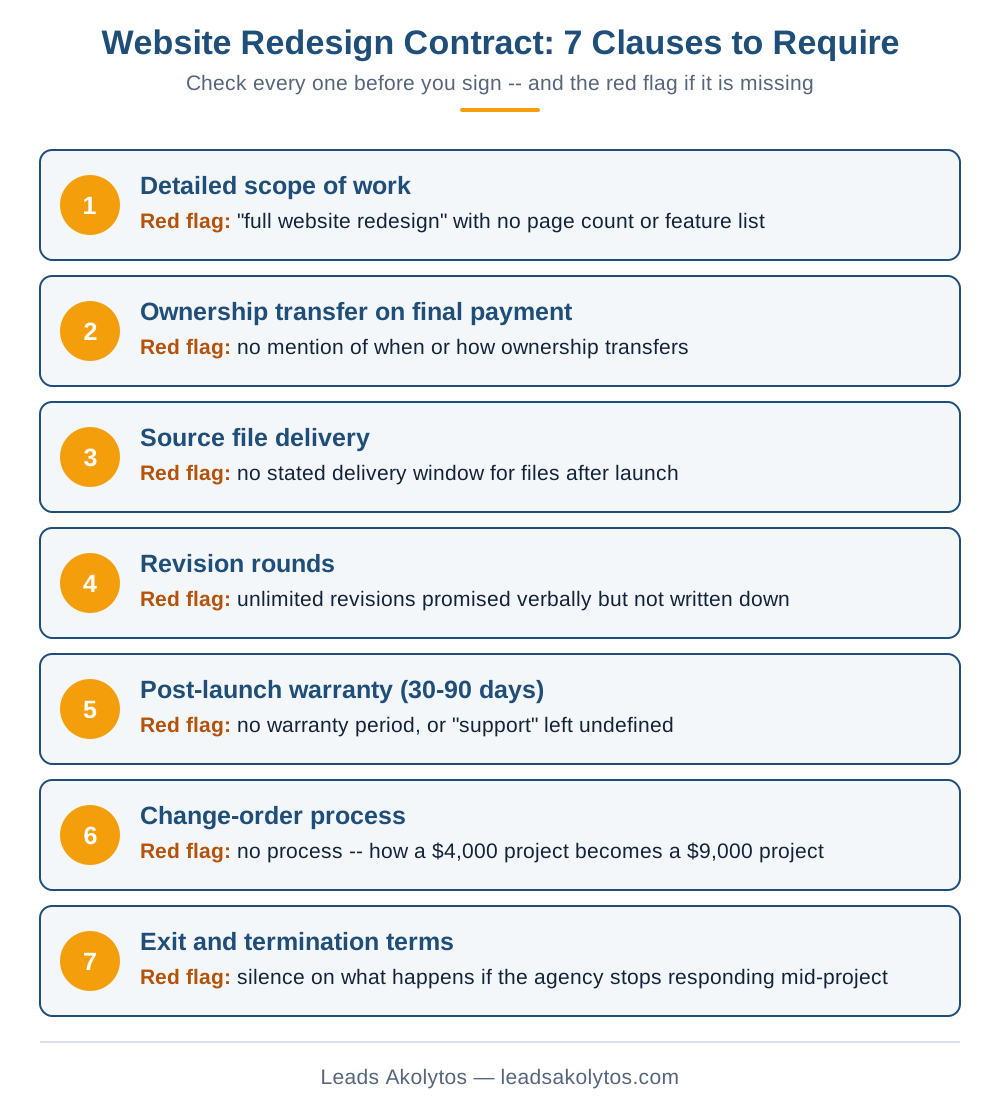
Use this graphic
You're welcome to republish this graphic on your own site, as long as you credit Leads Akolytos with a link back to this article. Copy the code below:
<a href="https://leadsakolytos.com/blog/website-redesign-contract-checklist/"><img src="https://leadsakolytos.com/blog/website-redesign-contract-7-clause-checklist.png" alt="Website redesign contract: 7 clauses to require" width="1200" /></a><br>Source: <a href="https://leadsakolytos.com/blog/website-redesign-contract-checklist/">Leads Akolytos</a>Why Scope Creep Is the Real Cost, Not the Invoice
The number on the proposal is rarely the number you end up paying. Industry write-ups on web design engagements consistently point to the same pattern: a redesign starts with a clear scope, the client requests "one more small thing" a few times during the build, and by launch the project has absorbed weeks of unbilled or disputed work that neither side planned for. A written change-order clause does not stop you from asking for changes -- it just means both sides agree on the price before the work happens instead of arguing about it after.
This is also where a vague scope of work turns into a drawn-out project. If "redesign the website" is the entire scope description, there is no shared definition of done, which means there is no clean way to tell whether you are negotiating a reasonable addition or paying twice for work that should have been included from the start. The FTC's own small-business guidance on vetting vendors makes a related point worth borrowing here: a legitimate vendor will put specifics in writing without being pushed, and reluctance to do so is a signal worth taking seriously on its own. See the FTC's guide to vetting vendors and avoiding scams for the fuller version of that principle.
Should You Have a Lawyer Review It, or Is This Checklist Enough?
For a typical website redesign contract in the low-to-mid four figures, most business owners can work through the seven-clause checklist above themselves and simply ask the agency to add in writing whatever is missing -- reputable agencies will not push back on this, since these are standard terms, not unusual demands. A lawyer review makes more sense when the contract value climbs into five figures, when the agency is also building custom software or handling sensitive customer data beyond a standard contact form, or when the agency pushes back on adding ownership or exit terms in writing -- that pushback is itself useful information about how the relationship will go if something goes wrong later.
What to Do If You Already Signed Without These Terms
If you are mid-project or already launched under a website redesign contract that is missing one of the seven clauses, you are not stuck. Send a short written request (email is fine) asking the agency to confirm, in writing, who holds the domain registration, whether you have admin-level hosting and CMS access, and what the process is for obtaining source files if the relationship ends. A agency with nothing to hide will confirm this in a few sentences. Hesitation, vague answers, or a request to "just trust us" is itself the clearest signal of how much practical control you actually have over your own site.
Get a Second Opinion Before You Sign
If you have a proposal in hand and want a second set of eyes on it before you commit, that is exactly the kind of question worth a quick call rather than guessing. Schedule a free strategy call and we will walk through what you have been sent and tell you honestly what is missing -- whether or not you end up working with us.
If your site is live but Google is not sending calls, rule out a leftover block first: see how to tell if your contractor website is blocking Google.
Ask for the redirect map in writing too. Missing redirects are a leading cause of lost calls after launch; our post on post-redesign traffic drops shows how to check them.
Frequently Asked Questions About Website Redesign Contracts
Do I legally own my website once I pay the final invoice?
Only if the contract says so. Ownership of the design, code, and content does not transfer automatically just because you paid -- it transfers because a clause in the contract says it does. Without that clause in writing, the agency can, in theory, still claim rights to the work even after you have paid in full.
How many rounds of revisions should be included in a website redesign?
Two to three structured revision rounds is standard for a typical contractor website redesign. More than that usually gets priced as additional work. What matters more than the exact number is that a number exists in writing at all -- "revisions included" with no cap is one of the most common sources of scope-creep disputes.
What is a reasonable post-launch warranty period?
Thirty to ninety days is typical, covering genuine defects -- things that do not work the way the contract described -- rather than new requests. A good contract draws a clear line between "this is broken and should be fixed free" and "this is a new feature and should be a change order."
What should I do if an agency refuses to put ownership terms in writing?
Treat it as a decision point, not a negotiating step to push past. An agency that will not confirm domain, hosting, and file ownership in writing before you sign is unlikely to hand those things over smoothly if the relationship ends badly later. If you want a neutral read on a proposal before you commit either way, schedule a free strategy call and we will go through it with you.
If you'd like one practical idea like this in your inbox each month, get The Leads Akolytos Monthly: one email a month, unsubscribe any time.
Want this handled for you?
We do this work for home service contractors every day, month-to-month, with no contracts. Book a free 30-minute call and we'll show you where you stand on Google.
Book my free call