Before you hire a landing page designer, ask seven questions: which ad and service the page is for, what a past page did for calls, what shows above the fold on a phone, how fast it will load, how calls and forms will be tracked, who owns the page and files, and what happens after launch. The answers tell you whether you're buying a page that gets calls or a page that just looks good.
Most contractors only hire a landing page designer once they're already paying for ads, which means every week with the wrong page costs real money. This guide gives you the questions, what a good answer sounds like, and the red flags that should end the conversation.
The Short Answer: What to Ask Before You Hire a Landing Page Designer
A good landing page designer for a contractor business should be able to tell you, specifically, which search or ad the page is built for, show you a real past page and what it did for calls or form fills, explain what a homeowner sees on a phone in the first few seconds, commit to a load-speed target, set up call and form tracking, put ownership of the page and files in writing, and plan for testing after launch. Vague answers on any of those are a reason to keep looking.
Why a Landing Page Designer Is Not the Same Hire as a Web Designer
A website has to do many jobs at once -- introduce the company, list every service, show the team, answer questions, rank in search. A landing page has one job: turn a specific visitor, usually someone who just clicked an ad, into a call or a form fill.
That changes what you should be paying for. A beautiful page with a slider, a menu of ten links, and the phone number at the bottom can be a perfectly good homepage and a poor landing page. When you hire a landing page designer, you're buying focus and conversion, not decoration. If you're still deciding whether you need a separate page at all, our guide on whether a dedicated landing page is worth it for contractors covers that decision first.
It also changes how Google treats your ads. Google's own explanation of Quality Score for Search campaigns lists landing page experience -- how relevant and useful the page is to people who click your ad -- as one of the three components. A page built for the ad isn't only better for the homeowner; it's part of how the ad account is evaluated.
7 Questions to Ask Before You Hire a Landing Page Designer
1. "Which ad, which service, and which area is this page for?"
The single most common landing page mistake is building one generic "contact us" page and sending every ad to it. Someone who searched "emergency drain cleaning" and someone who searched "bathroom remodel quote" want different things, and a page that tries to serve both serves neither well.
Good answer: they ask you which campaigns, services, and service areas the traffic is coming from, and plan the headline and first screen to match those searches.
Red flag: "We'll build you a great landing page" with no questions about where the visitors are coming from.
2. "Can you show me a page you built and what it did for calls or form fills?"
Screenshots prove someone can design. They don't prove the page worked. When you hire a landing page designer, ask for a live page you can open on your own phone, and ask what changed in calls, form fills, or cost per lead after it launched. Not every designer will have permission to share exact numbers, but a good one can at least describe what they measured and what improved.
Good answer: a live example, a plain explanation of what was measured, and honesty about what they can and can't share.
Red flag: a portfolio of mockups and no mention of results at all.
3. "What will a homeowner see on a phone in the first few seconds?"
Most contractor ad traffic is on mobile, so the first screen on a phone is the page. A homeowner with a leaking water heater should see, without scrolling, a headline that matches what they searched, a reason to trust you, and a tap-to-call button.
Good answer: they describe the mobile first screen specifically -- headline, trust signal (reviews, license, years in business), and one clear call to action.
Red flag: they only show you desktop designs, or the phone number lives in the footer.
4. "How fast will it load, and how will you measure that?"
Slow pages lose people before they ever see your offer, especially on cellular data. Google's Core Web Vitals give you a concrete, non-negotiable way to talk about speed. According to Google's web.dev guidance on Web Vitals, a good page loads its main content (Largest Contentful Paint) within 2.5 seconds, responds to taps (Interaction to Next Paint) in 200 milliseconds or less, and keeps its layout stable with a Cumulative Layout Shift of 0.1 or less, measured at the 75th percentile of page loads.
Good answer: they name those targets (or similar measurable ones) and tell you how they'll test the page before and after launch.
Red flag: "It'll be fast" with no way to check, or a design built around heavy video and image sliders.
5. "How will calls and form fills from this page be tracked?"
If nobody can tell which calls came from the page, nobody can tell whether the page works -- including the designer. This is the same blind spot behind many cases of ads getting clicks with no calls, which we walk through in our diagnostic for Google Ads clicks but no calls.
Good answer: they explain how form submissions and phone calls will be recorded as conversions, and they coordinate with whoever manages your ads.
Red flag: "Tracking is your ad agency's job" with no plan to connect the two.
6. "Who writes the copy, and who owns the page and files afterward?"
Two hidden problems live in this question. First, copy: many designers expect you to supply the words, which is how contractor landing pages end up with generic headlines. Find out who writes the headline, the trust section, and the call to action before you sign. Second, ownership: on many subscription-based page builders, the page lives on the builder's platform, so if the subscription lapses the page can go offline. Make sure you know where the page is hosted, who pays for it, and whether you can take the design and content with you.
Good answer: copy responsibility is spelled out, and ownership of the page, domain, and files is written into the agreement.
Red flag: the page lives in the designer's own account and nobody can tell you what happens if you stop working together.
7. "What happens after launch?"
The first version of a landing page is a starting point. Real improvement comes from watching how visitors behave and testing changes -- a different headline, a shorter form, a more prominent phone number.
Good answer: a defined number of revision rounds after launch, and a plan for at least one test once there's enough traffic to learn from.
Red flag: the project ends the day the page goes live.
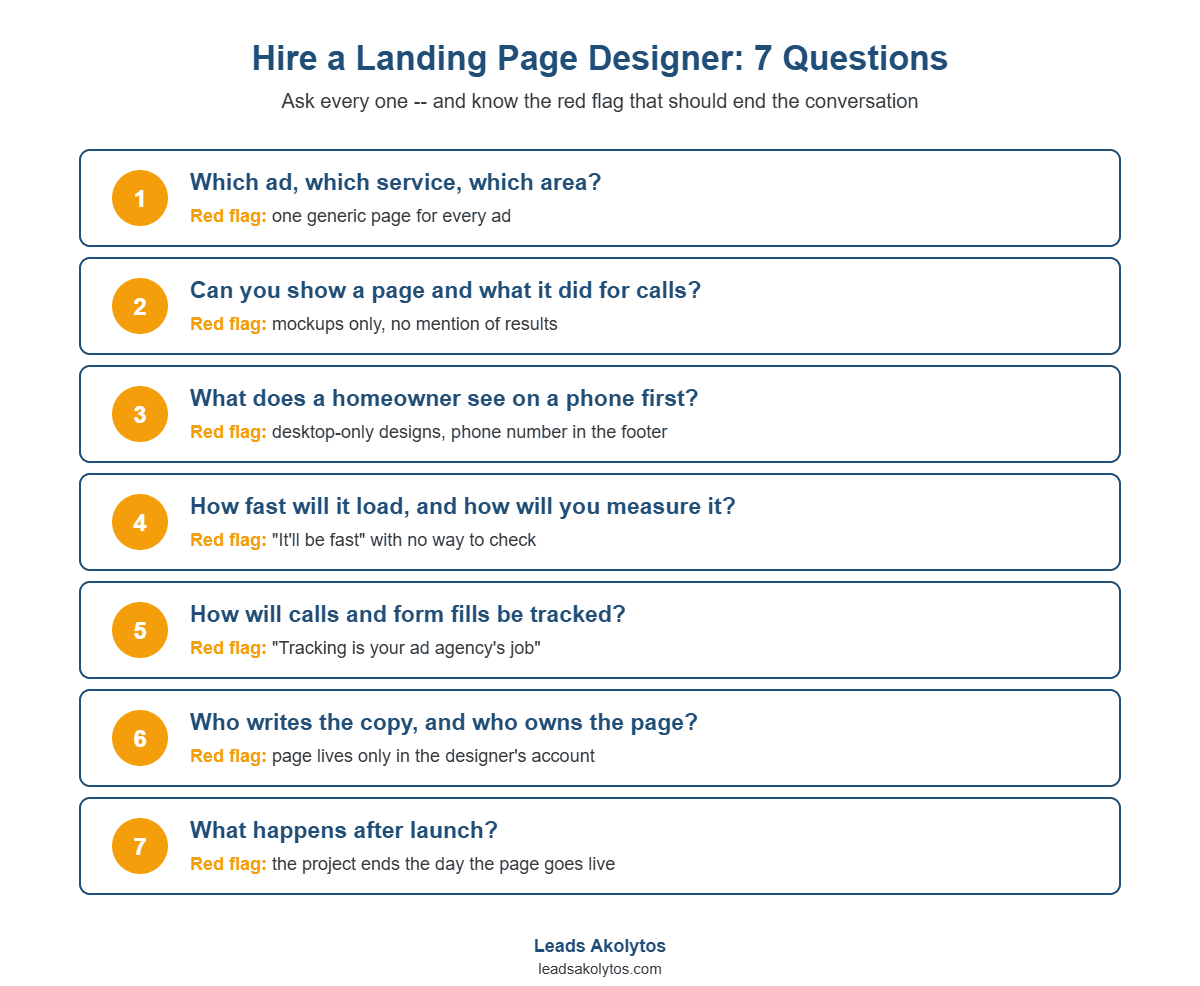
Use this graphic
You're welcome to republish this graphic on your own site, as long as you credit Leads Akolytos with a link back to this article. Copy the code below:
<a href="https://leadsakolytos.com/blog/hire-a-landing-page-designer-questions/"><img src="https://leadsakolytos.com/blog/hire-a-landing-page-designer-7-questions.png" alt="7 questions to ask before you hire a landing page designer" width="1200" /></a><br>Source: <a href="https://leadsakolytos.com/blog/hire-a-landing-page-designer-questions/">Leads Akolytos</a>The Answer Scorecard: Good Answers vs. Red Flags
Bring this table to your calls with any landing page designer you're considering. You don't need perfect answers to all seven -- but more than one or two red flags is a pattern.
| Question | A good answer sounds like | Red flag |
|---|---|---|
| 1. Which ad, service, and area? | Asks about your campaigns and builds the headline to match | One generic page for every ad |
| 2. Proof of results | Live page plus what was measured | Mockups only, no mention of calls or leads |
| 3. Mobile first screen | Matching headline, trust signal, tap-to-call above the fold | Desktop-only designs, phone number in the footer |
| 4. Load speed | Measurable targets like Core Web Vitals | "It'll be fast" |
| 5. Tracking | Calls and forms recorded as conversions | "That's the ad agency's job" |
| 6. Copy and ownership | Both spelled out in writing | Page lives only in the designer's account |
| 7. After launch | Revision rounds and a testing plan | Project ends at launch |
Should You Build It Yourself or Hire a Landing Page Designer?
Page builders make it possible for an owner to put up a landing page in an afternoon, and for a simple, low-budget campaign that can be enough. If you go that route, use the seven questions above as your own checklist: match the page to the ad, put the phone number first on mobile, keep it fast, and make sure calls are tracked.
Hiring makes more sense when you're spending enough on ads that a weak page wastes real money every week, when you need several pages for different services or cities, or when nobody on your team has time to test and improve the page after launch. That's the work a good designer earns their fee on -- not the first draft, but getting the page to actually convert. For typical price ranges, see our guide to how much a landing page should cost for a contractor business.
And if you already have a page and you're not sure it's working, our list of warning signs your landing page isn't converting is a good place to start before you hire anyone.
Frequently Asked Questions
What should I ask before I hire a landing page designer?
Ask which ad and service the page is for, what a past page did for calls or form fills, what shows above the fold on a phone, how fast the page will load, how calls and forms will be tracked, who owns the page and writes the copy, and what happens after launch.
Is a landing page designer different from a web designer?
Often, yes. A web designer builds a site that does many jobs at once. A landing page designer builds one focused page meant to turn a specific visitor, usually from an ad, into a call or form fill. Some designers do both well; ask about landing page results specifically.
How do I know if my landing page designer did a good job?
Look at whether calls and form fills from the page are being tracked, whether the page loads quickly on a phone, and whether your cost per lead improved after launch. A page that looks good but can't show any change in calls or leads hasn't proven itself yet.
Should I own my landing page if someone else builds it?
Yes. Make sure ownership of the page, the domain, and the design files is written into your agreement, and know where the page is hosted. If the page only exists inside the designer's account, you may lose it if you stop working together.
Talk Through Your Landing Page Before You Hire Anyone
If you're about to hire a landing page designer -- or you already have a page and aren't sure it's pulling its weight -- we're happy to look at it with you. On a free strategy call we'll check your page against these seven questions, look at how it fits the ads sending it traffic, and tell you honestly whether it needs a rebuild, a few fixes, or nothing at all.
Book your free strategy call, or see how we approach landing page design for contractors.
Want this handled for you?
We do this work for home service contractors every day, month-to-month, with no contracts. Book a free 30-minute call and we'll show you where you stand on Google.
Book my free call