Landing page converting is the question every contractor running ads should be able to answer with a real number, not a guess — here is how to check it and what to do if the answer is “not well enough.”
If you are running ads or handing out a link to a dedicated landing page and are not sure whether it is actually turning visitors into calls and booked jobs, the fastest way to know is to compare its conversion rate (form fills plus calls, divided by visitors) against a simple benchmark: most home-service landing pages convert somewhere between 3% and 10%. If yours is sitting well under 3% with steady traffic, something on the page — not your ad spend — is almost certainly the problem.
The Short Answer
A landing page is converting well when a healthy share of the people who land on it take the one action it was built for — calling, texting, or filling out a form — without needing to hunt for it. If you cannot say what your conversion rate actually is, that is itself a warning sign: you cannot know if a page is working if you are not measuring it.
Most contractors ask this the same way: “is my landing page converting, or am I just paying for clicks that go nowhere?” The 7 signs below answer that question concretely.
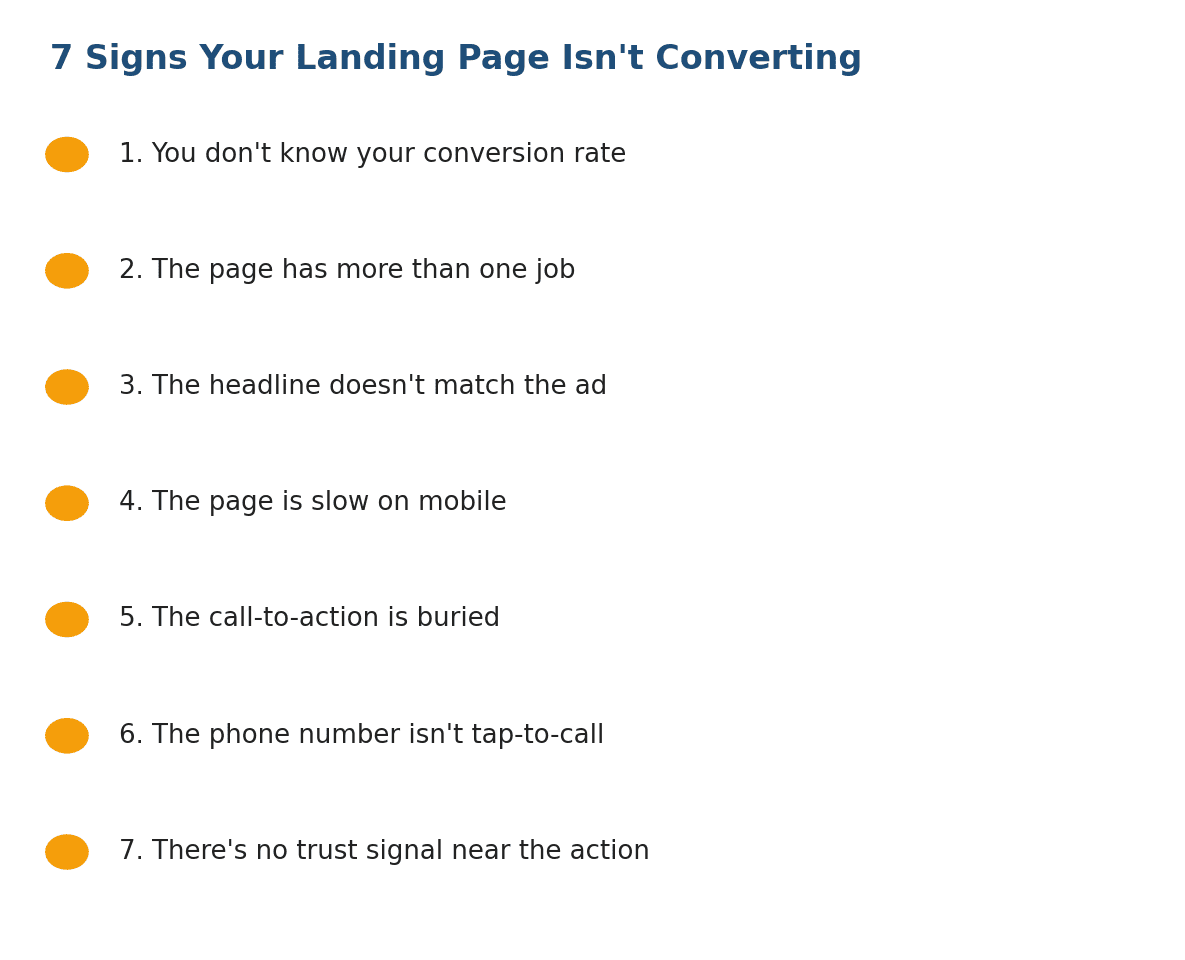
7 Signs Your Landing Page Is Costing You Leads Instead of Winning Them
1. You Do Not Actually Know Your Conversion Rate
This is the most common answer we hear from contractor owners: “I think it’s doing okay.” If your landing page and your Google Ads or Facebook Ads account are not connected through a form-fill and call-tracking setup, you are flying blind. Set up conversion tracking before you change a single word on the page — you cannot fix what you cannot measure.
2. The Page Has More Than One Job
A homepage has to serve every visitor: new customers, past customers, job seekers, even other businesses. A landing page has exactly one job — get the visitor to take the action tied to the ad or offer that sent them there. If your landing page still has a full navigation menu, links to five different services, and a blog feed in the sidebar, it is competing with itself.
3. The Headline Does Not Match the Ad
When someone clicks an ad for “24-Hour Emergency Plumbing” and lands on a page headlined “Welcome to [Company Name],” that mismatch costs you the visitor in the first three seconds. This is called message match, and it is one of the single biggest, cheapest fixes available — the headline on the landing page should echo the exact promise made in the ad.
4. The Page Is Slow on Mobile
Most contractor ad traffic is mobile. A landing page that takes several seconds to become interactive on a phone loses visitors before they ever see the offer. Google’s own Core Web Vitals guidance ties page speed directly to both user experience and ranking signals, and the same slowness that hurts SEO quietly kills paid conversion rates too.
5. The Call-to-Action Is Buried or Unclear
If a visitor has to scroll past three sections before finding a phone number or a form, or if the button says something vague like “Learn More” instead of “Get My Free Estimate,” you are adding friction at the exact moment you need the least friction possible.
6. The Phone Number Is Not Tap-to-Call
On mobile, a phone number that is just text — not a tap-to-call link — forces the visitor to copy it, switch apps, and dial manually. Most will not bother. This is a small technical detail with an outsized effect on real-world conversion rates.
7. There Is No Trust Signal Near the Action
Reviews, licensing/insurance badges, years in business, or a handful of recent job photos placed near the form or phone number reassure a visitor who is about to hand over their contact information to a stranger. A page with zero trust signals asks for a level of trust it has not earned yet.
How to Check Whether Your Landing Page Is Converting
Pull your landing page’s visitor count and conversion count (calls plus form fills) for the last 30-90 days from your ad platform or analytics tool. Divide conversions by visitors. Compare that number against the 3%-10% range above to gauge whether your landing page converting rate is healthy or needs work. If you are below it, walk through the 7 signs in order — message match and page speed are usually the two highest-leverage fixes, and both are checkable in a few minutes using Google’s own PageSpeed Insights tool.
Should You Fix This Yourself or Hire It Out?
If the fix is genuinely one of the 7 signs above — a headline rewrite, a faster host, a tap-to-call link — a contractor comfortable in their website’s page builder can often make the change in an afternoon. Where it usually makes sense to pay someone: when you need real A/B testing discipline, copywriting that actually converts (not just reads well), or a rebuild that ties the landing page’s tracking back into your ad platform correctly. Either way, the goal is the same: get your landing page converting at a rate you can trust.
Getting the tracking wrong means every other fix is guesswork.
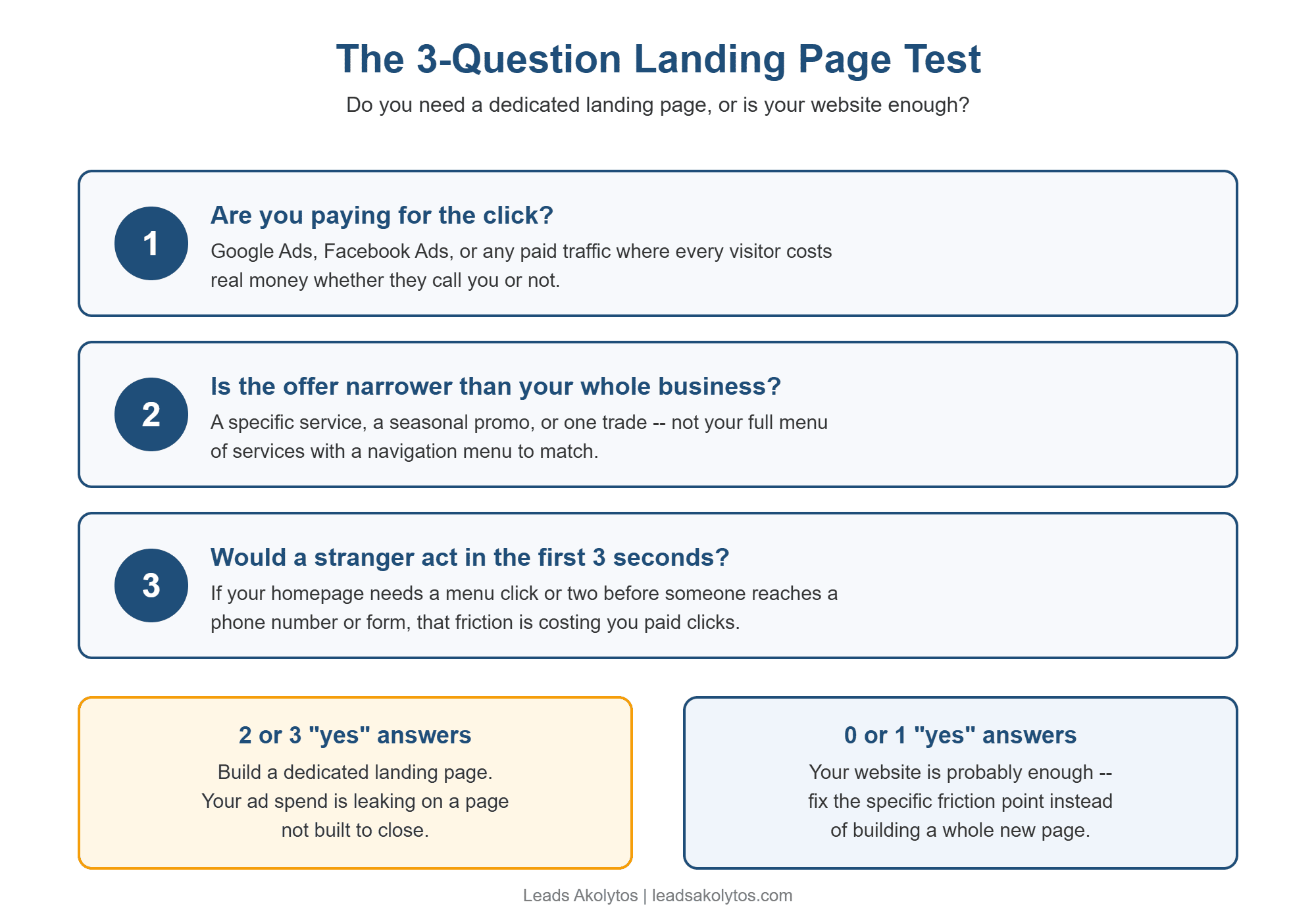
If you are not sure whether your current landing page setup is worth rebuilding or just needs targeted fixes, our landing page cost guide breaks down what a proper rebuild typically runs, and our piece on whether a dedicated landing page is worth it in the first place covers the decision one step earlier in the process. If you decide to bring in outside help, use our list of questions to ask before you hire a landing page designer to vet them first.
Frequently Asked Questions
What is a good landing page conversion rate for a contractor business?
Most home-service landing pages convert somewhere between 3% and 10%, depending on trade, offer, and traffic quality. Emergency/urgent-need trades (plumbing, HVAC repair) tend to sit at the higher end; larger-ticket, longer-consideration services (full remodels, roof replacements) often run lower.
How long should I test before deciding a landing page is not converting?
Give a page enough traffic to be statistically meaningful before judging it — as a rough guide, at least 100-200 visitors or a few weeks of steady traffic, whichever comes first. Judging a page on 15 visitors is judging noise, not performance.
Can a landing page be “too simple” to convert well?
Rarely. Landing pages that convert well for contractors are usually simpler than owners expect: one offer, one headline that matches the ad, a short trust section, and one clear call-to-action. Simplicity is a feature here, not a shortcut.
Should I DIY my landing page or hire it out?
Small, specific fixes (headline, tap-to-call, page speed) are reasonable to DIY if you are comfortable in your website platform. A full rebuild with proper conversion tracking and message-match copy across multiple campaigns is usually worth paying for, since a broken tracking setup makes every future decision a guess.
Not sure if your landing page needs a tune-up or a rebuild? Schedule a free strategy call and we will look at it with you.
Want this handled for you?
We do this work for home service contractors every day, month-to-month, with no contracts. Book a free 30-minute call and we'll show you where you stand on Google.
Book my free call