

Guest post by the Bidmere team.
Most leads that die after the phone call don't die on price. They die because the estimate showed up late, because the homeowner couldn't tell what was included, or because the number arrived with no explanation and nobody followed up. Those three problems are fixable, and fixing them is usually cheaper than buying more leads.
If you're paying for calls from Google, the call is only half the job. The other half is everything between "Can you come take a look?" and a signed proposal.
Contractor Estimate Follow-Up: The Short Answer
Contractors lose most leads between the call and the estimate to three things: a slow estimate, a scope the homeowner can't read, and no follow-up. Fix them in that order. Set a firm date for the written estimate on the first call and hit it. Write the estimate so it lists scope, inclusions, exclusions, allowances, schedule and terms, not one total. Then follow up on a simple schedule: the same day you send it, day 2 or 3 with one useful question, day 7 with something real, and a polite close-out on day 14. If estimates keep slipping because the person who writes them is also running jobs, fix the estimating step itself.
Speed Matters More Than Most Contractors Think
The best-known research on this is "The Short Life of Online Sales Leads," published in Harvard Business Review in March 2011 by James Oldroyd, Kristina McElheran and David Elkington. The authors sent test inquiries to 2,241 US companies. Only 37% responded within an hour, and 23% never responded at all. Among the companies that did reply within 30 days, the average response took 42 hours.
In a separate analysis of 1.25 million leads, the same researchers found that companies that tried to reach a lead within an hour were nearly seven times as likely to qualify it (have a real conversation with the decision maker) as companies that waited even one hour longer, and more than 60 times as likely as companies that waited 24 hours or more.
Two caveats. That study measured qualified conversations, not signed jobs, and it wasn't specific to construction. But the pattern holds for anyone who has ever called back a homeowner on Thursday about a Monday inquiry: by then they've talked to two other contractors, and one of them is already on the calendar.
For a trade contractor, "speed" has two separate clocks:
- Time to first response. How long between the inquiry and a human reply that sets the next step. This should be minutes or hours, not days.
- Time to a number. How long between the site visit (or the plans arriving) and a written estimate in the customer's hands.
Most contractors are decent at the first clock and bad at the second. The visit happens fast because it feels like progress. Then the estimate sits in a truck or an inbox for a week while the crew is busy on a live job. For the first clock, including inquiries that arrive after you close, see what happens to after-hours leads and how fast to call back a lead.
What to Say When You Can't Price It Yet
You won't always have enough information to give a number on the first call, and you shouldn't guess. A bad ballpark is worse than none, because the customer anchors on it and every later number looks like a price increase.
What you can always give is a firm next step with a date attached. Something like:
"I can't give you an honest number until I've seen the attic access and measured the run. I can be out Wednesday morning, and you'll have a written estimate by Friday afternoon."
That one sentence does three things: it explains why you're not quoting yet, it books the visit, and it sets an expectation you can be held to. Then hit the date. A written estimate that arrives when you said it would is a small proof that you'll show up when you say you will on the job.
If a job is genuinely complicated (structural questions, an engineer's letter, a long material lead time), tell the customer that on the visit and give them a date for a budget range first and a firm price second. Silence is what loses them, not the wait.
Make the Estimate Easy to Say Yes To
A homeowner comparing three quotes isn't really comparing three numbers. They're trying to work out whether the three contractors are quoting the same job. When one estimate says "Replace roof: $14,800" and another lists tear-off, underlayment, flashing, ventilation, disposal and the warranty, the detailed one usually looks safer even if it costs more.
A clear estimate answers the questions the customer would otherwise call three competitors to ask:
- Scope. What you're doing, in plain language, with quantities where they matter (squares of roofing, linear feet of gutter, number of fixtures).
- Inclusions. Permits, disposal, cleanup, protection of landscaping and floors, final inspection.
- Exclusions. What you're not doing and what could change the price: rotted decking found after tear-off, code upgrades, owner-supplied fixtures, hidden water damage. Put a unit price on the likely surprises (for example, a price per sheet of replaced decking) so a change order doesn't feel like an ambush.
- Allowances. If the customer still has to pick a tile or a fixture, say what's budgeted and what happens if they pick something pricier.
- Schedule. Expected start window and rough duration.
- Terms. Deposit, payment milestones, how long the price is good for, and your warranty.
Exclusions feel like they'll scare people off. In practice they do the opposite. A contractor who names the risks up front looks like the one who has done this before, and the customer has fewer reasons to go back to the lowest bidder with a list of questions.
One more detail: send the estimate in a format the customer can actually read on a phone and forward to a spouse. A clean PDF with your company name, license number and a single total beats a photo of a handwritten sheet every time.
Should You Publish Price Ranges on Your Website?
This comes up with nearly every contractor who's tired of driving to appointments that go nowhere. There's no single right answer, but there is a pattern.
Ranges help when:
- Your jobs are fairly standard (a water heater swap, a standard asphalt reroof on a single-story house, a panel upgrade), so a range is honest.
- You keep getting calls from people whose budget is a fraction of what the work costs. A range filters them out before your estimator drives across town.
- Your competitors are vague, so a published range reads as confidence.
Ranges hurt when:
- The work varies so much that any range is either too wide to mean anything or too narrow to be true. Remodels and additions usually fall here.
- The range becomes the price in the customer's head. If you publish "$9,000 to $18,000," expect everyone to assume $9,000.
- You can't keep it current. A range from two years of material prices ago will cause more arguments than it prevents.
A middle path works for a lot of trades: publish what drives the price instead of the price. "A typical reroof depends on the number of squares, pitch, number of layers to tear off, and decking condition" sets expectations without committing you to a number, and it gives the customer the vocabulary to compare quotes properly. If price shoppers are filling your calendar, how to use website messaging to filter price shoppers covers the wording side.
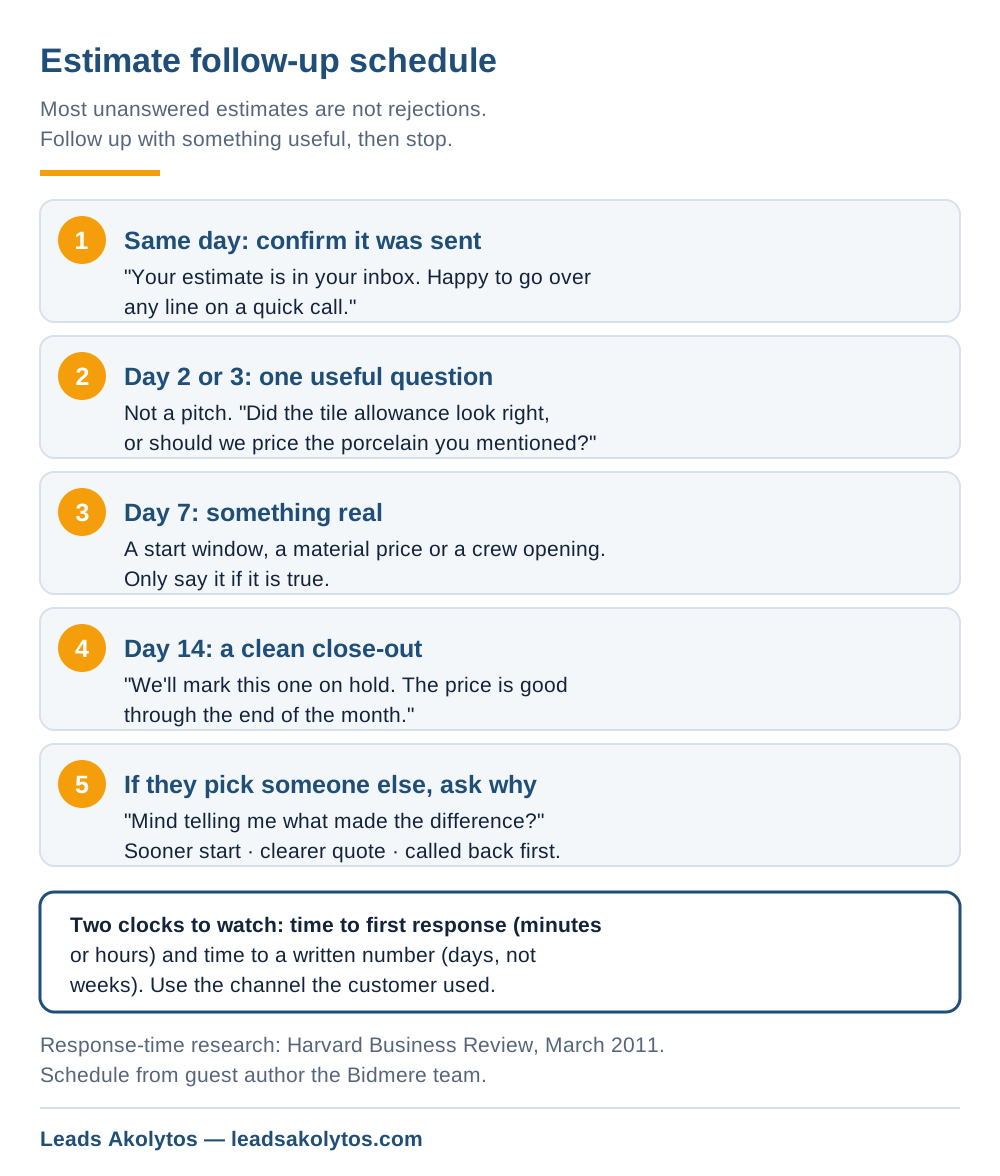
A Simple Quote Follow-Up Schedule
Most estimates that go unanswered aren't rejections. The customer got busy, is waiting on a spouse, is waiting on a third quote, or has a question they didn't want to call about. A short, polite follow-up sequence recovers a meaningful share of those jobs, and almost no contractor does it consistently.
Here's a schedule that's easy to stick to:
- Same day as you send the estimate: A short text or email confirming it was sent and offering to walk through it. "Your estimate for the bathroom remodel is in your inbox. Happy to go over any line on a quick call."
- Day 2 or 3: One question, not a sales pitch. "Did the tile allowance look right, or would you like us to price the porcelain you mentioned?"
- Day 7: A check-in tied to something real: scheduling, a material price, or a crew opening. "We have a start window opening the week of the 18th. Want us to hold it while you decide?" Only say this if it's true.
- Day 14: A clean close-out. "We'll mark this one as on hold so we're not filling your inbox. The price is good through the end of the month if you want to pick it back up."
A few rules keep this from turning into nagging:
- Every message should either answer a likely question or offer something useful. "Just checking in" adds nothing.
- Use the channel the customer used. If they texted, text.
- Stop after the close-out message. If they come back later, you look professional instead of desperate.
- Track it. A spreadsheet with the customer, date sent, amount and next follow-up date is enough. If you use a CRM or FSM software, set the reminders when you send the estimate, not after.
When a customer does pick someone else, ask one question: "Mind telling me what made the difference?" The answers ("they could start sooner," "their quote was easier to understand," "they called back first") tell you more about where your leads are going than any ad report. To see which lead sources turn into signed jobs, not only calls, see the real cost per lead.
When Estimating Capacity Is the Real Bottleneck
Plenty of contractors already know all of this and still lose leads, because the person who writes estimates is also the person running jobs. During a busy stretch, estimates slip to nights and weekends, response times stretch from days to weeks, and the leads you paid for go to whoever quoted first.
If that sounds familiar, look at the estimating step on its own. Options include blocking fixed estimating hours each week, using templates so every estimate starts from the same scope and exclusions list, training a second person to do takeoffs, or outsourcing takeoffs and estimates on busy weeks. Whatever you pick, the goal is the same: the time to a number shouldn't depend on how busy the crew is.
Roofers and remodelers feel this most, because their estimates take the longest to build. Our roofing and remodeling pages cover the marketing side of those trades.
Frequently Asked Questions
How soon should a contractor follow up after sending an estimate?
Confirm it was received the same day, then follow up with a specific question within two or three days. A check-in around day seven and a polite close-out around day fourteen covers most jobs without becoming pushy.
How fast should I respond to a new lead?
As fast as you realistically can, ideally within the hour. In the HBR research cited above, companies that tried to reach a lead within an hour were nearly seven times as likely to have a real conversation with the decision maker as those that waited one more hour.
Should a contractor estimate list exclusions?
Yes. Listing exclusions and likely unknowns, with unit prices where you can, makes your estimate easier to compare, reduces change-order disputes, and makes you look more experienced than a contractor who gives a single total.
Why do customers stop responding after getting a quote?
Usually not because of price alone. Common reasons are a slow quote, a scope they couldn't understand, waiting on another bid or a spouse, or an unanswered question. A short follow-up that answers a likely question recovers many of these.
Should I give a ballpark price on the first call?
Only if the job is standard enough for the number to be honest. Otherwise give a firm next step with a date ("written estimate by Friday afternoon") and keep it. A bad ballpark anchors the customer, and every later number looks like a price increase.
The Harvard Business Review figures in this article were checked by Leads Akolytos on November 11, 2026, against the HBR article page and the study's own wording as quoted in SmartCompany's July 4, 2011 report. The full HBR article is behind a paywall.
Want a Second Look?
If you'd rather go over how your calls turn into estimates and signed jobs with someone, Leads Akolytos offers a free 30-minute strategy call. We work only with home service contractors, with no setup fees and no long-term contracts. You can book a time here.
If you'd like one practical idea like this in your inbox each month, get The Leads Akolytos Monthly: one email a month, unsubscribe any time.
About the Author
The Bidmere team helps contractors prepare estimates, quantity takeoffs and bid packages remotely. If you want a starting point for clearer quotes, Bidmere's free contractor quote template covers scope, inclusions, exclusions and payment terms.
Want this handled for you?
We do this work for home service contractors every day, month-to-month, with no contracts. Book a free 30-minute call and we'll show you where you stand on Google.
Book my free call