
Guest post by the ZoeyAI team.
Most contractors know the feeling. You finish a long day, get home, and see that someone filled in your website form at 7:45 p.m. asking about a leaking water heater. You call them at 7 a.m. the next morning. They've already booked someone else.
Nobody did anything wrong. The homeowner had a problem, went looking for help, and took the first business that responded. That is the reality of after-hours leads for plumbers, electricians, roofers, HVAC techs and every other trade: the inquiry arrives when the office is closed, and the job goes to whoever answers first.
This article looks at why evening and weekend inquiries are so easy to lose, what the research actually says about response speed, and a practical set of fixes you can put in place without hiring a night-shift receptionist.
How Contractors Catch After-Hours Leads: The Short Answer
Most after-hours leads are lost to silence, not to a better competitor. The homeowner who fills in your form at 8 p.m. hears nothing, assumes you're closed and books whoever answers first. You catch those leads by making sure every inquiry gets an instant acknowledgement that says when a person will call, answering the common questions (area, emergency service, pricing, licensing) on your website, asking how urgent the job is on your form, and clearing overnight leads in priority order first thing in the morning. Start with the instant reply and the FAQ answers: they cost almost nothing and fix the two biggest leaks for most trades.
Why the Evening Is When Homeowners Look for Help
Homeowners notice problems after work. The heater won't start when they come home. The leak shows up when they're doing the dishes. The fence comes down in a Saturday storm. Plenty of non-urgent jobs, such as a quote for a new deck or a bathroom remodel, get researched at night too, because that is when people finally have time to sit down with their phone.
So the after-hours inquiry is not an edge case. For many service businesses it is a regular part of their lead flow, and often the part that gets the slowest response.
What the Research Says About Lead Response Time
The most cited work on this topic is "The Short Life of Online Sales Leads", published in Harvard Business Review in March 2011 by James Oldroyd, Kristina McElheran and David Elkington. It reported two pieces of research.
In the first, the authors sent a web inquiry to 2,241 US companies and timed the responses. 37% replied within an hour, 16% within one to 24 hours, 24% took longer than 24 hours, and 23% never replied at all.
In the second, they analyzed 1.25 million sales leads received by 42 US companies. Firms that tried to contact a lead within an hour were nearly seven times as likely to qualify it (defined as having a meaningful conversation with a key decision maker) as firms that tried an hour later, and more than 60 times as likely as firms that waited 24 hours or longer.
Two cautions are worth keeping in mind. The data is more than a decade old, and one of the authors ran a company that sold lead-response software (Elkington was CEO of InsideSales.com). The study also measured qualification, not closed jobs. But the direction is clear and matches what most contractors see on the ground: a lead that waits overnight is a much weaker lead. For what fast enough means on calls, Local Services Ads messages and web forms, see how fast to call back a lead.
Where After-Hours Leads Actually Leak
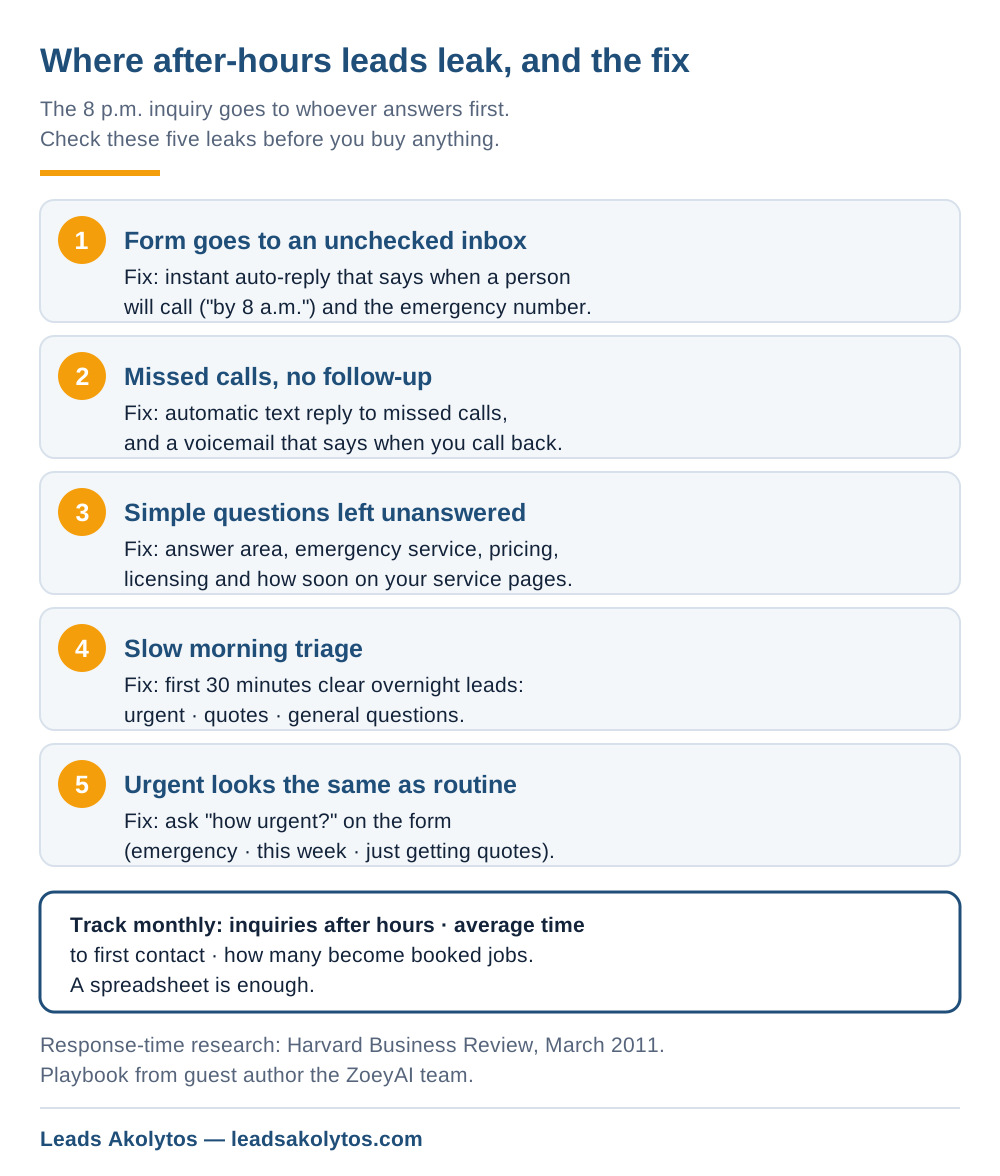
Before you fix anything, find where leads are being lost. For most contractors it is one of these five places.
- The contact form goes into a black hole. The form sends an email to an inbox nobody checks after 5 p.m., or worse, to an old address someone set up years ago. The homeowner gets no confirmation and assumes the business is closed or slow.
- Missed calls with no follow-up. The phone rings at 8 p.m., goes to a generic voicemail, and the caller hangs up without leaving a message. There is no record of the call beyond a number in the call log.
- No answer to the simple questions. Many evening visitors aren't ready to book. They want to know whether you serve their town, whether you take emergency calls, roughly what a service call costs, or whether you work on their brand of system. If your website doesn't answer those questions, they move on to a site that does.
- Slow morning triage. Even when the inquiry is received, it often sits until the owner or office manager works through email mid-morning. By then the homeowner may have called three other businesses.
- No way to tell urgent from routine. A burst pipe and a request for a quote on new recessed lights land in the same inbox in the same format. Without a quick way to separate them, the urgent job doesn't get the urgent response.
To put a dollar figure on the missed-call leak, the free missed call calculator runs the math on your own call volume and average job value.
A Practical After-Hours Playbook
None of these fixes requires a big budget. Pick the ones that fit how your business runs.
Make sure every inquiry gets an instant acknowledgement
The simplest fix is an automatic reply to every form submission. It should confirm the inquiry was received, say when a person will respond (for example, "we'll call you by 8 a.m."), and give the emergency number if you offer after-hours service. This doesn't win the job by itself, but it stops the homeowner assuming you never got the message.
Do the same for text messages if you advertise a mobile number. Many phone plans and business phone systems can send an automatic text reply to missed calls.
Put the answers to common questions on the page
Look at the last few months of inquiries and list the questions that come up again and again. Typical ones for trades:
- Which towns or ZIP codes do you cover?
- Do you take after-hours or weekend calls, and is there an extra fee?
- How does your pricing work (service call fee, hourly rate, flat-rate quotes)?
- Are you licensed and insured?
- How soon can you come out?
Answer each one clearly on your service pages and in an FAQ section. A homeowner who gets a straight answer at 8 p.m. is far more likely to leave their details than one who has to guess.
Ask the right questions up front
A good after-hours form or chat captures enough to triage the lead without a phone call. For most trades that means:
- Name and best phone number
- Town or ZIP code
- Type of job
- How urgent it is (emergency, this week, just getting quotes)
- A photo, if relevant
The urgency question is the one most contractors skip, and it is the one that lets you call the burst pipe first thing (or that night) and schedule the deck quote for later.
Decide what "after hours" actually means for your business
Be honest about what you can deliver. If you offer emergency service, say so clearly and route those inquiries to a phone that someone answers. If you don't, say that too, and tell people exactly when they'll hear back. A clear "we'll call you before 8 a.m." beats a vague "we'll be in touch" every time. If you're weighing a live answering service for nights, answering service or answer it yourself compares the cost with the jobs you're losing.
Consider website chat, with clear limits
Website chat tools have become a common way to cover the evening gap. A chat widget can answer the routine questions above from your own website content and collect the lead details, then pass the conversation to you in the morning, or immediately if it is urgent.
If you go down this path, a few rules keep it useful rather than annoying:
- Keep the answers grounded in your actual services, areas and pricing policy. It should never make up a price or promise a time you can't meet.
- Make it obvious how to reach a person, and hand the conversation over when the customer asks for one or the question is outside what the tool knows.
- Send every captured lead to a place you actually check, with the urgency flag at the top.
- Read through the conversations each week to spot questions it couldn't answer, then add those answers to your site.
Chat is a supplement, not a replacement for picking up the phone. Its job is to keep the homeowner engaged and give you the details you need to call back quickly. For a deeper look at testing whether an AI chatbot's answers are accurate before you trust it with customers, Fleurant AI's guide on how to evaluate AI chatbot accuracy walks through building a simple test set.
Build a morning routine for overnight leads
The first 30 minutes of the working day should be about clearing overnight inquiries in priority order: urgent jobs first, then anyone who asked for a quote, then general questions. If you have office staff, make this their first task. If it's just you, do it before you head to the first job.
Measure it
Pick one or two numbers and track them monthly:
- How many inquiries arrive outside business hours
- How long it takes, on average, to make first contact with them
- How many of them turn into booked jobs
You don't need fancy software for this. A spreadsheet with the time each inquiry came in and the time you first contacted them is enough to show whether your fixes are working. Once the lead is caught, the next leak is the estimate itself: see why contractors lose leads between the call and the estimate.
Questions to Ask Before You Buy Any After-Hours Tool
If you're comparing answering services, call-handling apps or chat tools, these questions separate the useful ones from the noise:
- Where do the leads go, and how quickly do I get notified?
- Can it tell an emergency from a routine inquiry?
- Can I see and edit what it says to customers?
- What happens when it doesn't know the answer?
- What does it cost per month, and are there per-lead or per-minute charges?
- Can I cancel easily if it isn't working?
For AI phone tools specifically, how to vet an AI receptionist has a test-call script to run during the free trial.
The Bottom Line on After-Hours Leads
After-hours leads are not a lost cause. They are often homeowners with a real problem who are ready to book whoever responds first. The contractors who win those jobs aren't necessarily working longer hours. They've made sure every evening inquiry is acknowledged right away, the common questions are answered on the website, urgent jobs are flagged, and someone works through overnight leads first thing in the morning.
Start with the instant acknowledgement and the FAQ answers. They cost almost nothing, and they fix the two biggest leaks for most trades.
Frequently Asked Questions
How fast should a contractor respond to a web lead?
As fast as you can, and within the hour where possible. In the HBR study of 1.25 million sales leads, firms that tried to contact a lead within an hour were nearly seven times as likely to qualify it as firms that waited an hour longer, and more than 60 times as likely as firms that waited 24 hours or more. The data is old and not trade-specific, but the direction matches what contractors see.
What should an after-hours auto-reply say?
Three things: that the inquiry was received, when a person will call back (a specific time, such as "by 8 a.m."), and your emergency number if you offer after-hours service. Send it by text as well as email when the lead left a mobile number.
Do I need to answer the phone 24 hours a day?
Only if you offer emergency service. If you do, route those calls to a phone someone answers. If you don't, say so on your website and in your voicemail, and tell callers exactly when they'll hear back.
Is website chat worth it for a contractor?
It can be, as long as it only answers from your real services, areas and pricing policy, hands off to a person when asked, and sends every lead to a place you check with the urgency flagged. It supplements answering the phone; it doesn't replace it.
How do I know if my after-hours fixes are working?
Track three numbers each month: how many inquiries arrive outside business hours, the average time to first contact, and how many become booked jobs. A simple spreadsheet is enough.
The Harvard Business Review figures in this article were checked by Leads Akolytos on November 11, 2026, against the HBR article page (authors and affiliations) and the study's own wording as quoted in SmartCompany's July 4, 2011 report. The full HBR article is behind a paywall.
Slow season and thinking about switching the ads off? Read what Google says about pausing Local Services Ads first.
Want a Second Look?
If you'd rather go over how your evening calls and forms get handled with someone, Leads Akolytos offers a free 30-minute strategy call. We work only with home service contractors, with no setup fees and no long-term contracts. You can book a time here.
If you'd like one practical idea like this in your inbox each month, get The Leads Akolytos Monthly: one email a month, unsubscribe any time.
About the Author
The ZoeyAI team builds AI website chat for small businesses, including trades and home service contractors, that answers customer questions and captures inquiries after hours. Learn more at ZoeyAI.
Want this handled for you?
We do this work for home service contractors every day, month-to-month, with no contracts. Book a free 30-minute call and we'll show you where you stand on Google.
Book my free call