You miss calls when you are under a sink, on a roof or driving between jobs, and every one that goes to voicemail is a customer who may already be dialing the next company on the list. The question is not whether missed calls cost you money. It is whether an answering service costs less than the jobs you are losing, and since October 1, 2026, Google Local Services Ads can bill you for some calls you never picked up.
The Short Answer
An answering service for contractors is worth it when the booked jobs it saves are worth more than its monthly bill. Count your missed calls for two weeks, estimate how many were real jobs, multiply by your gross profit per job, and compare that with the price. Live services bill by the minute or by the call: Ruby lists $250 a month for 50 minutes and Smith.ai lists $300 a month for 30 calls (both checked on their pricing pages on October 31, 2026). If you run Google Local Services Ads, the math tightens: a missed call during your business hours is now billed as a lead if the caller stays on the line more than 20 seconds, and a call that hits voicemail counts as connected. Cheaper fixes exist too: a ring group to a second phone, a faster callback routine, or the AI receptionist add-on in your FSM software.
What a Missed Call Costs a Contractor
A missed call costs you the gross profit of the job it would have become, not the ticket price. That is the number to use, because it is what actually lands in your account after labor and parts.
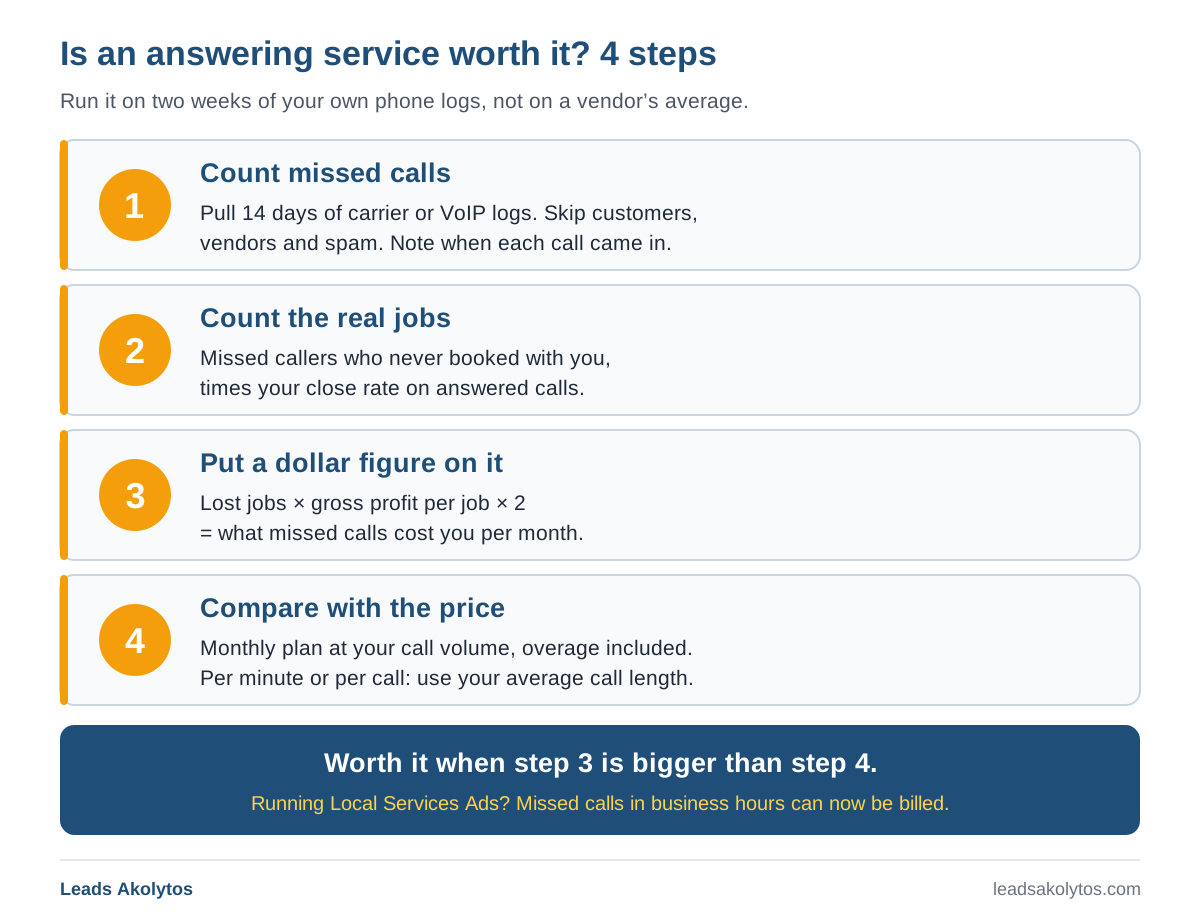
Most owners guess at missed calls. Do not guess. Your phone carrier or VoIP system logs every inbound call, answered or not. Pull two normal weeks and sort them:
- Count every missed call from a number that is not already a customer, a vendor or spam.
- Note the time of each one: during jobs, at lunch, after hours or on weekends.
- Check how many of those callers you reached on a callback, and how many booked.
- Multiply the ones you lost by your close rate on answered calls and your gross profit per job.
The missed call calculator does this math in three questions. If the result is a few hundred dollars a month, a cheap fix is enough. If it is several thousand, paying for coverage is easy to justify.
Timing matters as much as volume. Emergency trades (plumbing, HVAC, electrical, garage doors) lose the most, because the caller with water on the floor or no heat calls the next number within minutes. A painter or remodeler who calls back the same afternoon loses far fewer.
The Local Services Ads Rule That Changed the Math
If you run Google Local Services Ads, an unanswered call can now cost you a lead charge. Google emailed advertisers in August 2026 that the change took effect October 1, 2026, and its How leads work help page now spells out the rules:
- Missed calls: a call you miss during your business hours is charged if the customer stays on the line more than 20 seconds.
- Voicemail and greetings: during business hours, a call that reaches voicemail or an automated greeting is treated as connected, and is charged past 20 seconds whether or not the caller leaves a message.
- Phone menus: if callers must press a key, the 20-second clock starts after the key press, and callers who hang up before pressing anything are not charged.
- Hours: business hours are the ones on your Google Business Profile. If your ad schedule differs, unanswered calls are charged only inside both.
- Repeat callers: a customer who calls again within 15 days of a charged lead is not charged a second time.
So for an LSA advertiser, a voicemail during business hours is no longer free. You pay for the lead and then race the competition to call back. Three actions follow:
- Set your Business Profile hours to the hours someone can really answer.
- Match your LSA ad schedule to those hours.
- Cover the phone during those hours, by a person, a ring group or a service.
Google is also moving Local Services Ads into Google Ads; our post on what the LSA move to Google Ads means covers what changes there.
Your Four Options, From Cheapest Up
There are four ways to cover the phone, and the right one depends on how many calls you miss and when.
Option 1: route the calls yourself
The cheapest fix is often call routing you already pay for. Most business phone systems can ring two or three phones at once or in order, so the office, the owner and a lead tech all get the call. Pair it with a rule: every missed call gets a callback within 15 minutes, and a text if the callback is not answered. Cost: close to zero. Limit: it still fails when everyone is on a job.
Option 2: hire a customer service rep
A full-time CSR answers, books and knows your business, but costs the most. The BLS Occupational Outlook Handbook puts the median receptionist wage at $18.27 an hour (May 2025). Benefits add more: in the BLS Employer Costs for Employee Compensation release for June 2026, benefits were 30.0% of total compensation for private industry workers. At that share, an $18.27 wage works out to roughly $26 an hour all-in, or about $4,500 a month for full-time hours. It pays when call volume fills the day, and the same person can also chase estimates and confirm appointments. It does not cover nights.
Option 3: a live answering service
A live answering service puts a trained person on the line for a monthly fee, billed by minute or by call. Two published examples, checked on October 31, 2026:
- Ruby: $250 a month for 50 minutes, $395 for 100, $720 for 200, $1,725 for 500. That is $3.45 to $5.00 per minute, depending on the plan.
- Smith.ai live receptionists: $300 a month for 30 calls ($11.50 per extra call), $810 for 90 calls, $2,100 for 300 calls. Smith.ai says it does not bill spam or sales calls if your line passes caller ID.
Per-minute plans favor short calls; per-call plans favor long ones. A plumber whose calls run 3 minutes and a remodeler whose calls run 10 get very different bills from the same plan, so price it on your own average call length from your phone logs.
Option 4: an AI receptionist
AI receptionists answer every call at once, around the clock, and many can book into your schedule. Jobber, Housecall Pro and ServiceTitan each sell an AI answering add-on, and standalone AI services exist too. Prices and included usage change often and differ between pages, so check the price inside your own account before you compare. Test it yourself before customers hear it: call it as a panicked homeowner, ask about price, and ask for a person. If it cannot hand an emergency to a human fast, keep it for overflow and after-hours only.
The Break-Even Check, on Your Numbers
The break-even rule is one line: monthly cost divided by gross profit per job equals the number of extra booked jobs the service must save each month.
- Take the monthly price at your real call volume, including overage.
- Divide by your gross profit on an average job.
- Compare with the jobs you lost in your two-week count, doubled for a month.
Here is an example with made-up inputs to show the arithmetic. If your gross profit on an average service call is $250 and a plan costs $300 a month, the service must save 1.2 jobs a month. If your log shows six lost jobs in two weeks, it pays easily. If it shows one lost job a month, it does not, and a ring group plus a callback rule is the better buy. The same math works for comparing your cost per lead from ads, covered in our real cost per lead breakdown: a lead you paid for and then missed costs the full ad price with no job.
What to Check Before You Sign
Most answering service problems show up in the details of the contract, not the demo. Ask every vendor these:
- Do you bill per minute or per call, and how do you round?
- Are spam, wrong numbers and hang-ups billed?
- Can agents book straight into my FSM software, or only take messages?
- How do you handle an emergency: who do you call, and what if the tech does not answer?
- Can you answer in Spanish?
- Is there a contract term, setup fee or holiday surcharge?
- Do I keep my business number? (Use call forwarding, never port your main number to a vendor.)
Keep your own number on your Google Business Profile and your website. Your name, address and phone should match everywhere, and a vendor's number in those spots can cost you the line if you ever leave.
How to Know It Is Working
Judge any answering setup by booked jobs, not answered calls. Before you switch, record your baseline from the phone logs: calls, missed calls, callbacks and bookings. Thirty days after, pull the same numbers. Call tracking makes this much easier because it shows which source each call came from; our guide to call tracking for contractors explains the setup. If calls are low to begin with, an answering service is not the fix; start with why you are not getting calls from Google.
Frequently Asked Questions
How much does an answering service cost for a contractor?
Live services typically run a few hundred dollars a month and up. On October 31, 2026, Ruby listed $250 for 50 minutes and Smith.ai listed $300 for 30 calls. Your real cost depends on call volume and average call length, so price it on two weeks of your own phone logs.
Does Google charge for missed calls on Local Services Ads?
Yes, since October 1, 2026. A call missed during your business hours is charged if the caller stays on the line more than 20 seconds, and a call that reaches voicemail or a greeting during business hours counts as connected. Calls outside your business hours or ad schedule are not charged as missed calls.
Is an AI receptionist good enough for a plumbing or HVAC company?
It can be for booking routine work and covering overflow. Emergencies are the risk: test it with a mock emergency call and make sure it reaches a human fast. Many owners use AI after hours and people during the day.
Should I just let calls go to voicemail and call back?
Only if your callers wait. Emergency callers usually do not, and if you run Local Services Ads, a voicemail during business hours can now be billed as a lead. A ring group and a 15-minute callback rule beat plain voicemail at almost no cost.
Will an answering service hurt my Google rankings?
Not if you keep your own number. Use call forwarding so your Business Profile, website and directory listings all show the same business number. Never list the vendor's number as your main line.
Want a Second Opinion?
You can run every step above on your own this week. If you would rather go through your call logs and ad spend with someone, Leads Akolytos offers a free 30-minute strategy call. We work only with home service contractors across 14 trades, with no setup fees and no long-term contracts. See our plumbing and HVAC pages, or book a time here.
Want this handled for you?
We do this work for home service contractors every day, month-to-month, with no contracts. Book a free 30-minute call and we'll show you where you stand on Google.
Book my free call