Choosing between pay-per-lead vs SEO for contractors is one of the most consequential marketing decisions a contracting business makes. If you run ads on HomeAdvisor, Angi, Thumbtack, or a similar pay-per-lead marketplace, you already know the math: you pay for every lead whether it turns into a job or not, and you keep paying it in month twelve exactly like you did in month one.
SEO works differently — the upfront cost is real, but the lead you rank for today keeps arriving next month without a new invoice. So which one actually costs less per job, not per lead?
The Short Answer
Pay-per-lead services are usually cheaper in the first 1-3 months because there’s no ramp-up period — you buy a lead, you get a lead.
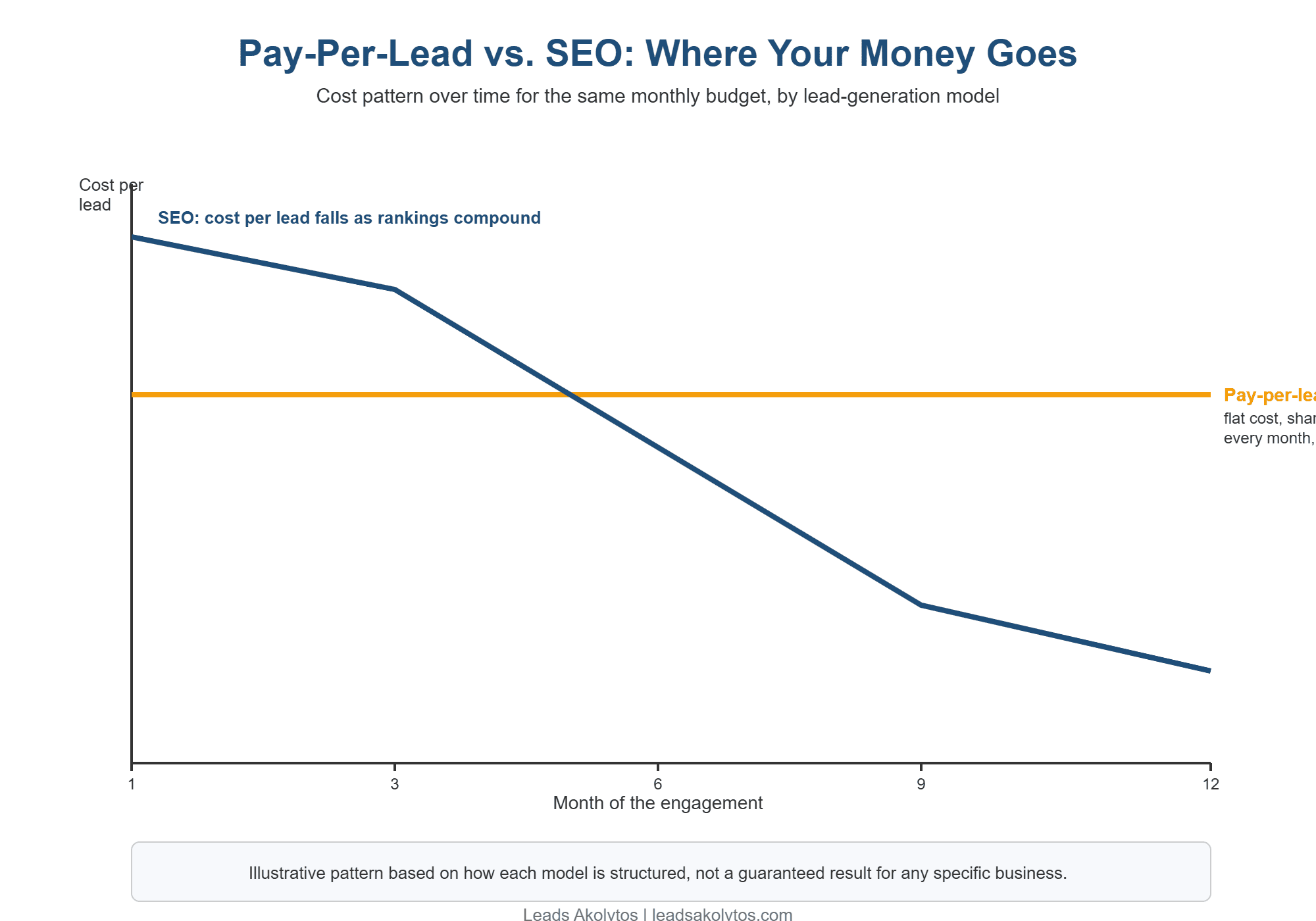
But because pay-per-lead pricing never drops and the leads are frequently shared with 3-4 other contractors bidding for the same job, the true cost per closed job often ends up higher than SEO within 6-12 months, once SEO’s lower close rate advantage and falling cost curve are accounted for. The crossover point depends on your trade, your close rate on shared leads, and how competitive your market is — but for most contractors who stay with SEO past month six, SEO wins on cost per job from that point forward.
How Each Model Actually Charges You
Pay-per-lead marketplaces charge a fixed or auction-based price per lead — typically $15 to $95 for home service categories depending on the trade and region, according to pricing ranges HomeAdvisor and Angi publish for contractors. That price does not change based on whether the lead answers the phone, whether they hire you, or whether they hire the three other contractors who bought the same lead.
The FTC’s 2023 settlement with HomeAdvisor specifically cited the company for selling leads that were shared, stale, or outside a contractor’s stated service area — a pattern many contractors describe anecdotally but that is now a matter of public regulatory record.
SEO charges you differently: an agency fee or in-house cost that stays roughly flat month to month, in exchange for organic rankings that, once established, keep generating leads without an additional per-lead charge. The tradeoff is time — Google’s own SEO documentation and most agencies set expectations around a 4-to-12-month ramp before rankings produce a steady lead flow, depending on how competitive your market and keywords are.
A Real Cost-Per-Job Comparison
Cost per lead is the wrong number to compare, because the two models produce leads of very different quality. A shared pay-per-lead prospect who is already talking to three competitors closes at a meaningfully lower rate than someone who found you organically and clicked your listing specifically. To compare fairly, you have to look at cost per closed job, which depends on three inputs: cost per lead, your close rate on that lead type, and how many leads you need per month.
A rough industry-observed pattern: shared pay-per-lead prospects close at roughly 10-20%, since you’re competing head-to-head with whoever calls back first or bids lowest. Organic SEO leads, who searched for your specific service and clicked your result over the paid ads above it, tend to close at a noticeably higher rate because there’s no active bidding war happening on the other end of the phone.
A pay-per-lead cost of $50 with a 15% close rate works out to roughly $333 in lead spend per closed job — and that number never improves, because the price per lead doesn’t drop as you buy more. An SEO program that costs a flat monthly fee and produces a steadily growing number of organic leads has a cost-per-job figure that keeps falling every month rankings hold, because the marginal cost of an additional organic lead is close to zero.
Where Pay-Per-Lead Still Wins
Pay-per-lead isn’t a bad model in every case. It makes sense when you need leads immediately — a slow month, a new service area with zero organic presence yet, or a seasonal spike you can’t wait 4-6 months for SEO to catch.
It also requires no content, no website work, and almost no setup time, which matters if you don’t have the bandwidth to manage an SEO project right now. Many contractors run both at once: pay-per-lead for the immediate gap, SEO building in the background to reduce dependence on it over time. If paid channels are more your speed right now, our side-by-side comparison of PPC vs. SEO for contractors breaks down that specific tradeoff in more depth.
Pay-Per-Lead vs SEO for Contractors: The Hidden Cost of Shared Leads
The part of pay-per-lead pricing that rarely gets mentioned upfront is exclusivity, or the lack of it. Most marketplace leads are sold to 3-4 contractors simultaneously by default — exclusive leads exist but cost significantly more per lead.
That means your real close rate isn’t just about your pitch, it’s about who calls back fastest. Contractors who’ve switched away from pay-per-lead models often cite this as the specific breaking point: paying full price for a lead, then losing the job to a competitor who simply answered the phone first.
How to Decide for Your Business
Run the numbers on your own trade before deciding which side of the pay-per-lead vs SEO for contractors question fits your business.
Multiply your average pay-per-lead cost by your actual close rate on those leads (track it for a month if you don’t already know it) to get your real cost per job. Compare that to what an SEO program would cost monthly, divided by a conservative estimate of organic leads it could produce by month six in your market.
If your pay-per-lead cost per job is already above what a contractor SEO company typically charges monthly, and you can tolerate a few months of ramp-up, SEO is very likely the better long-term move. If you need leads inside the next two weeks and have zero organic presence, pay-per-lead is the more realistic short-term fix.
Worth also weighing against a similar pay-for-performance option: see our Google Local Services Ads vs. SEO comparison if exclusive, verified leads matter more to you than marketplace volume.
A Third Option: Exclusive, Managed Lead Generation
For contractors still weighing pay-per-lead vs SEO for contractors, there’s a middle path between marketplace pay-per-lead and pure organic SEO: designated lead generation run by an agency on your behalf, where leads are generated specifically for your business (not sold to competitors simultaneously) through a combination of targeted campaigns and conversion-focused pages.
It costs more upfront than a bare-bones marketplace subscription, but it removes the shared-lead bidding war entirely, since the leads are never sold to anyone else. Before you sign with any exclusive lead generation provider, though, vet the company with six honest questions first — exclusivity claims are only as good as the contract behind them.
For contractors who’ve been burned by shared leads but still need faster results than organic SEO alone provides, this is often the practical middle ground while SEO rankings build in the background.
The pay-per-lead vs SEO for contractors debate ultimately comes down to your timeline and risk tolerance, not a universal right answer. Whichever direction makes sense for your business, the decision shouldn’t be made on cost-per-lead alone — run your own cost-per-job numbers first (HVAC contractors moving off pay-per-lead platforms can see a worked version of this in how to build an owned HVAC lead engine). If you want a second set of eyes on that math for your specific trade and market, a free strategy call is a fast way to get a realistic estimate instead of guessing.
Frequently Asked Questions
Is pay-per-lead or SEO cheaper for contractors?
When comparing pay-per-lead vs SEO for contractors, pay-per-lead is usually cheaper in the first 1-3 months since there’s no ramp-up time. SEO tends to become cheaper per closed job after roughly 6-12 months, because organic leads convert at a higher rate and the marginal cost of each additional lead is close to zero once you rank.
Are HomeAdvisor and Angi leads exclusive to me?
Usually not by default. Most marketplace leads are sold to 3-4 contractors at the same time unless you specifically pay for an exclusive-lead tier, which costs significantly more per lead.
Can I run pay-per-lead and SEO at the same time?
Yes, and many contractors do. Pay-per-lead covers immediate gaps in lead flow while SEO builds in the background, then gets scaled back once organic rankings are producing enough leads on their own.
How long does it take for SEO to beat pay-per-lead on cost per job?
It varies by trade and market competitiveness, but most contractors who track the numbers see SEO’s cost-per-job cross below their pay-per-lead cost-per-job somewhere between month 6 and month 12.
What’s the real cost of a ‘cheap’ shared lead?
A low per-lead price can be misleading if the close rate is also low.
A $25 lead that closes at 8% costs roughly $312 per job — often more expensive than a $50 lead that closes at 20% ($250 per job). Always compare cost per closed job, not cost per lead.
A Worked Example
Take a mid-size HVAC contractor spending $2,000 a month on a pay-per-lead platform at an average $60 per lead, receiving about 33 leads a month, closing 18% of them — roughly 6 jobs.
That’s about $333 per closed job, every month, with no improvement over time.
The same $2,000 a month put into SEO might produce very few organic leads in month one, ramping to 15-20 organic leads a month by month eight as rankings mature, closing at a higher rate (organic searchers already decided they want a quote from a real business, not a bidding war) of around 30%. By month eight, that’s 5-6 closed jobs from the same budget, but the number keeps growing in month nine, ten, and eleven without the cost increasing — something the pay-per-lead model structurally cannot do, because its cost per lead is fixed by the platform, not by your own rankings.
Questions to Ask Before You Switch
Before moving your budget from one model to the other, get real answers to these: What is your actual close rate on marketplace leads over the last 90 days, not your guess? How many of those leads were shared with competitors, and did you lose any specifically because someone else called back first?
If you switched to SEO, could your business tolerate a 4-6 month ramp period with a lead volume dip before rankings mature? And is your market competitive enough that ranking organically would take meaningfully longer than the industry-typical range? Honest answers to these four questions will tell you more than any generic cost comparison, including this one.
How to Decide Between Pay-Per-Lead and SEO for Your Business
When you’re comparing pay-per-lead vs. SEO for contractors, the honest answer usually depends on your cash flow and your patience for a ramp-up period. Pay-per-lead vendors can deliver volume almost immediately, but every job you book comes with a per-lead fee baked in permanently — there’s no compounding return.
SEO for contractors works the opposite way: slower in month one, but the leads you rank for keep arriving without a per-lead toll once you’re established. If you have 60-90 days of runway and want to stop paying a fee on every job indefinitely, weigh pay-per-lead against SEO on a 12-month cost basis, not a first-month one, before you commit budget to either channel.
Bottom line: when you run the pay-per-lead vs. SEO for contractors math side by side over a full year, most contractors find pay-per-lead cheaper for the first few months and SEO cheaper for every month after that. Choose based on which timeline actually matches your business right now.
Tracking the Real Numbers: Pay-Per-Lead vs. SEO for Contractors Over Time
Pay-per-lead vs.
SEO for contractors is not a one-time decision — it’s a comparison you should re-run every quarter using your own actual numbers, not industry averages. Track cost per lead, close rate, and cost per booked job separately for each channel, since the pay-per-lead vs. SEO for contractors math changes as your SEO rankings mature and your paid-lead costs fluctuate with competition.
Most contractors find that pay-per-lead vs. SEO for contractors favors paid leads in month one (faster volume, no ramp-up) and shifts toward SEO by month six to nine, once organic rankings stabilize and the marginal cost per organic lead drops toward zero. Re-running the pay-per-lead vs. SEO for contractors comparison quarterly catches that shift instead of locking in a decision made on day-one assumptions.
A Simple Test for Pay-Per-Lead vs. SEO for Contractors
If you only have budget for one channel right now, use this test: can you tolerate 3-6 months without new leads while SEO ramps up? If not, the pay-per-lead vs. SEO for contractors decision leans toward pay-per-lead first, with SEO layered in once cash flow allows.
If you can absorb the ramp-up period, the pay-per-lead vs. SEO for contractors math usually favors starting SEO earlier, since the compounding cost advantage grows every month you wait.
If neither pure pay-per-lead nor DIY SEO feels right, there is a middle path worth knowing about — see our breakdown of designated lead generation for contractors and why exclusive leads often out-convert shared ones.
Want this handled for you?
We do this work for home service contractors every day, month-to-month, with no contracts. Book a free 30-minute call and we'll show you where you stand on Google.
Book my free call