Designated lead generation for contractors means every lead that comes in is yours and yours alone — no competing bids, no racing three other contractors to be first on the phone. If you’ve ever gotten a “hot lead” only to find out the homeowner already booked someone else who called first, you already know why exclusivity matters.
What’s the Difference Between Designated and Shared Leads?
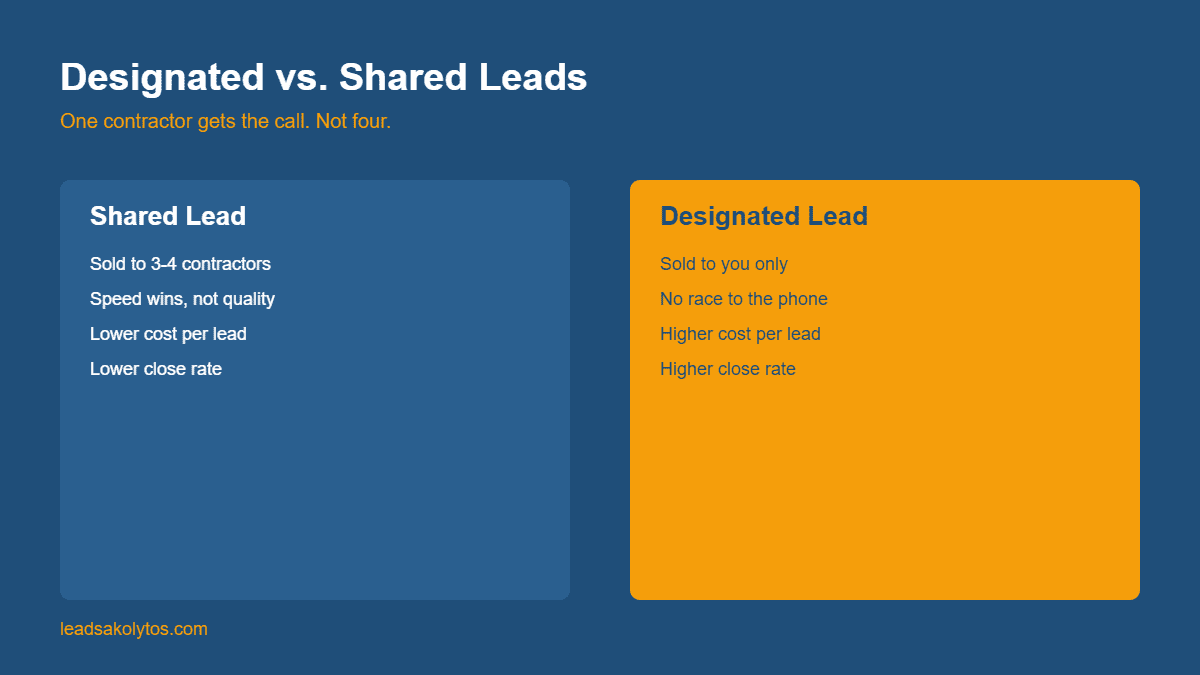
A designated (exclusive) lead is sold or delivered to one contractor only, giving you the full window to follow up without racing competitors. A shared lead is sold to multiple contractors at once — often 3-4 — which means speed-to-call, not quality of service, decides who wins the job.
That single difference changes almost everything about how a lead-generation program should be run for a home-service business. The FTC’s guidance on telemarketing and sales practices is worth a skim if you’re evaluating any lead-generation vendor’s claims, exclusive or shared.
7 Reasons Designated Leads Win for Contractors
1. No race-to-the-phone pressure
With shared leads, the contractor who calls back in the first 5 minutes usually wins the job, regardless of who does better work. Designated leads remove that artificial time pressure entirely.
2. Higher close rates
Because you’re the only one calling, homeowners aren’t fielding four different sales pitches in the same afternoon. That alone tends to raise close rates compared to shared-lead marketplaces.
3. Better use of your team’s time
Chasing shared leads that convert at a low rate wastes estimator and sales time. Designated leads let your team focus follow-up effort where it’s much more likely to pay off.
4. Consistent, trackable cost per acquisition
When you know a lead is exclusively yours, you can actually measure cost per acquisition and cost per closed job accurately — shared-lead math gets murky fast once you’re splitting the pool with competitors you can’t see.
5. Brand control
You control the entire homeowner experience from first contact instead of being one of four voices competing for attention, which matters for referrals and reviews down the line.
6. Leads matched to your actual service area and capacity
A well-run designated program can be tuned to your real service radius and crew capacity instead of flooding you with leads outside your zone or beyond what your team can handle this month.
7. It pairs naturally with organic SEO growth
Designated leads work well as a bridge while your organic local SEO and Map Pack rankings build over months — exclusive leads keep the pipeline full now, and organic growth lowers your cost per lead over time. If you are also weighing Google’s own pay-per-lead program, see our comparison of Google Local Services Ads versus SEO for contractors.
Is Designated Lead Generation Worth the Higher Cost?
Designated lead generation for contractors typically costs more per lead than shared leads, and that’s the honest tradeoff. If your close rate on designated leads is meaningfully higher (and it usually is, because you’re not racing competitors), the cost per closed job can still come out lower even though the cost per lead is higher. The way to know for sure is to track both numbers for at least 60-90 days: cost per lead alone doesn’t tell the full story.
If you’re currently buying shared leads from a marketplace and getting frustrated with low close rates, designated lead generation built around your actual service area and capacity is worth testing against what you’re doing now.
For a broader look at how paid leads compare to organic growth over time, see our breakdown of pay-per-lead vs. SEO for contractors.
Curious whether designated lead generation fits your business? Book a free 30-minute strategy call and we’ll walk through your numbers honestly — no contracts, no pressure.
One more practical difference worth checking before you sign: how a designated lead generation contract handles a lead that turns out to be a bad match — wrong service area, wrong job type, or a bogus contact form submission. A vendor confident in their designated lead generation for contractors program will have a clear, written credit or replacement policy for genuinely invalid leads, spelled out before you pay, rather than a vague promise to “look into it” case by case. If a proposal is silent on this, ask directly; the answer tells you a lot about how the rest of the relationship will go.
Frequently Asked Questions
How much more do designated leads cost than shared leads?
It varies by trade and market, but exclusive leads commonly run noticeably higher per lead than shared leads. The comparison that matters is cost per closed job, not cost per lead alone.
Can I switch from shared to designated leads mid-contract?
Most lead-generation arrangements are month-to-month or allow adjustment at renewal. Check your current agreement’s terms, but exclusivity is usually something you can negotiate or switch into without a long lock-in.
Do designated leads guarantee I’ll close the job?
No. Exclusivity removes the competing-bid problem, but you still have to follow up quickly, quote fairly, and do good work to close the job — designated leads improve your odds, they don’t guarantee a sale.
Why Designated Lead Generation for Contractors Wins
Designated lead generation for contractors means every lead in your inbox is yours alone, not resold to three competitors bidding on the same job. Contractors who switch to designated lead generation consistently report higher close rates simply because they’re not racing four other callbacks.
What Designated Lead Generation for Contractors Actually Costs Versus Shared Leads
Designated lead generation for contractors almost always carries a higher price per lead than shared or resold lead sources, and that is by design, not a markup. When a lead is shared with 3-5 other contractors, the provider is being paid multiple times for the same homeowner’s information. Designated lead generation for contractors flips that math: one lead, one contractor, one shot at the job without racing three competitors to the phone first.
Do the simple arithmetic before deciding. If a shared lead costs $25 but converts at 8% because you’re competing with four other bids, your real cost per booked job is roughly $312. If designated lead generation for contractors costs more per lead but converts at a much higher rate because you’re the only bidder, your real cost per booked job can end up lower in practice, despite a higher price up front. For a deeper breakdown of this math across channels, see our full real cost per lead comparison of SEO versus paid ads.
Questions to Ask Before You Pay for Designated Lead Generation for Contractors
Not every provider that claims to offer designated lead generation for contractors is actually delivering exclusivity. Ask directly: is this lead sold to me and only me, in writing, with a specific guarantee? Some providers use “designated” loosely to mean “designated to your trade category,” which is not the same as designated lead generation for contractors in the true single-buyer sense.
Ask how the leads are generated in the first place. Designated lead generation for contractors sourced from a contractor’s own paid search or SEO campaigns tends to be higher intent than designated lead generation for contractors sourced from a lead-aggregator’s own generic ad campaigns, because the homeowner already associates the ad with a specific company rather than a directory.
Finally, ask what happens when a designated lead turns out to be a bad fit — wrong service area, wrong project size, or spam. Reputable designated lead generation for contractors programs offer a credit or replacement; providers that refuse to replace a single bad lead out of a batch are signaling how they will treat every dispute going forward.
Should You Handle This Yourself or Pay for Designated Lead Generation for Contractors?
Running your own paid campaigns to generate designated leads is possible, and for owners with the time to manage ad accounts, landing pages, and call tracking, it can be cheaper long-term than paying a specialist for designated lead generation for contractors. The honest tradeoff is time: expect 5-10 hours a month of ongoing management once campaigns are live, on top of the setup work.
Paying an outside company for designated lead generation for contractors makes the most sense when you want predictable volume without the ad-management overhead, and when you can verify the exclusivity terms in writing before you pay. Either path can work — what fails is paying premium designated-lead prices for leads that are not actually exclusive, which is worth periodically verifying once a contract is running rather than assuming it forever — see our 5-step audit for checking whether your exclusive leads are actually exclusive. Before you pay those premium designated-lead prices to any outside provider, run them through six honest vetting questions covering exclusivity, lead definitions, and true cost per lead, so the exclusivity claim is real before you sign anything. For real dollar figures instead of ranges, see our designated lead generation cost breakdown, including a worked cost-per-booked-job comparison against shared-lead marketplaces.
Want this handled for you?
We do this work for home service contractors every day, month-to-month, with no contracts. Book a free 30-minute call and we'll show you where you stand on Google.
Book my free call