The Short Answer
Local Services Ads vs SEO for contractors comes down to sequencing, not picking a winner: for most home service contractors, the right move isn’t choosing one over the other — it’s sequencing them correctly. Google Local Services Ads (LSA) get you leads in days because you only pay when a customer calls or messages you through the ad, and Google backs qualifying trades with the Google Guaranteed or Google Verified badge.
SEO takes months to build, but once it’s working it keeps sending calls without a per-lead charge, and it compounds instead of shutting off the moment you stop paying. If your pipeline is thin right now, start LSA immediately for cash flow, and run SEO in parallel so you’re not permanently dependent on a Google ad account you don’t control.
This isn’t a theoretical debate. It’s a budget decision contractors make every quarter, and getting it wrong either starves your pipeline this month or leaves you renting leads forever. Here’s how to think it through with real numbers.
What Google Local Services Ads Actually Are
Local Services Ads are Google’s pay-per-lead advertising product built specifically for local service businesses — electricians, plumbers, HVAC companies, roofers, cleaners, movers, garage door companies, and similar trades. Unlike standard Google Ads, which charge per click regardless of whether that click turns into a real inquiry, LSA charges you only when a potential customer directly contacts you through the ad — a phone call, a message, or a booking.
Qualifying businesses can earn Google’s verification badge, which requires passing a screening and verification process. (see our full breakdown of what Local Services Ads screening actually checks for the specifics) The short version of the Local Services Ads vs SEO for contractors decision here is that the screening step is a one-time gate, not an ongoing cost, so it should not be the deciding factor either way. According to Google’s own Local Services Help documentation, this process is risk-based and can include background checks on the business and its workers, license and insurance verification, and business registration checks.
Google notes the process is ongoing — “advertisers are regularly re-evaluated,” and failing a review can mean losing the badge or having ads suspended. Google has also consolidated its older Google Guaranteed and Google Screened badges into a single Google Verified badge, so if you set up LSA now, that’s the badge you’ll be working toward.
Once approved, your listing can appear at the very top of Google’s local search results — above organic listings, above the Local Pack map, and above standard paid ads — with your rating, review count, hours, and the verification badge visible before the searcher clicks anything.
What SEO Actually Delivers That LSA Doesn’t
SEO — ranking organically in Google Search and the Local Pack — works differently. You don’t pay Google per lead. You invest in your website, your Google Business Profile, your content, and your backlink profile, and over time Google rewards that work with visibility that isn’t rented. Miss a payment on LSA and your leads stop the same day. Stop actively promoting a well-built SEO foundation and your rankings typically hold for months, sometimes longer, because you own the asset — the website, the content, the reviews, the links — rather than renting a slot in an auction.
SEO also captures a wider range of searches. LSA is built around a narrow set of service categories and geographic radius targeting. Organic SEO can rank you for the long-tail, specific questions homeowners actually type — “why is my AC blowing warm air,” “emergency water heater replacement cost,” “licensed electrician panel upgrade near me” — questions that never show an LSA ad but drive real, qualified traffic when your content answers them well.
The Real Cost Comparison
Industry benchmarks vary by trade and market, but LSA leads commonly run in the range of $15 to $75 per lead depending on your category and competition, and that’s per lead — not per job booked. If your close rate on LSA leads is 30-40%, your real cost per booked job is several times the per-lead price.
SEO has a much different cost curve: higher upfront investment with no return for the first several months, then a cost-per-lead that keeps falling the longer the campaign runs, because the content and rankings you built in month three are still generating calls in month eighteen without additional ad spend.
We broke down these numbers trade-by-trade in our full cost-per-lead comparison of SEO vs. paid ads, which is worth reading in full if you’re building a marketing budget from scratch. The short version: paid channels like LSA win on speed, SEO wins on long-run cost efficiency, and most profitable contractor marketing budgets use both at different ratios depending on how urgently the business needs leads right now.
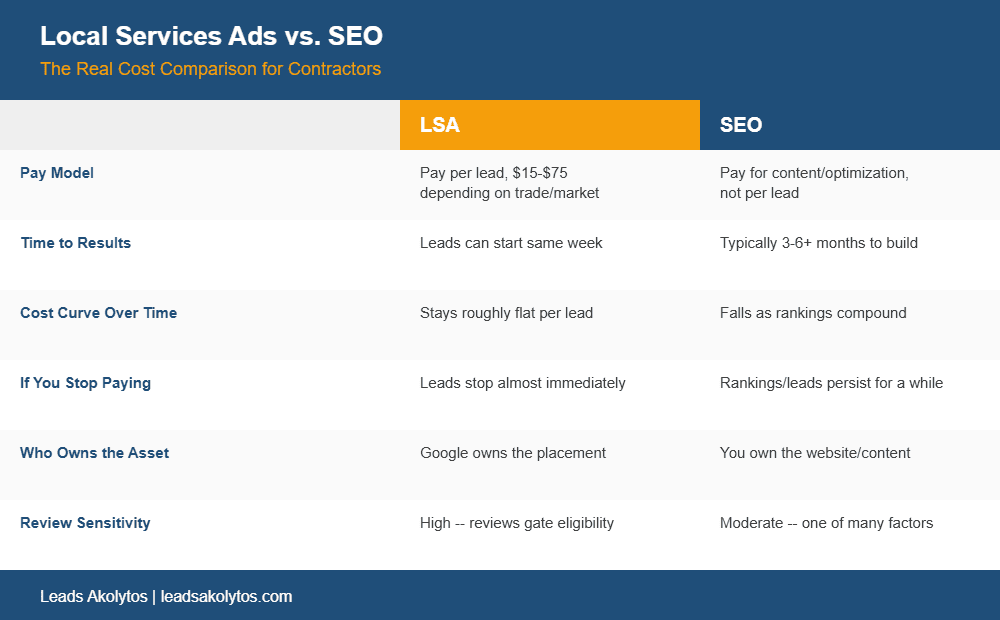
Use This Graphic
You’re welcome to republish this comparison on your own site or share it with other contractors, as long as you credit Leads Akolytos with a link back to this article. Embed code:
<a href="https://leadsakolytos.com/blog/local-services-ads-vs-seo-for-contractors/"><img src="https://leadsakolytos.com/blog/local-services-ads-vs-seo-for-contractors-comparison.png" alt="Local Services Ads vs SEO for contractors comparison" style="max-width:100%;"></a> Infographic by <a href="https://leadsakolytos.com/">Leads Akolytos</a>
When LSA Is the Right Call
- You need leads this week, not this quarter. New business, slow season, a crew you need to keep booked — LSA can start delivering calls almost immediately after approval.
- You have strong reviews already. LSA ranking is heavily influenced by review volume, rating, and responsiveness, so businesses with an established review base tend to perform well fast.
- You can answer calls quickly. Google’s own guidance emphasizes responsiveness — slow response times hurt your ranking inside the LSA platform itself.
When SEO Is the Right Call
- You’re playing the long game. If you plan to be in business in three years, an asset that compounds beats a lease you renew every month.
- You want to stop being fully dependent on one platform. Google can and does change LSA eligibility, pricing, and categories. A business built entirely on rented ad space has no insurance policy if that changes.
- Your margins can’t absorb per-lead costs forever. Once SEO is established, the marginal cost of the next lead trends toward zero compared to a paid channel.
Local Services Ads vs SEO for Contractors: Why Most Should Run Both
The businesses that grow steadiest rarely pick one lane. They run LSA (and sometimes Google Ads) to keep the crew busy in the short term while SEO content, on-page optimization, and backlinks build in the background. As the organic pipeline strengthens — usually somewhere in the 6-to-12-month range, which we cover in detail in how long SEO actually takes to work for a contractor business — many contractors dial back paid spend and let organic search carry a bigger share of the lead volume, freeing up budget for the trades or seasons where paid is still worth running.
The mistake to avoid is treating LSA as a permanent replacement for SEO because it’s faster, or ignoring LSA because SEO feels more “legitimate.” Both are tools. Used together with a clear-eyed budget, they cover each other’s weaknesses — LSA’s speed offsets SEO’s slow ramp-up, and SEO’s compounding value offsets LSA’s permanent per-lead cost.
A Simple Framework for Splitting Your Budget
Contractors we talk to often ask for a number, so here’s a starting framework rather than a hard rule. If your pipeline is genuinely empty and you need calls in the next two weeks, put 70-80% of your marketing budget into LSA and/or paid search for the first one to two months while SEO work begins in parallel. As organic visibility starts showing up — usually first in Google Business Profile and Local Pack results, then in broader organic rankings — you can shift the ratio, often landing somewhere close to even by month six, and tilting further toward SEO by month twelve as the compounding content and link-building investment starts carrying more of the lead volume on its own.
The exact split depends on your trade’s competitiveness, your market, and how aggressive your growth goals are, but the direction of travel — starting paid-heavy and shifting organic-heavy over time — holds true across most trades we work with, from electricians and HVAC companies to roofers and remodelers.
One more practical point worth flagging: LSA spend is easy to track against results, since every lead is logged in the platform with a call recording or message thread. SEO is harder to attribute cleanly, especially in the first few months, because a lead might discover you organically weeks before they actually call. Set up call tracking and keep a simple monthly log of lead source, even if it’s rough, so you’re comparing real numbers rather than guessing which channel is actually paying off.
If you’re an electrician specifically, also check our electrician SEO checklist before increasing spend on either channel.
How to Split a Fixed Budget Between LSAs and SEO
Most contractors are not choosing between Local Services Ads and SEO in the abstract. They have one marketing number and have to divide it. Here is a practical way to think about that split without pretending there is a universal right answer.
If you need work in the next 30 days, weight toward LSAs. Local Services Ads put you in front of homeowners now, and you pay per lead rather than per click. When the schedule is thin and payroll is not, that immediacy is worth more than a ranking you will hold next spring. Start there, and treat the spend as the cost of keeping crews busy while the slower asset gets built underneath you.
If your schedule is full but your margins are not, weight toward SEO. Every Local Services Ads lead carries a price that resets every month you keep running. Organic rankings, once earned, keep producing without a per-lead charge attached. Contractors who are busy and still not profitable are usually paying too much per lead, and that is a problem SEO solves slowly and durably rather than quickly and temporarily.
Do not let either channel run unattended. LSAs need disputed leads reported and service areas kept tight, or you pay for calls you were never going to win. SEO needs pages actually published, not just audited. The most expensive version of this decision is splitting the budget and then supervising neither half.
Revisit the split every quarter, using cost per booked job. Not cost per lead, and not rankings. Cost per booked job is the only number that accounts for lead quality, and it is the number that tells you honestly which channel deserves more of next quarter.
The straight answer to which comes first is that Local Services Ads buy you time and SEO buys you independence. Most contractors need both, in that order, and the mistake is not picking wrong so much as never revisiting the choice once the schedule changes.
If you would rather skip the screening timeline altogether and start getting exclusive, pre-qualified leads sooner, book a free strategy call to see whether a designated lead generation program is a faster fit for your business right now.
Frequently Asked Questions
Do I need a website to run Local Services Ads?
Not technically — LSA can run off your Google Business Profile and LSA listing alone. But a strong website still matters for credibility, for capturing the organic and referral traffic LSA doesn’t touch, and for supporting the SEO side of your marketing long-term.
How fast can I get approved for the Google Verified badge?
It varies by trade, location, and how quickly you supply license, insurance, and background check documentation. Some businesses are approved within days; others take a few weeks if additional verification steps are required.
Is LSA worth it if I already rank well organically?
Often yes, especially in competitive periods or seasons. Ranking organically doesn’t block you from also appearing in the LSA slot, so many well-optimized contractors still run LSA to capture additional top-of-page real estate.
What happens to my leads if I pause my LSA budget?
They stop. LSA is a pay-per-lead system with no residual visibility once you pause spend, which is the core argument for building SEO alongside it rather than relying on paid leads indefinitely.
Can bad reviews hurt my LSA performance?
Yes. Rating and review volume are factored into LSA ranking and consumer trust, so review management matters just as much for paid visibility as it does for organic and Google Business Profile performance.
Which should a brand-new contractor business start with?
Most new businesses benefit from starting LSA immediately for cash flow while investing in SEO from day one, since SEO’s payoff arrives months later — starting both early means the SEO foundation is already working by the time you want to scale down paid spend.
If you’re trying to figure out the right mix of paid and organic for your specific trade and market, book a free 30-minute strategy call and we’ll map it out together — no contracts, no pressure.
What is the quick answer on Local Services Ads vs SEO for contractors?
The quick answer to Local Services Ads vs SEO for contractors is that they solve different problems, so most established contractors eventually run both. Local Services Ads vs SEO for contractors isn’t really an either-or budget decision once a business generates enough revenue to support two channels — it becomes a question of which one gets funded first while the SEO foundation is still being built.
Does the Local Services Ads vs SEO for contractors decision change by trade?
Yes. The right answer to Local Services Ads vs SEO for contractors often depends on ticket size and urgency. Emergency trades like plumbing and HVAC tend to lean harder into Local Services Ads early because same-day intent searches convert well there, while remodelers and other high-consideration trades usually get more long-term value by weighting the Local Services Ads vs SEO for contractors split further toward SEO.
How much should a contractor budget for Local Services Ads vs SEO for contractors in year one?
A workable starting split for Local Services Ads vs SEO for contractors is roughly even in year one — enough Local Services Ads spend to keep the phone ringing while the SEO for contractors work builds toward organic rankings that eventually reduce reliance on paid clicks.
Can a small contractor skip one side of the Local Services Ads vs SEO for contractors question entirely?
It is possible, but risky. Skipping SEO for contractors and relying only on Local Services Ads means every lead stays tied to ongoing ad spend, while skipping Local Services Ads means waiting months for the first meaningful organic leads to arrive.
What is the one-sentence summary of Local Services Ads vs SEO for contractors?
If there is a single takeaway on Local Services Ads vs SEO for contractors, it is this: use Local Services Ads for speed and SEO for durability, and budget for both rather than treating the Local Services Ads vs SEO for contractors question as a permanent either-or choice.
Who wins the Local Services Ads vs SEO for contractors debate for a brand-new business with no reviews yet?
For a brand-new contractor business, Local Services Ads vs SEO for contractors tips slightly toward Local Services Ads first, since the Google Guarantee badge and pay-per-lead model can produce calls before a website has built up enough trust signals to rank. Once a handful of jobs are done and reviews start coming in, shifting more of the Local Services Ads vs SEO for contractors budget toward organic content usually pays off.
Does geography change the Local Services Ads vs SEO for contractors calculation?
It can. In smaller or less competitive metro areas, the Local Services Ads vs SEO for contractors math often favors SEO sooner, because fewer competitors are bidding on Local Services Ads and organic rankings are easier to earn. In large, crowded metros, Local Services Ads vs SEO for contractors decisions tend to lean more heavily on paid placement simply to get visible at all.
Plumbers in particular have some trade-specific angles worth layering on top of this comparison — see growing plumbing business SEO beyond word-of-mouth referrals.
If exclusivity matters more to you than channel type, it’s also worth comparing designated lead generation for contractors against both paid ads and SEO before committing budget.
Want this handled for you?
We do this work for home service contractors every day, month-to-month, with no contracts. Book a free 30-minute call and we'll show you where you stand on Google.
Book my free call