Exclusive leads are supposed to be sold to you and no one else. If you’re paying a premium for them, the fastest way to check whether your exclusive leads are actually exclusive is a 5-minute cross-check most contractors never run: on your very next lead, ask the caller directly whether they submitted the same request anywhere else, then compare that lead’s timestamp and contact details against your own CRM history. If your provider can’t explain, in writing, exactly how they prevent a lead from reaching a second contractor, or their contract is silent on resale, that’s the real answer — not whatever their sales rep tells you on the phone.
What “Designated” or “Exclusive” Is Actually Supposed to Mean
A designated or exclusive lead is supposed to be sold to exactly one contractor in a given service area for a given job request — the opposite of a shared-lead marketplace, where the same homeowner’s request gets sold to three, five, or sometimes more contractors who then compete to be the first to call back. The entire premium you pay for designated lead generation exists to buy you out of that race. If the lead isn’t actually exclusive, you’re paying exclusive-tier pricing for shared-tier competition, which is the single most common way this service quietly stops being worth it without anyone noticing for months.
Lead-generation bait-and-switch is not a hypothetical risk either — the FTC has documented and taken enforcement action against lead operations that collected contact information under one pretense and routed it somewhere else entirely, which is the same underlying failure mode a resold “exclusive” lead represents on a smaller scale.
The 5-Step Exclusivity Audit
You don’t need to take your provider’s word for it, and you don’t need special software to check. Run these five steps on your next 10-15 leads and you’ll know within two weeks whether “exclusive” is holding up in practice.
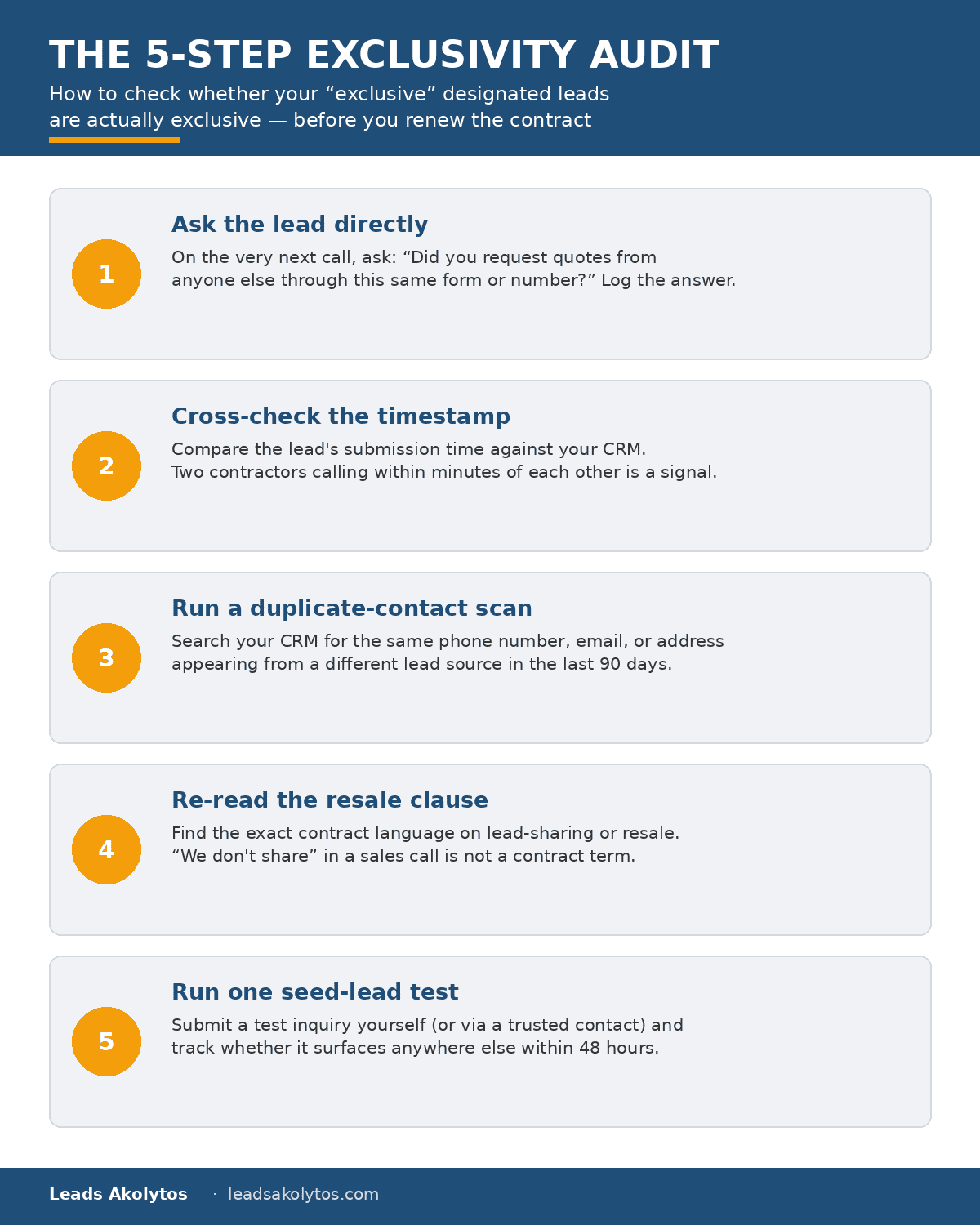
Use this graphic: You’re welcome to republish the 5-Step Exclusivity Audit graphic above on your own site or in a presentation, with attribution and a link back to this article. Embed code:<a href="https://leadsakolytos.com/blog/exclusive-leads-actually-exclusive/"><img src="https://leadsakolytos.com/blog/exclusivity-audit-checklist.png" alt="The 5-step exclusive leads audit checklist" /></a> via <a href="https://leadsakolytos.com/">Leads Akolytos</a>
1. Ask the lead directly
On the very next call, ask a version of: “Did you request quotes from anyone else through this same form or number?” Most homeowners will answer honestly, and this single question surfaces resale faster than any technical check. Log the answer every time for two weeks, not just when you’re suspicious — a pattern only shows up in aggregate.
2. Cross-check the timestamp
Compare the lead’s submission time in your provider’s dashboard against when you actually received it, and against when any competing contractor mentions being contacted (this comes up naturally in step 1). Multiple contractors calling the same homeowner within minutes of each other on a lead that was sold as exclusive is one of the clearest signals something is being resold. If you don’t already have call recording and timestamped attribution set up, Google’s own guide to phone call conversion tracking covers the basic setup that makes this step possible in the first place.
3. Run a duplicate-contact scan
Search your own CRM or spreadsheet for the same phone number, email address, or property address showing up from a different lead source within the last 90 days. A homeowner who submitted a form to your “exclusive” provider and also shows up in your Google Business Profile messages or a shared-lead platform you tried previously is worth a closer look at where that overlap is actually coming from.
4. Re-read the resale clause
Find the exact sentence in your contract that addresses lead-sharing or resale — not the sales pitch, the actual document. “We don’t share leads” said on a discovery call is not a contract term, and a contract that is simply silent on resale is not the same as a contract that prohibits it. If you can’t find explicit language either way, that’s a fair, specific question to put to your account manager in writing so you have a paper trail.
5. Run one seed-lead test
Submit a test inquiry yourself, or through a trusted contact who isn’t a competitor, using a phone number and email you control. Track whether that seed lead surfaces anywhere else — a call from an unrelated vendor, a follow-up from a different marketing company — within 48 hours. One test won’t prove a pattern, but a seed lead that leaks is a strong, concrete data point rather than a suspicion.
Red Flags That Suggest Resale, Even Before You Run the Audit
- The homeowner mentions “a few companies called.” Said unprompted, this is the single strongest signal — and it comes up more often than most contractors think to ask about.
- Suspiciously fast competitor callbacks. If homeowners consistently mention a competitor called within the hour, and that competitor doesn’t buy leads from the same channels you know about, ask where that lead actually originated.
- Your close rate on “exclusive” leads matches your old shared-lead close rate. Exclusive leads should close meaningfully better than shared ones, precisely because you’re not racing anyone. If the math looks the same as your shared-lead era, exclusivity may not be the actual difference happening.
- Vague or shifting answers about geographic or category exclusivity. “Designated” sometimes only means designated within a narrower category or radius than you assumed — get the exact boundary in writing, not a general assurance.
What to Do If You Find Out Your Leads Aren’t Exclusive
Bring the specific evidence — timestamps, the homeowner’s own words, the seed-lead result — to your account manager before assuming bad faith on your exclusive leads; a genuine platform bug or a subcontracted lead source your main provider didn’t disclose is possible and is a different conversation than deliberate resale.
Either way, ask for the fix in writing and a defined window to see it hold. If it doesn’t, switching lead generation companies without losing your pipeline is a manageable process when you plan the transition rather than cutting off cold, and evidence from this audit is exactly the leverage you’ll want if you end up negotiating an early exit from the contract.
How Exclusive Leads Vetting Is Different From Vetting a Provider Before You Sign
This audit assumes you already have a designated lead generation contract running and want to verify it’s holding up in practice. If you’re still choosing a provider, the questions are different — how to vet a lead generation company before you pay per lead covers what to ask before you sign anything, including exclusivity guarantees that sound clear in a sales call but turn out to have exceptions once you read the actual contract.
Frequently Asked Questions
How do I know if my leads are being resold?
Run the 5-step audit above for two weeks: ask homeowners directly whether they requested quotes elsewhere, cross-check timestamps and contact details in your own CRM, and submit one seed lead you control to see if it leaks. A pattern across several leads is far more reliable than a single suspicious call.
Is it normal for “exclusive” leads to still have some overlap?
Occasional overlap can happen innocently — a homeowner who submits your provider’s form and separately searches Google and finds a different contractor organically is not evidence of resale. The audit is designed to catch a pattern, not a single coincidence, which is why steps 1 through 3 are meant to be run across multiple leads rather than treated as a one-time check.
What should I do if my contract doesn’t mention lead resale at all?
Ask your provider in writing to confirm their resale policy and get the answer added as a contract amendment, not just a verbal assurance. A provider confident in their exclusivity claim will have no problem putting it in writing; hesitation to do so is itself useful information.
Does a higher price always mean more exclusive leads?
Not automatically — price tells you what you’re being charged, not what’s actually happening on the back end. The audit above is how you confirm the premium you’re paying for designated lead generation is buying real exclusivity rather than just a higher invoice for the same shared-lead dynamics.
Want a second set of eyes on a designated lead generation contract you’re evaluating, or help setting up call tracking that makes an exclusivity audit like this one easy to run every month? Schedule a free strategy call with Leads Akolytos.
Want this handled for you?
We do this work for home service contractors every day, month-to-month, with no contracts. Book a free 30-minute call and we'll show you where you stand on Google.
Book my free call