
The Short Answer
Knowing how to vet a lead generation company before you sign up matters: get straight answers to six questions: is every lead truly exclusive to you, how is a “lead” defined and what happens with bad ones, where do the leads actually come from, what’s the real cost per lead once every fee is counted, can you see live data instead of just a monthly recap, and what happens if you want to cancel. If a provider can’t answer all six clearly and in writing, that’s the answer you need before you pay a dollar.
Why Vetting a Lead Generation Company Is Different From Vetting Other Marketing Vendors
Hiring an SEO company or a PPC manager is a bet on a process. Hiring a lead generation company is a bet on a product — a stream of leads you’re often paying for whether or not they turn into jobs. That difference is exactly why lead generation has more room for vague promises and slippery definitions than almost any other marketing service a contractor buys.
A “lead” from one company means a homeowner who filled out a form with real contact info and a real project. A “lead” from another company can mean a call that rang for eleven seconds before hanging up, or a name resold to four other contractors in your trade at the same time. Both get called “a lead.” Only one of them is worth paying for.
This is the same reason the Federal Trade Commission has published specific guidance for businesses that generate and sell consumer leads, warning that lead sellers must be truthful about how leads are sourced and who else receives them (see the FTC’s business guidance on lead generation practices at ftc.gov/business-guidance). If regulators think lead sourcing and exclusivity are worth spelling out in writing, a contractor spending a few hundred to a few thousand dollars a month should ask for the same in writing before signing anything.
Once you have vetted a provider on these six questions, the next natural question is budget — see our breakdown of what designated lead generation actually costs for real pricing tiers and a cost-per-booked-job comparison against pay-per-lead platforms.
Question 1: Is Every Lead Truly Exclusive to You?
Exclusivity is the single biggest cost-versus-value lever in lead generation, and it’s the question most contractors forget to ask directly. Shared-lead marketplaces sell the same homeowner’s information to multiple contractors in the same trade and area — sometimes three, four, or more at once. You’re not just doing the job if you win it; you’re racing three other quotes to the same inbox, often before you’ve even called back.
A truly exclusive or “designated” lead program sends that homeowner’s information to one business only. This is the core of learning how to vet a lead generation company: ask directly, “Is this lead sold to me alone, or to other contractors at the same time?” A provider that hesitates, or answers with something like “it’s mostly exclusive” or “leads are prioritized to you,” is telling you it isn’t exclusive.
Get the exclusivity policy in writing, not just in a sales call.
Question 2: How Is a “Lead” Defined, and What Happens to Bad Ones?
Part of learning to vet a lead generation company is asking for the provider’s exact definition of a billable lead before you see a single invoice. Does a lead have to include a working phone number and a real service request, or does a form submission with a fake name still count? Does a call have to last a minimum number of seconds to be billable?
Then ask the harder follow-up: what’s the dispute process when a lead is fake, wildly out of your service area, or for a job you don’t do? A credible provider has a stated credit or refund policy for bad leads, in writing, with a clear window to file a dispute (typically a matter of days, not an open-ended “contact support”).
A provider with no defined dispute process is telling you that once you pay, you own every lead — good or worthless — with no recourse.
Question 3: Where Do the Leads Actually Come From?
There’s a real difference between a lead that came from a homeowner actively searching Google for your exact service in your exact city, and a lead that came from a broad ad network, a co-registration form, or a third-party lead aggregator the provider itself doesn’t fully control.
Search-driven leads — someone typing “emergency plumber near me” or “electrician [city]” and calling or filling out a form from the results — tend to convert better because the homeowner is already in a buying decision when they reach out. Google’s own guidance on how it evaluates local business listings (see Google’s Business Profile help center at support.google.com/business) makes clear that Map Pack visibility, which drives a large share of search-based local leads, depends on an accurate, actively managed listing — not paid placement. If a provider can’t explain in plain terms how a lead reached them, be skeptical of how “warm” it really is.
Ask: “Walk me through exactly how a lead is generated, step by step, from the moment a homeowner starts searching to the moment it lands in my inbox.” A provider who owns that whole path — their own SEO, their own Google Business Profile management, their own site — can answer in detail. A reseller of someone else’s traffic usually can’t.
Question 4: What’s the Real Cost Per Lead, All-In?
Cost per lead is only meaningful once you add up every fee attached to it: the base price per lead or per month, any setup fee, any minimum monthly spend, and any charge for leads you dispute and lose. Two providers quoting “$40 a lead” are not comparable if one includes unlimited disputes and the other charges you for every lead regardless of quality.
Ask for a real, worst-case monthly cost example: “If I get 20 leads this month and 5 turn out to be bad, what do I actually pay?” A provider that can answer that in one sentence has a straightforward pricing structure. A provider that needs to loop in “it depends on your plan tier” three times is one where you should get the full pricing sheet in writing before agreeing to anything verbally.
Compare that all-in number against your own numbers: your average job value and your current close rate on leads from any channel you already use (referrals, past customers, existing ads). If the true cost per lead — after bad-lead disputes — is close to or higher than what you’d pay in Google Ads for a comparable click, exclusivity and quality need to be doing real work to justify the switch.
Question 5: Can You See Live Data, Not Just a Monthly Recap?
A monthly PDF summarizing “leads delivered” is easy to produce and hard to verify. Ask instead whether you get real-time or near-real-time access to see each lead as it comes in — the source, the timestamp, and (where legally permitted) the contact details — rather than a rolled-up count at month’s end. This matters for a practical reason beyond trust: if lead volume or quality drops mid-month, you want to catch that in week one, not find out on the invoice 30 days later.
Providers who are confident in their lead quality tend to offer dashboards or direct notifications by default. Providers who resist giving you visibility into individual leads are often protecting a number that wouldn’t hold up to scrutiny.
Question 6: What Happens If You Want to Cancel?
Ask this before you sign, not after you’re unhappy: what’s the notice period to cancel, is there a minimum term or early-termination fee, and do you keep anything (a website, content, backlinks, a Google Business Profile you didn’t own before) if you leave? This question also exposes a structural difference between lead generation models. A pay-per-lead or shared-lead marketplace typically leaves you with nothing once you stop paying — no owned asset, no residual traffic.
A designated lead generation program built on your own SEO, content, and Google Business Profile (the way Leads Akolytos structures its Designated Lead Generation plans, for example) leaves you with a website and search rankings that keep working even if you eventually switch providers. Neither model is automatically “right” — but you should know which one you’re buying before you pay for four months of it.
The 6-Question Vetting Checklist
Use this checklist every time you vet a lead generation company. Print this, or read it out loud on your next sales call: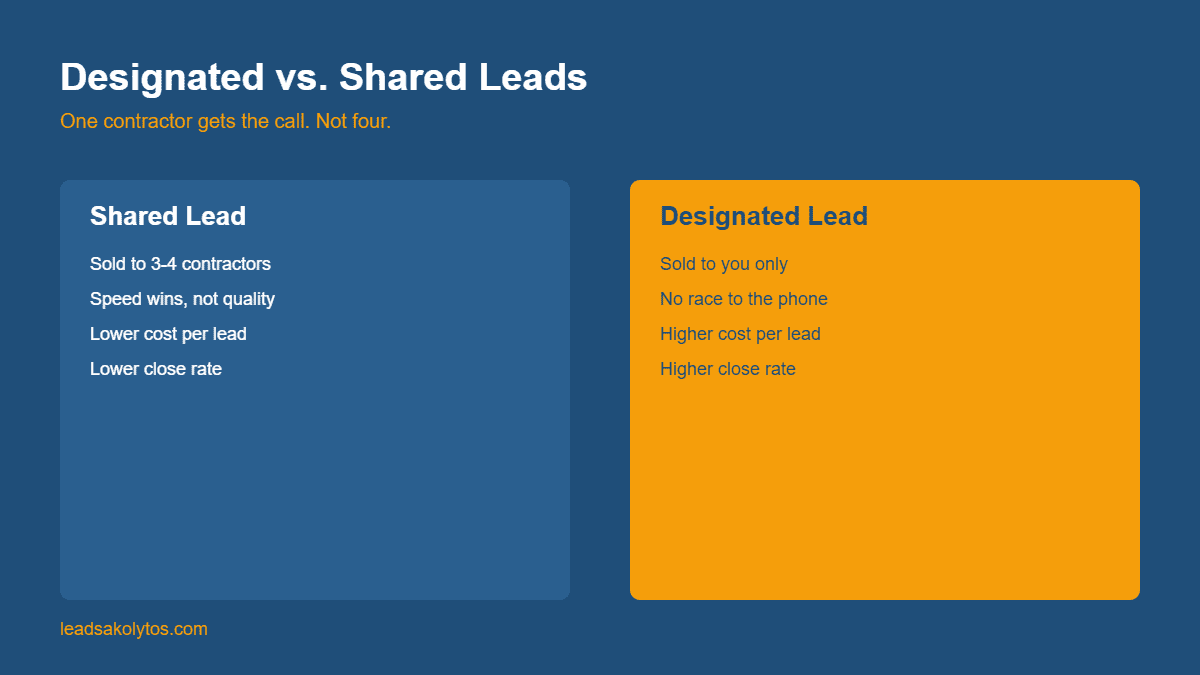
- Is every lead sold exclusively to me, or shared with other contractors?
- Exactly what counts as a billable lead, and what’s the dispute process for bad ones?
- Where do leads actually come from, step by step?
- What’s my true, worst-case monthly cost per lead once fees and disputed leads are counted?
- Can I see leads in real time, not just in a monthly summary?
- What’s the cancellation process, and what (if anything) do I keep if I leave?
Red Flags That Should Make You Walk Away
- A provider that won’t put exclusivity, lead definitions, or the dispute process in writing — only in a verbal pitch.
- Pressure to sign a long-term contract before you’ve seen a single sample lead or a month of real data.
- A “guaranteed number of leads per month” with no explanation of what happens if that number includes low-quality leads.
- Refusal to explain, in plain language, where leads come from.
- No stated refund or credit policy for fake or clearly invalid leads.
Should You Handle Lead Generation Yourself, or Hire It Out?
If you have the time to consistently build and manage your own Google Business Profile, publish content, and monitor local search rankings — the underlying work behind most legitimate designated lead generation — you can do this yourself with no monthly fee beyond hosting and any tools you use. Realistically, that’s a multi-hour-per-week ongoing commitment, not a one-time setup, since Google Business Profile activity, review management, and content all need continuous attention to keep working.
The honest case for hiring it out isn’t that a contractor can’t learn SEO — it’s that most owners already have a full-time job running the business, and lead generation work that gets touched for two hours one month and skipped the next month rarely compounds into consistent calls. If you can commit real, ongoing weekly time to it, DIY is a legitimate option. If your realistic answer is “I’ll get to it when things are slow,” that’s the signal that paying a provider — after vetting them with the six questions above — is the more honest choice for your business.
Frequently Asked Questions
Is it better to pay per lead or pay a flat monthly rate for lead generation?
It depends on exclusivity and what you’re actually buying. Pay-per-lead pricing can work if leads are genuinely exclusive and the dispute process is fair, but many pay-per-lead marketplaces sell the same lead to multiple contractors, which drives your real cost per closed job higher than the sticker price suggests. A flat monthly rate tied to owned assets (your website, your Google Business Profile, your content) can cost less per lead over time because the leads keep coming from work that compounds instead of a per-click purchase.
How many leads should I expect per month from a legitimate provider?
Any number given without context about your trade, market size, and competition should be treated skeptically. Ask for a range based on comparable clients in your trade and metro area, and ask how that range was measured — rankings, call tracking, or estimates.
What’s a reasonable dispute window for a bad lead?
Look for a clearly stated window, typically a matter of days from when the lead was delivered, not an open-ended “contact us anytime” with no defined process or resolution timeline.
Can I ask a lead generation company for references from contractors in my exact trade?
Yes, and you should. A provider confident in its lead quality will connect you with an existing client in a similar trade (not necessarily the same city, to avoid a conflict of interest) who can speak to real lead volume and close rate.
Does a longer contract mean better pricing on lead generation?
Not necessarily, and it shifts risk onto you. A provider confident in lead quality shouldn’t need a long-term contract to make the numbers work in month one. Month-to-month terms let you verify quality before committing further spend.
The Bottom Line
Learning how to vet a provider comes down to six questions, asked before you sign anything, separate a lead generation partner from a lead reseller: exclusivity, lead definition and dispute process, lead source, true all-in cost per lead, real-time visibility, and cancellation terms. Any provider unwilling to answer all six in writing is telling you something important before you’ve spent a dollar.
If you want a second opinion on a lead generation proposal you’re evaluating — or want to see what a transparent, exclusive-lead program actually looks like — book a free 30-minute strategy call. We’ll walk through your current lead sources with you, no pressure, no obligation.
Before You Sign: One Last Gut Check
If you take nothing else from this guide, take this: the entire point of learning how to vet a provider is to ask the six questions above before you sign, not after your first bad month of leads. A contractor business that skips this step is trusting a stranger’s sales pitch instead of a written answer. Vetting a lead generation company properly takes maybe twenty minutes on a call — a small price for knowing exactly what you are paying for per lead. If you are already working with a provider and considering a change, our guide to switching lead generation companies without losing your pipeline walks through how to make that transition safely.
A Short Script for Your First Call
When you vet a provider, ask these four questions in order and write down the answers: What’s the exclusivity policy — are leads sold to me alone or shared with competitors? What’s the average close rate other contractors in my trade see? What happens if a lead is fake or unreachable — do I get a credit? How is “lead” defined — a phone call, a form fill, or something weaker? A company that can’t answer all four clearly on the spot is telling you something.
Skipping this step to “just try it and see” is the single most common regret owners report after a bad first month with a new provider.
Red Flags That Mean You Should Walk Away
Three signals consistently show up when contractors skip the step to properly vet a provider: guaranteed lead counts with no exclusivity language in writing, a refusal to share which other contractors in your service area are also buying the same leads, and pressure to sign before you’ve had 24 hours to review the contract. Any one of these alone is a reason to slow down and vet a provider more carefully before paying anything.
The most reliable way to vet a provider is to ask for two references from contractors in your exact trade who have used the service for at least six months — not a testimonial page, an actual phone number you can call. A company that hesitates to connect you with a real, current customer when you vet a provider is rarely one worth paying.
Bottom line: take the twenty minutes to vet a provider before your first payment clears, not after your third disappointing month.
Why This Vetting Step Gets Skipped
Most contractors who fail to vet a provider aren’t lazy — they’re busy, and a smooth sales call makes skipping the vetting step feel reasonable in the moment. Building “vet a provider before signing” into your actual purchasing checklist, the same way you’d check a subcontractor’s license, removes the decision from a moment when you’re under pressure to say yes quickly.
The One-Page Checklist
Print this before your next sales call. To properly vet a provider: confirm exclusivity in writing, confirm the lead definition in writing, confirm the refund/credit policy in writing, and get two live references. If a sales rep won’t put any of these four items in writing, that alone is reason enough to vet a provider elsewhere before spending a dollar.
Want this handled for you?
We do this work for home service contractors every day, month-to-month, with no contracts. Book a free 30-minute call and we'll show you where you stand on Google.
Book my free call