Your remodeling calendar is full in spring, then a gap opens in September and no referrals fill it. Referrals bring good jobs, but you cannot turn them up when the board is empty. Google can bring the same kind of homeowner steadily, if the homeowner can find you and check your work before calling.
The Short Answer: How a Home Remodeler Gets Steady Calls From Google
Local SEO for a home remodeler comes down to four jobs: a complete Google Business Profile with the right categories and service area, one strong page for each type of project you want, a steady flow of honest reviews, and fast follow-up when someone calls. Google says local results depend mainly on relevance, distance and prominence, and each of those jobs moves one of them. Expect months, not weeks. Most of the setup is work you can do yourself, and it costs nothing but time.
Why Referrals Alone Leave Gaps in a Remodeler's Calendar
Referrals depend on when past clients happen to talk to someone, not on when your crew needs work. They also get checked. A homeowner who hears your name from a neighbor will often search it before calling, and your profile, reviews and photos either back up the recommendation or weaken it.
The market gives you less room for gaps too. Harvard's Joint Center for Housing Studies projected in its July 2026 Leading Indicator of Remodeling Activity that growth in renovation and repair spending would slow to 0.5 percent by the second quarter of 2027, on about $519 billion in spending, as reported by Hardwood Floors Magazine. In a flat market, each project you win is more likely to come from a competitor, so being easy to find and check counts for more.
Paid search is the comparison worth knowing. LocaliQ's home services benchmarks (April 2024 to March 2025 data, page updated July 15, 2026) put the median cost per lead at $165.67 for general construction and contractors. Ads can fill a gap quickly, and you pay for each lead. Rankings cost time up front and keep working after the work is done. Many remodelers will run both for a while.
How to Set Up Your Google Business Profile as a Remodeler
Your profile is what a homeowner sees first in the map results, so finish every field that applies. Google's local ranking page says relevance, distance and prominence drive results, and that more reviews and positive ratings can help your ranking.
- Address: if you work from home and drive to jobs, hide your address. Google's guidelines say so, and rule out virtual offices and remote mailboxes.
- Service area: list the towns you really build in, within about 2 hours' drive of your base, as the guidelines ask.
- Categories: search for "Remodeler", "Kitchen remodeler" and "Bathroom remodeler" in your profile, and pick only those that describe your work. Look at what the top 3 map results use. Our post on changing a Business Profile category explains the re-verification risk first.
- Services: add each project type you want more of, with a short description.
- Photos: post real finished work and work in progress from your own jobs.
- Name: use your real business name. Adding keywords breaks the guidelines and can get a profile suspended.
The Business Profile checklist walks through the remaining fields.
Which Pages a Remodeling Website Needs
Build one strong page for each project type you want, then add town pages only where you have real work to show. A kitchen page should cover your process, realistic timelines, permits, financing if you offer it, and photos of your own kitchens. That answers a homeowner's real questions and gives Google a clear match for the search.
The old advice to publish every service in every city will not hold up. Google's spam policies define doorway abuse as pages created to rank for specific, similar searches, including pages aimed at specific cities or regions. Before you add a town page, ask:
- Have you finished real projects there?
- Can you show photos from those jobs?
- Can you say something true about permits, housing age or common projects in that town?
If the answers are no, leave the town in your service area list and skip the page. Our guide to remodeler local pages that bring leads shows what a strong one includes.
Remodelers have one federal rule to get right on these pages. The EPA's Renovation, Repair and Painting rule says firms cannot advertise or perform covered work that disturbs paint in pre-1978 homes without firm certification, and that includes sole proprietors. If you are certified, say so on your site. In an older town, it gives a homeowner a concrete reason to trust you. If you are not, sort that out before you market work on older homes.
When Homeowners Plan Remodels, and How to Use That
Treat the calendar below as a planning pattern to test, not as measured data. Open Google Trends, set your state, and compare terms like "kitchen remodel" and "bathroom remodel" over 5 years. Then check your own call log. Where the two agree, publish or update the matching page a season ahead, because new pages take time to rank.
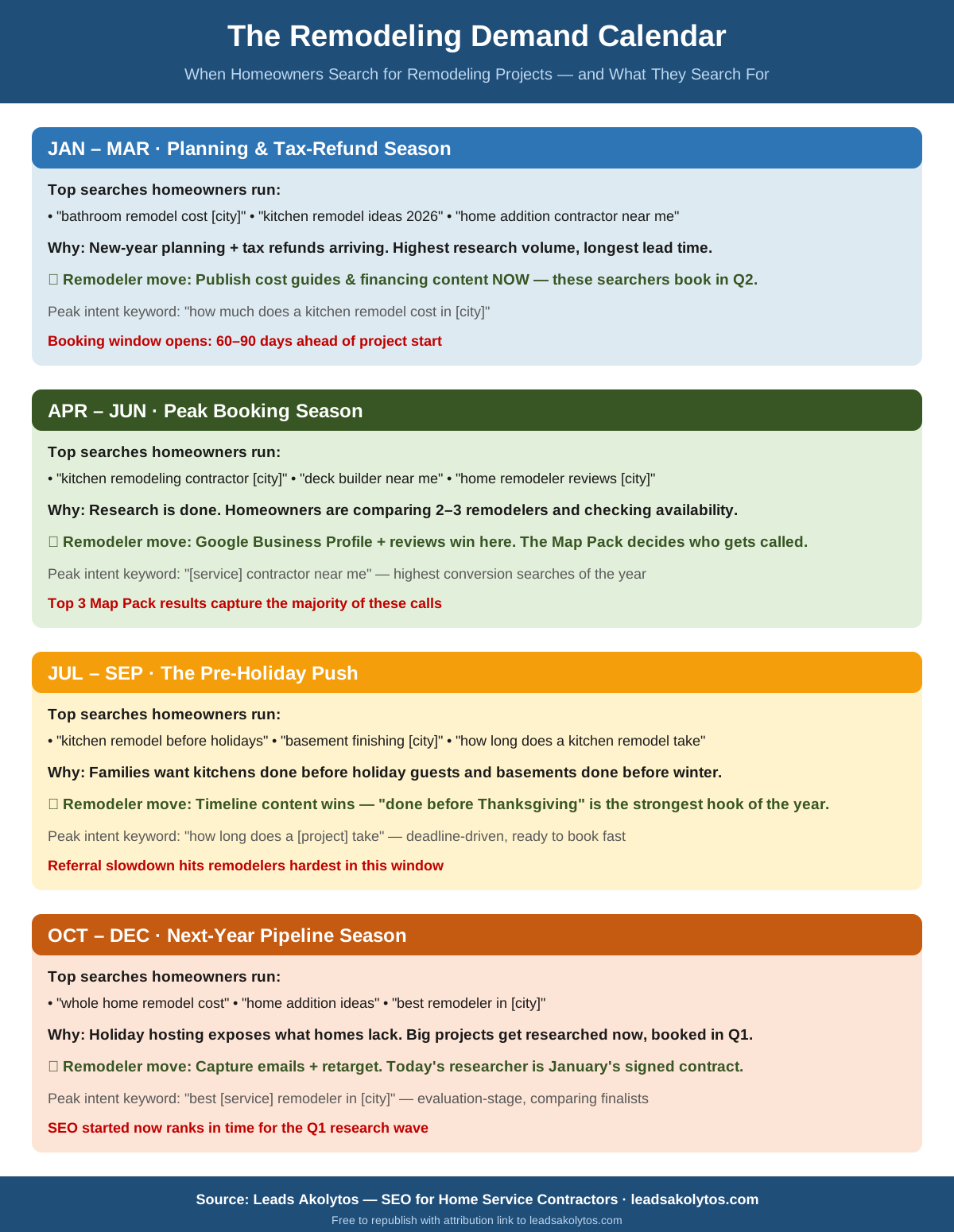
Want to use this calendar on your site? You're welcome to, just credit us. Copy this embed code:
<a href="https://leadsakolytos.com/blog/local-seo-for-home-remodelers-how-to-turn-google-into-your-most-reliable-referral-engine/"><img src="https://leadsakolytos.com/blog/remodeling-demand-calendar-original.svg" alt="Remodeling Demand Calendar by Leads Akolytos" /></a>
- January to March: publish cost and financing answers.
- April to June: keep your reviews and project photos current.
- July to September: publish timeline answers, such as how long a kitchen takes.
- October to December: publish whole-home and addition pages for next year's planners.
How to Get Reviews Without Breaking Google's Rules
Ask every finished client the same way, right after the final walkthrough, and let them write what they want. Google bans offering anything for a review, filtering who gets asked, and asking for specific content. So do not script customers to mention the kitchen or the town. Remodeling clients often write detail on their own, because the job was large and personal.
- Save your direct review link in your phone.
- Text it the day of the final walkthrough.
- Reply to every review yourself.
- Compare your count to the top 3 map results each quarter.
Our guide to asking customers for reviews has the rules and wording, and the 2026 reviews scorecard shows what consumers look for.
What AI Search Changes for Remodelers
AI answers draw on the same material as good local SEO, so you do not need a separate plan to start. A clear project page with prices you can defend, named towns and a real process gives an AI tool something specific to quote. Keep your name, phone and services consistent across your profile, site and directories. Our post on AI search for contractors goes further, and nobody can promise a placement in an AI answer.
How to Tell Whether It's Working
Judge this by booked consultations by source, not by rankings alone. Once a month, check three things:
- Your Business Profile Performance report: calls, website clicks and the searches that found you.
- Your intake sheet: ask every caller how they found you, and write down the project type.
- Search Console: the pages and queries gaining impressions.
Our map pack timeline explains why the timing varies by market, and local SEO cost covers what paying for help runs if you stop having the time.
Frequently Asked Questions
How long does local SEO take for a home remodeler?
It takes months, and no honest source gives a fixed date. Google itself says SEO changes can take from a few hours to several months to show. Your market, your competitors' reviews and how much real project content you publish all change it. Profile fixes tend to show first because they are quick to make.
Do I need a page for every city I serve?
No. Build town pages only where you have real projects and something true to say. Pages that swap the city name can fall under Google's doorway abuse policy. List the other towns in your service area instead.
Which Google Business Profile category should a remodeler choose?
Choose the one that best describes most of your work, and confirm the name exists in your profile. Add others only if you really do that work. Check the top 3 map results for your main search to see what they use.
Is local SEO worth it if I already get steady referrals?
It is worth the free setup either way, since referred homeowners often look you up before calling. Going further depends on whether you have gaps to fill and the capacity to take more work. If you are booked out a year, a clean profile and steady reviews may be enough.
Can I do local SEO myself as a remodeler?
Yes. Google's own guidance says a small local business can probably do much of this itself. The usual problem is keeping up with photos, reviews and pages once jobs get busy. Our post on hiring out SEO or doing it yourself helps you decide.
Facts in this article were checked on their sources on November 9, 2026: Google's local ranking page, Business Profile guidelines and spam policies, the EPA's RRP contractor page, LocaliQ's home services benchmarks, and Hardwood Floors Magazine's July 23, 2026 report on the Harvard Joint Center's Leading Indicator of Remodeling Activity.
Want a Second Look?
You can do everything above yourself. If you would rather go over your profile and project pages with someone, Leads Akolytos offers a free 30-minute strategy call; we work only with home service contractors, with no setup fees and no long-term contracts. You can book a time here, or read more about how we look at remodeler marketing.
If you'd like one practical idea like this in your inbox each month, get The Leads Akolytos Monthly: one email a month, unsubscribe any time.
Want this handled for you?
We do this work for home service contractors every day, month-to-month, with no contracts. Book a free 30-minute call and we'll show you where you stand on Google.
Book my free call