Building the right remodeler local SEO pages for each neighborhood you serve is one of the fastest ways to fix that. Late summer is when many remodelers feel the slowdown. Spring calls are done, jobs are booked, and all of a sudden the phone is quieter, even though homeowners are sitting at home searching for their next project. They are not typing broad terms anymore; they are typing things like “kitchen remodeler” and “bathroom remodeling in Oakwood Heights.”
We see this gap all the time. There is real demand in specific neighborhoods, but your website only speaks to the main city. In this article, we will walk through how to build neighborhood-focused local SEO landing pages that turn those searches into real, high-intent home remodeling lead generation, without getting in trouble for duplicate content or making your site a mess.
Why Local Landing Pages Win Remodeling Leads
Short answer: a page written specifically for one neighborhood beats a generic city-wide page because it matches exactly what the homeowner typed and shows Google (and the homeowner) that you actually work in that area — but only if the page is genuinely unique, not a copy-paste job with the town name swapped. Google explicitly treats near-duplicate location pages built at scale as a spam policy violation, so the value only shows up when each page earns its place with real local detail.
When someone looks for a remodeler, they usually want someone close, someone who knows their area. Search engines pick up on that and lean hard on proximity and relevance for home services. That means a page that clearly says “kitchen remodeling in Brookside” often beats a generic “kitchen remodeling” page.
For remodelers, this is powerful. Local landing pages tend to pull in people who already know:
- Which room they want to remodel
- Roughly when they want to start
- A general budget range they are comfortable with
These visitors are “ready to talk,” not just browsing pretty pictures. They are more likely to call, more likely to book a visit, and more likely to turn into solid projects.
A smart local page plan also lets you cover your full service area, not just the city where your office sits. Many remodelers will happily drive 30 to 60 minutes for the right job. You want pages that reflect that. The trick is to group locations in a way that feels natural, like:
- Main city pages
- Surrounding town pages
- Focused neighborhood or ZIP code pages
Done right, your site sends a clear signal: “We remodel homes across this whole area, and we understand how people live in each pocket of it.” For the broader picture of how local SEO works for remodelers beyond just landing pages, see our guide to local SEO for home remodelers.
Mapping Your Service Area Like a Pro
Before you touch your website, grab a simple map or even a notepad. You need to define where you actually want to work. Start with three lists:
- Core cities where you already do steady work
- High-value suburbs and nearby towns you want more of
- Specific neighborhoods or ZIP codes that fit your ideal projects
Think about areas with older homes that need updates, historic districts with strict rules, or subdivisions where people are starting to outgrow their layouts. These spots are often planning fall and winter projects right as summer is winding down.
Now sort everything into tiers:
- Primary city hubs, your big magnets
- Secondary towns, good volume but maybe a bit farther out
- Micro-areas, named neighborhoods or ZIP codes with strong potential
This keeps you from making 50 thin pages that say the same thing. Each location you pick gets a page because there is real demand, not just because it is on the map.
Tie this to the season too. Late summer is perfect for highlighting:
- Kitchens and living areas finished before the holidays
- Basements and lower levels ready before cold, wet weather
- Bathroom updates that fit around school schedules
Start small. Pick 5 to 10 priority areas instead of trying to cover the whole region at once.
Don’t Guess: Score Every Neighborhood Before You Build a Page
Most guides stop at “pick your top neighborhoods,” which leaves you guessing. Instead, run every candidate neighborhood through a simple 5-point scorecard before you commit the time to write a page for it. Score each factor, add up the points out of 15, and let the number tell you what to do next:
- Within a 45-minute drive of your home base — +3 points if yes, 0 if no
- 3+ completed projects there in the last 24 months — +3 points if yes, 0 if no
- Real search demand you can point to (Google Business Profile insights, keyword data, or your own site search queries) — +4 points
- Housing stock, HOA rules, or permitting genuinely differs from your core city — +2 points
- You already have real photos or a testimonial tied to that specific area — +3 points
Add it up: 11-15 points means build a full page now, you have real, provable demand and proof to back it up. 6-10 points means add it as a served-area bullet on your city hub page for now and revisit in 90 days once you have more project history there. 0-5 points means skip it, there isn’t enough real demand or proof yet to justify a thin page that could drag down the rest of your site.
This scorecard also doubles as your duplicate content guardrail: if you lay two of your local pages side by side, the shared template copy (headline structure, CTA, page layout) should stay well under 40% of total content. Everything else, housing stock, local FAQs, project proof, area-specific details, needs to be genuinely unique to that page. That threshold lines up with how Google describes doorway pages: pages that exist mainly to rank for a city or neighborhood name with little unique value of their own.
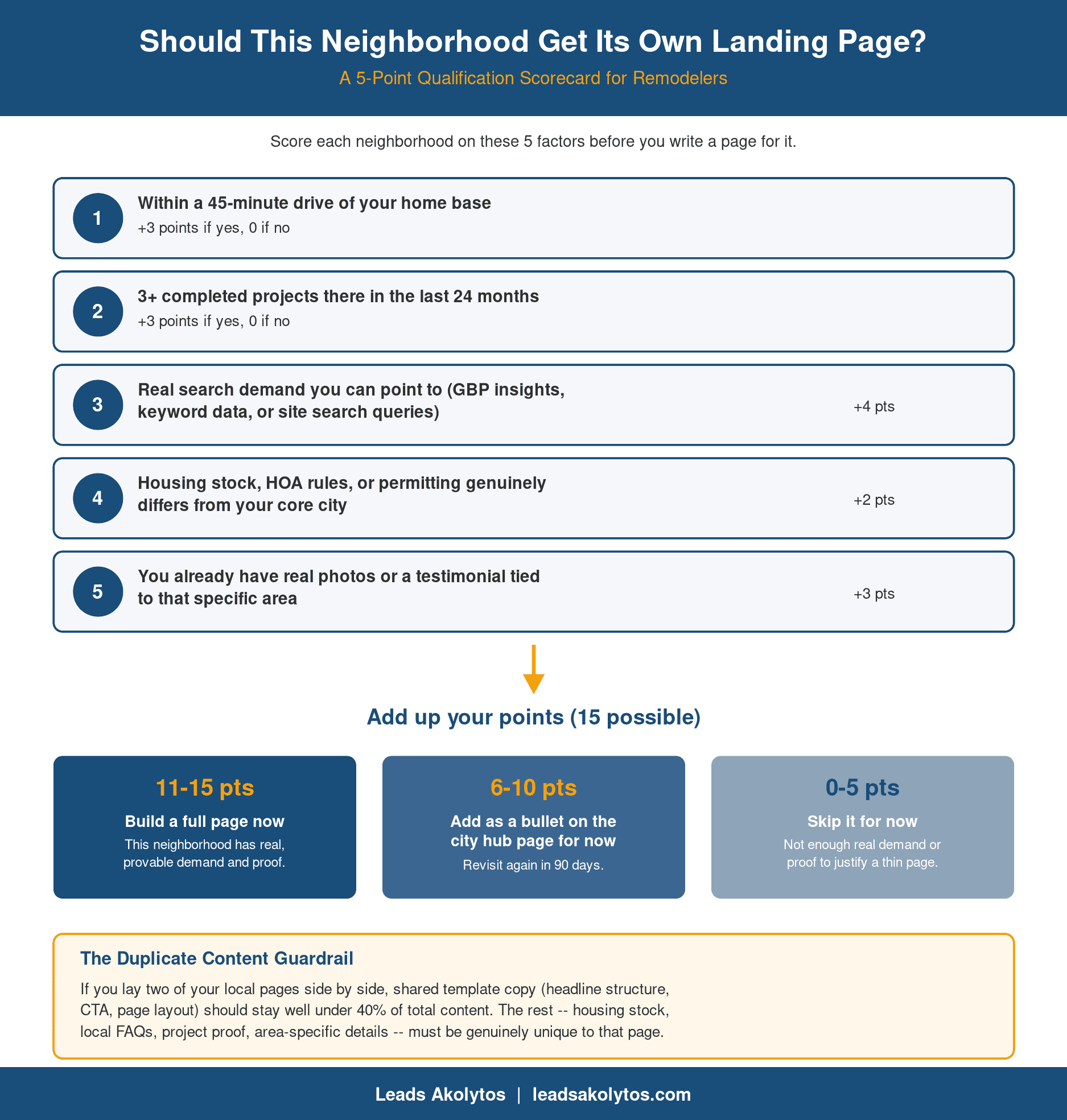
Use this graphic: you’re welcome to republish this scorecard on your own site or resource, with attribution and a link back to this article. Just copy the embed code below:
<a href="https://leadsakolytos.com/blog/remodeler-local-seo-pages/" target="_blank" rel="noopener"><img src="https://leadsakolytos.com/blog/neighborhood-page-scorecard.png" alt="Neighborhood landing page qualification scorecard for remodelers" style="max-width:100%;"></a><p>Scorecard by <a href="https://leadsakolytos.com/">Leads Akolytos</a></p>
Crafting Unique, Non-Duplicate Local Pages
You can use the same structure for every location page while still keeping the content unique. A simple format looks like this:
- Localized headline and intro
- Neighborhood-specific pain points
- Projects you have done or could do nearby
- Local FAQs
- Clear call to take the next step
The structure stays the same. The details change. Swap out generic lines for real neighborhood context. For example, think about:
- Typical home ages and styles in that area
- Common floorplans and layout issues you see
- Style preferences, like modern, farmhouse, or traditional
- HOA rules, lot sizes, or awkward additions that cause headaches
You can also work in seasonal hooks. In August, talk about getting the kitchen ready before holiday guests. For certain neighborhoods, push basement projects that make lower levels warmer and more useful before winter.
Then add proof from that area wherever you can:
- Short case blurbs from past projects nearby
- Testimonials that name the town or neighborhood
- Before-and-after photos sorted by area
- Simple lists like “Streets we have worked on in this part of town”
All of these give you fresh, natural copy and build trust that you actually know the homes on those streets.
SEO Essentials That Make Local Pages Rank
You do not need fancy tricks, but you do need the basics on every local page. Make sure each one has:
- A unique title tag that includes the service and the location
- A clear meta description that speaks to local homeowners
- A clean URL, such as /kitchen-remodeling-oakwood-heights
- An H1 heading that repeats the main focus in natural language
Even small changes between pages help search engines see them as unique.
Next, set up smart internal links. Each neighborhood page should point to:
- Its “parent” city or area page
- Main service pages, like kitchens, baths, and basements
- A gallery or portfolio section focused on that part of town
This creates a simple path for both search engines and people, from broad to specific, and then into real project examples. Done consistently, this is what separates strong remodeler local SEO pages from thin, forgettable ones. If you haven’t nailed down which terms to target on each page yet, our guide on how to pick SEO keywords that actually book jobs walks through that process.
Do not ignore the technical and off-page helpers either. Things that often make a difference include:
- Embedding a clear service area map
- Keeping your business name, address, and phone consistent everywhere
- Making sure pages load fast and look great on mobile
Most remodeling searches happen from a phone or tablet on the couch, so mobile speed and tap-friendly buttons matter. A fully optimized Google Business Profile reinforces every one of these local pages, since Google cross-checks your profile’s service areas against what your website actually claims to cover.
Turning Local Visitors Into Booked Remodeling Jobs
Traffic alone does not keep your crews busy. Each local page must work like a small, focused sales tool. Think about the first thing someone from that neighborhood sees. It might be a headline like “Serving Homeowners in Westwood Since We Opened Our Doors” along with a quick line about the types of projects you handle there.
On the page itself, make it simple to start a conversation:
- Short, friendly forms with “Tell us about your project” prompts
- Click-to-call buttons that stand out on mobile
- Clear notes about typical project timelines for the season
Your messaging should match the calendar. In late summer, you can talk about:
- Kitchen and living room updates ready before guests arrive
- Bathroom remodels done between now and early winter
- Basement and insulation-related work focused on comfort and warmth
Finally, track what is working. Set up call tracking numbers or form tags by group of local pages so you can see which neighborhoods:
- Send the most leads
- Close into the best jobs
- Match your ideal type of project
Over time, this guides where you focus more content, more ad spend, and more sales effort.
When we build neighborhood SEO strategies for remodelers at Leads Akolytos, this is the process we lean on, step by step. It turns local search into a steady source of real projects, not just clicks.
Launch Your First Five Local Pages This Month
A full neighborhood strategy does not need to start huge. In fact, it is better if it does not. Begin with a small, smart cluster:
- One main city hub page
- Two priority suburb or town pages
- Two high-potential neighborhood pages where you already have photos or reviews
Give yourself about a month to roll it out. That’s really all it takes to launch your first working set of remodeler local SEO pages. A simple plan could be:
- Week 1, map your service area, then run each candidate through the scorecard above and pick your five locations
- Week 2, gather project notes, photos, and quotes from those areas
- Week 3, write and publish each page using the shared structure
- Week 4, tune titles, internal links, and calls to action, then submit in your search tools
From there, watch which pages start to pull in calls and forms. Use what you learn to improve the content, add new photos, and decide which nearby areas should get pages next. The National Association of the Remodeling Industry’s remodeler resources are also a useful place to check local permitting and industry standards as you write area-specific detail into each page.
A neighborhood-by-neighborhood local SEO plan can turn late summer slowdowns into steady, predictable home remodeling lead generation. That’s the whole point of building remodeler local SEO pages in the first place. Start tight, stay focused, and let each new cluster of pages build on the last until your whole service area is covered with clear, helpful, local-focused content.
Frequently Asked Questions About Neighborhood Local SEO Pages
How many neighborhood pages should a remodeler start with?
Start with five: one city hub page, two suburb or town pages, and two neighborhood pages where you already have project photos or a testimonial. Add more only after the first batch is scoring well on the 5-point scorecard.
Will local landing pages get flagged as duplicate content?
Only if you copy the same content and swap the city name. Google’s spam policies specifically call out near-identical location pages as doorway pages. Keep shared template copy under 40% of the page and fill the rest with genuinely local detail, and you’re on the right side of that line.
Do I need a page for every town in my service area?
No. Run each candidate through the scorecard first. A town with no completed projects, no search demand, and no local proof isn’t ready for its own page yet, add it to your city hub page instead until it earns one.
What’s the fastest way to get local proof for a new page?
Pull from your own project files: even one or two photos and a short client quote tied to that specific neighborhood is enough to start. Ask recent customers in that area for a two-line testimonial that names their town.
How long before neighborhood pages start generating leads?
Most remodelers see early impressions within 4-8 weeks and real calls within 2-4 months, similar to other local SEO content, faster if the page links to real project photos and reviews from that specific area.
Turn Online Interest Into High-Value Remodeling Projects
If you are ready to turn more website visitors into booked consultations, our targeted home remodeling lead generation strategies are built to help you do exactly that. At Leads Akolytos, we focus on delivering qualified, local homeowners who are actively looking to start their next project. Let us review your current marketing, identify the gaps, and build a custom plan that fits your budget and growth goals. Have questions or want to see what this could look like for your business? Contact us today to get started.
If you’re weighing residential lead generation more broadly, our guide on unlocking residential contractor lead generation with SEO lays out the full picture beyond local landing pages alone.
Should You Build These Pages Yourself, or Pay Someone?
Everything above is work a remodeler can do without hiring anyone. Whether you should is a different question, and it turns on three things: how much of your own time this will take, how expensive the common mistakes are, and whether the pages will keep getting built once you are busy again.
The time cost is the part people underestimate. A genuinely useful local page is not a template with the town name swapped out. It needs real project references from that area, photographs of work you actually did there, and copy that would not make sense if you pasted a different neighbourhood into it. Budget several hours per page if you are writing them properly, and remember that five pages is a project, not an afternoon.
The expensive mistake is duplication. The fastest way to build remodeler local SEO pages is to clone one page fifteen times and change the place names. It is also the way to end up with a set of pages Google treats as near-duplicates and largely ignores, which means the effort produces nothing. Google’s guidance on scaled and duplicated content is explicit about this, and it is the single most common reason a local page project fails quietly.
The real risk is that it stops. Most remodelers build two or three pages, get busy, and never build the rest. A half-finished set covers a fraction of your service area and looks abandoned to anyone who finds it. This is the strongest argument for paying someone: not that the work is hard, but that an outside party keeps producing pages during the months you have no capacity to think about marketing.
How to decide. If you have a slow stretch coming, someone in the business who writes clearly, and a photo library from past jobs, build them yourself and keep the money. If you are already at capacity, or if you have started this project before and abandoned it, paying for it is the cheaper option in practice even though it is the one with an invoice attached. Our plans start at $1200 a month with no contract, which is the number to weigh against the hours.
If you want a straight answer on which applies to you, book a free strategy call. We will tell you honestly if this is a project you should keep in-house, because a half-built set of pages helps nobody, including us.
Is it worth paying someone to build local pages, or should I write them myself?
Write them yourself if you have a slow season ahead and someone who can write about real projects in each area. Pay someone if you have already started this once and stopped. The work is not technically difficult; what you are buying is that page six through fifteen actually get built. Plans start at $1200 a month with no contract, so compare that against several hours per page of your own time.
DIY vs. Hiring It Out: What Remodeler local SEO pages Actually Costs You
Before you decide whether to tackle remodeler local SEO pages yourself or bring in help, weigh it honestly: doing it in-house costs your time (often 5-10+ hours a month once you factor in research, execution, and tracking results) plus the risk of trial-and-error mistakes that a specialist would avoid. Working with a dedicated team like ours starts at $1200/month with no long-term contracts, so the downside of trying it is small and the ramp-up is fast. You’ll work directly with the person handling your account, not a rotating manager, before you commit either way.
FAQ: Is it worth paying someone for remodeler local SEO pages?
If you have the hours to spend learning and iterating, DIY can work. If your time is better spent running jobs and managing crews, a $1200/month, no-contract engagement typically pays for itself within a couple of closed jobs. Schedule a free strategy call to get a straight answer for your specific business before you decide.
Want this handled for you?
We do this work for home service contractors every day, month-to-month, with no contracts. Book a free 30-minute call and we'll show you where you stand on Google.
Book my free call