“How long does SEO take for contractors?” is usually the second question an owner asks, right after what it costs. It deserves a straight answer, because the wrong expectation is what kills most campaigns long before the work has had a chance to fail on its own merits.
What follows is a realistic month-by-month timeline: what moves first, what moves last, and how to tell the difference between slow progress and no progress.
The Short Answer
How long does SEO take for contractors? Most home service businesses start seeing measurable movement — more impressions, better rankings on non-branded terms, a handful of new calls traceable to organic search — within 3 to 6 months of consistent SEO work. Meaningful, compounding lead flow that changes the shape of your business typically takes 6 to 12 months. Contractors who expect results in 30 days are set up to quit right before the payoff. That’s the timeline for organic SEO overall — if you’re specifically wondering about the Google Map Pack, see our local SEO and Map Pack timeline breakdown, since it runs on a different clock.
That range isn’t a sales line. It matches what Google’s own Search Central documentation says about how long it can take for changes to a site to affect rankings, and it lines up with independent data from agencies and analysts who track ranking timelines across thousands of local business websites (see Search Engine Land’s SEO timeline guide for a breakdown of what to expect month by month).
This is exactly why so many contractors ask how long does SEO take for contractors before committing budget to a campaign.
Why SEO Isn’t Instant — Even When You Do Everything Right
If you’ve run paid ads before, the SEO timeline can feel painfully slow by comparison. With Google Local Services Ads or PPC, you turn the budget on and calls start Monday. SEO doesn’t work that way, and understanding why helps you set realistic expectations with your team, your spouse, or whoever’s asking “is this working yet?”
Google Has to Trust You First
Search engines don’t just read your website — they watch how it performs over time. A new page, a new set of service pages, or a freshly optimized Google Business Profile gets indexed fast, but ranking well for competitive terms like “emergency plumber near me” or “roof replacement [city]” requires Google to build confidence in your site’s relevance and authority. That confidence is built through consistent signals: content that matches what people search for, backlinks from other legitimate sites, positive engagement, and a track record of the business actually existing and operating where it says it does.
Your Competitors Aren’t Standing Still
Local SEO is relative. You’re not just trying to satisfy Google’s algorithm in a vacuum — you’re trying to outrank the five or six other contractors in your service area who are also updating their sites, collecting reviews, and (if they’re smart) doing SEO too. If a competitor has a two-year head start on backlinks and content, closing that gap takes real time, not a weekend sprint.
Content and Links Take Time to “Mature”
A blog post or new service page you publish today doesn’t rank on page one tomorrow. It usually goes through a slow climb — page 5, then page 3, then page 1, position 8, then position 4 — over weeks or months as Google gathers more data about how users interact with it. This is normal and expected, not a sign that something’s broken. The same dynamic applies to a dedicated content program — see our full breakdown of how long does content marketing take to start generating leads for the content-specific version of this timeline.
How Long SEO Takes, Month by Month
Here’s roughly what to expect if you’re starting from a typical small contractor website with little to no prior SEO investment:
Months 1–2: Foundation
Technical fixes, Google Business Profile optimization, on-page updates to existing service pages, and the first round of new content go live. You likely won’t see ranking movement yet, but this is the work that everything else depends on. If your GBP wasn’t fully built out before, this alone can start generating calls faster than organic rankings will — Google Business Profile visibility often moves quicker than organic web rankings because it draws on a smaller, more local data set.
Timeline is only one part of the picture — see how many leads a contractor should expect from SEO for how to build your own realistic range.
Months 3–4: Early Signals
You’ll typically start seeing new keywords showing up in Google Search Console, small ranking improvements for lower-competition terms (specific services, specific neighborhoods), and possibly your first few leads that mention finding you “on Google.” Traffic is still modest, but the trend line should be pointing up.
Months 5–8: Compounding Growth
This is usually when things start to feel real. More keywords rank on page one, the phone starts ringing more consistently from organic search and Maps, and your Google Business Profile pulls more calls, direction requests, and website clicks. Content published in month one or two often reaches its ranking potential around now.
Months 9–12+: Compounding Advantage
By this point, a well-run SEO program should be producing a steady, less volatile stream of leads — and each new month of content and links makes the next month easier, because you’re building on an established, trusted domain instead of starting from zero. Contractors who stick with SEO for a full year rarely go back to paying $60–$150 per lead for shared paid leads, because organic leads are now showing up at a fraction of that cost.
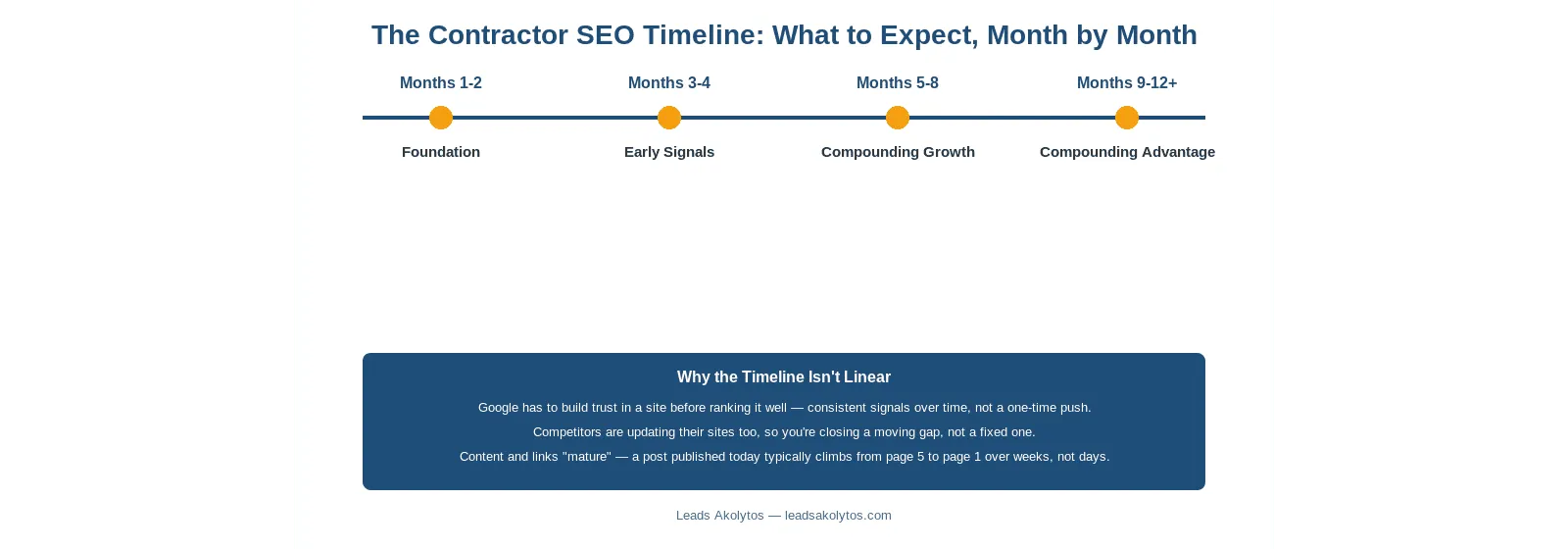
Use this graphic: You are welcome to republish this timeline on your own site or in a presentation, with credit and a link back to this article.
<a href=”/blog/how-long-does-seo-take-to-work-for-a-contractor-business/”>Source: Leads Akolytos, The Contractor SEO Timeline</a>
What Slows the Timeline Down (or Speeds It Up)
- Domain age and history. A 10-year-old site with some existing authority moves faster than a brand-new domain.
- How competitive your market is. Ranking for “electrician” in a mid-size city with a handful of competitors is faster than in a metro with fifty companies bidding on the same keywords.
- Review velocity and quality. Consistent, recent reviews are a ranking factor for local pack visibility and also build the trust that turns clicks into booked jobs.
- Content consistency. One blog post won’t move the needle. A steady publishing cadence — which is why plans built around weekly or multiple-times-weekly content exist in the first place — is what compounds.
- Technical health. A slow, broken, or poorly structured site can hold back everything else no matter how much content you publish.
Does the Timeline Change by Trade?
The mechanics of SEO are the same across trades, but the timeline can feel different depending on how your business gets hired.
Emergency and High-Frequency Trades (Plumbers, Electricians, HVAC, Garage Door)
These searches happen year-round and often same-day, which means Google has a constant stream of user behavior data to learn from. Rankings for “emergency” and “repair” terms can move noticeably faster than for big-ticket, considered purchases — sometimes within the 3-4 month range for less competitive terms — because search volume and click data accumulate quickly.
Seasonal and Considered-Purchase Trades (Roofers, Landscapers, Remodelers, Gutter Cleaning)
Search volume for these services often spikes at specific times of year (storm season for roofers, spring for landscapers), so ranking gains made in the off-season may not show up as leads until demand returns. This is why timing content and technical work ahead of your busy season matters — publishing roofing content in January to be ready for spring storm season is a very different strategy than publishing reactively in June.
Trust-Heavy, In-Home Trades (Cleaning, Moving, Handyman, Pest Control)
Because these services involve letting a stranger into your home, reviews and Google Business Profile trust signals tend to carry outsized weight, and can influence booking rates faster than organic rankings alone. A strong GBP with recent reviews can start converting well even before your website ranks on page one organically.
Does a Bigger Monthly Investment Actually Shorten the Timeline?
Within reason, yes — and it’s worth understanding why. SEO progress is largely a function of how much consistent, quality work gets done each month: how many pages get optimized, how much new content gets published, how many legitimate backlinks get earned. A plan built around one blog post a week moves slower than one built around four, simply because there’s four times the content signaling relevance to Google and giving people a reason to link to and share your site.
That’s the logic behind tiered SEO plans — a 25-keyword, 1-blog-per-week starter plan is appropriate for a business just getting serious about SEO, while a 100-keyword, 4-blog-per-week plan is built for a business trying to dominate a competitive metro area faster. Neither skips the months of trust-building described above, but more consistent output does compress how quickly each stage plays out.
How to Tell SEO Is Working Before the Leads Show Up
You don’t have to wait six months blind. If your current provider can’t answer “what happened last month and why” in specific terms, that’s worth asking about — our guide on picking SEO keywords that actually book jobs covers how to judge whether the keywords being targeted are even the right ones to move the needle on lead volume, not just traffic.
And if you’re weighing SEO against paid ads while you wait for organic traffic to build, our breakdown of the real cost per lead for SEO vs. paid ads lays out the numbers side by side.
- Google Search Console impressions — are more people seeing your site in search results, even if they’re not clicking yet?
- Keyword rankings — are your target terms moving from page 3-4 toward page 1-2?
- Google Business Profile insights — are calls, direction requests, and website clicks from your profile trending up?
- Organic traffic — is the number of visitors arriving from unpaid search growing month over month?
- AI answer visibility — is your business getting mentioned when people ask ChatGPT or Google’s AI Overviews for a contractor in your area? AI search is already sending some contractors real leads, so it’s worth checking alongside the usual metrics.
If you’d rather not guess at whether your numbers are on pace, that’s exactly the kind of thing worth walking through with someone who looks at contractor SEO data daily — it’s one of the things we cover on a free 30-minute strategy call.
What to Do If It’s Been 6+ Months With No Movement
If you’ve genuinely invested in SEO for half a year with consistent content and no improvement in impressions, rankings, or leads, something is off — usually one of a few things: a technical issue blocking indexing, a Google Business Profile suspension or suppression, content that’s too thin or generic to compete, or a backlink profile with zero real authority behind it. This is also, unfortunately, where a lot of contractors discover they were sold a “set it and forget it” package with no real strategy behind it — a pattern worth understanding regardless of who you work with going forward.
Still deciding where the next dollar should go? See our comparison of Google Local Services Ads vs. SEO for a head-to-head look at timeline and cost.
How to Hold a Provider Accountable to the Timeline
A realistic timeline only protects you if someone is checking against it. Most contractors sign up, hear that SEO takes time, and then have no way to tell month seven from month two. Build the checkpoints in before you start.
At 30 days, ask for the baseline. You should receive a written starting position: current rankings for the terms that matter, current organic traffic, and current calls and form fills coming from organic search. If nobody recorded where you started, nobody can prove you moved. This is the most common gap in contractor SEO engagements, and it is entirely preventable.
At 90 days, ask what shipped. Not what was worked on, but what actually went live: new pages published, existing pages rewritten, technical fixes deployed, listings and citations corrected. Leading indicators such as impressions and the number of non-branded keywords you rank for should be moving by now, even if the phone has not changed yet.
At six months, ask about calls, not rankings. Rankings are the mechanism; calls are the point. If impressions climbed but calls did not, the bottleneck is usually the pages themselves rather than the SEO work: thin copy, no obvious next step, or a slow mobile experience that loses people before they dial.
At twelve months, compare cost per lead against your other channels. By this point you have enough history to judge honestly. If organic is producing leads at a lower cost than paid, the investment is working and should probably grow. If it is not, you have a real number to take into that conversation instead of a hunch.
None of these checkpoints require you to understand SEO. They require you to ask for the same thing you would ask any subcontractor: what did you do, what did it produce, and how does that compare to what you were promised.
Frequently Asked Questions About How Long SEO Takes for Contractors
Is 3 months enough time to know if SEO is working?
Three months is usually enough to see early signals — more impressions, movement on lower-competition keywords, a stronger Google Business Profile — but it’s rarely enough to judge the full impact on lead volume. Most SEO contracts and realistic expectations are built around a 6-12 month view.
Does paying for a more expensive SEO plan make results happen faster?
More investment usually means more content, more technical work, and more link-building happening in parallel, which can accelerate the timeline — but it doesn’t bypass the trust-building process search engines require. A $3500/month plan with 4 blogs a week will typically outpace a $1200/month plan with 1, but both still take months, not days.
Why did my rankings drop after a few weeks of improvement?
Minor fluctuation is normal, especially early on, as Google tests where a page belongs in the results. Bigger drops are usually tied to a core algorithm update, a technical issue, or a competitor’s content outranking yours — not a sign that SEO itself failed.
Should I do SEO and paid ads at the same time to fill the gap?
Many contractors run paid ads or Local Services Ads for near-term leads while SEO builds in the background, then scale paid spend down as organic traffic grows. It’s a reasonable way to avoid a lead gap during the ramp-up period.
Does switching SEO providers reset the timeline?
It can. A provider change often means new strategy, new content direction, and sometimes technical changes — all of which can cause a temporary dip before things stabilize. It’s one more reason consistency matters more than chasing the next new vendor.
How long until Google Business Profile improvements show results?
Faster than organic web rankings — often 2-6 weeks for changes like categories, services, photos, and posts to influence Local Pack visibility, since Maps rankings pull from a narrower, more local data set than broad organic search.
Setting realistic expectations is half the battle — the other half is making sure the work being done each month is actually the right work for your trade and your market. If you want a clear-eyed read on where your site stands and what a realistic timeline looks like for your business specifically, book a free 30-minute strategy call and we’ll walk through it together — no contracts, no pressure.
In short, how long SEO takes depends on your starting point, but most see measurable movement well within the first two quarters.
Deciding how to split limited marketing dollars? See SEO vs. social media marketing for contractors for a trade-by-trade breakdown.
The Short Answer, One More Time
If you take one thing away from this guide, let it be this: how long SEO takes who are starting from a thin or brand-new website? Budget 4-6 months before rankings move meaningfully, and 6-12 months before that traffic turns into a steady lead flow you can plan around. Anyone who tells you how long SEO takes in weeks rather than months is either overpromising or describing paid ads, not organic search.
What Actually Resets the Clock
The honest answer to how long SEO takes changes the moment you change something structural on the site. A domain migration, a full redesign that changes URLs, or switching from one CMS to another restarts a meaningful chunk of the trust Google has already built toward your pages. If you are mid-timeline and considering a site rebuild, ask your SEO provider how long SEO takes to recover after a migration specifically, not just how long the original ramp took, because those are two different clocks.
Content pruning is the opposite case: removing thin, outdated, or duplicate pages can sometimes shorten how long SEO takes to see movement, because it concentrates ranking signals on fewer, stronger pages instead of spreading them thin. This only works when the pruned pages were genuinely low-value, not when it is used to hide a lack of content — cutting good pages to chase a faster number is the wrong trade.
Whatever your starting point, ask your SEO provider to show month-by-month ranking and traffic data from a comparable past client, not a generic industry claim, when you ask how long SEO takes in your specific trade and market.
If you only remember one number, remember this: how long SEO takes to show early movement is 3-4 months, and how long SEO takes to turn that movement into a predictable stream of calls is 6-12 months. Anyone answering how long SEO takes with a number outside that range is either describing a different starting point than yours or setting an expectation that will not hold up.
Want this handled for you?
We do this work for home service contractors every day, month-to-month, with no contracts. Book a free 30-minute call and we'll show you where you stand on Google.
Book my free call