
SEO vs. Social Media Marketing for Contractors: Where Should Your Budget Go First?
Short answer on SEO vs social media for contractors: if you have to pick one first, put your first marketing dollars into SEO — specifically your Google Business Profile and service-area pages — because that is where homeowners are already searching with buying intent. Social media builds awareness and trust over time, but it rarely closes a job on its own for most trades. The right long-term mix for most contractors is 60-70% SEO/local search and 30-40% social, adjusted by trade and by how much of your work already comes from repeat and referral customers. If you do decide to invest in social media, budget realistically — see our social media management cost guide for 2026 pricing by tier.
Why This Question Comes Up Every Budget Cycle
Every contractor with a marketing budget under about $3,000/month eventually hits the same wall: there isn’t enough money to do SEO and social media and paid ads all at once, at least not well. Marketing agencies and in-house hires pitch different channels depending on what they sell, which makes an honest, trade-specific comparison hard to find. This post breaks down SEO vs social media for contractors properly: what each channel actually does, where they overlap, and how to sequence your spend instead of splitting it thin across everything at once.
What SEO Actually Buys You
Search engine optimization means showing up when someone searches “[your service] near me” or “[your service] in [city]” — both in Google’s normal organic results and in the Google Business Profile map pack that sits above them. These searchers have already decided they need the work done; they are choosing who does it. That is why SEO leads convert at a meaningfully higher rate than most other digital channels for home service businesses — the intent is already there, which is the same reason SEO tends to beat paid ads on cost per lead once it matures.
The tradeoff is speed. SEO for contractors typically takes 3-6 months to show early movement and 6-12 months for durable lead flow, because it depends on Google trusting your site’s relevance and your Google Business Profile’s activity and reviews over time.
What Social Media Actually Buys You
Social media — Instagram, Facebook, and increasingly short-form video — does a different job. It builds brand recognition, showcases finished work, and keeps your business visible to people who already know you (past customers, neighbors, referral sources). It’s also where a strong before/after photo or a project video can travel further than any single search result, especially for visually driven trades like remodeling and roofing.
What social media rarely does well on its own is capture someone in the exact moment they need emergency or urgent service. Nobody scrolls Instagram looking for a plumber at 11 PM with a burst pipe — they search Google.
Where the Two Channels Actually Overlap
SEO and social media aren’t fully separate lanes. Google increasingly treats consistent business activity — posts, photos, reviews, updates — as a trust signal across your whole online presence (see Google’s own guidance on local ranking factors), and a well-run social profile with real project photos also gives homeowners a way to verify you’re legitimate before they call. In practice, the best-performing contractor marketing programs use social content as proof points that support the SEO-driven lead (a homeowner searches, finds you, then checks your Instagram or Facebook reviews before dialing).
How to Sequence Your Budget by Trade
How you settle SEO vs social media for contractors depends heavily on how visual and how urgent your trade is:
- Emergency-heavy trades (plumbing, HVAC, electrical): weight budget toward SEO and Google Business Profile first — most demand is need-now search, not scroll-and-decide.
- Visual, considered-purchase trades (remodeling, roofing, landscaping): still start with SEO for the map pack and service pages, but shift more budget to social/portfolio content sooner, since buyers in these categories research longer and want to see real work before they call.
- Businesses under 2 years old with few reviews: SEO first, almost always — you need the Google Business Profile foundation and review volume in place before social spend pays off, since a thin, unreviewed profile undercuts trust either way.
A Simple Way to Decide If You’re Torn
Reduce SEO vs social media for contractors to one question: when a homeowner in your market needs your service today, where do they go first? For the large majority of home service trades, the honest answer is Google — either a search or the map pack. That’s the signal to fund first. Social media earns its budget once your Google Business Profile and core service pages are in solid shape and you’re ready to build the next layer of trust and reach on top of that foundation.
What Each Channel Actually Costs: The Published Numbers
Almost every article on SEO vs social media for contractors quotes a price range and stops. Here are the figures we could actually source, with the study and sample size named so you can check them yourself.
For SEO, the most useful published dataset is the Ahrefs SEO pricing survey (2023, updated 2024), which polled 439 SEO service providers. It found that providers serving local markets charge an average of $1,557 per month, against $3,474 per month for those serving worldwide markets, and that the most common hourly rate for local SEO work is $75 to $100. One caveat worth stating plainly: that survey asked providers what they charge, not buyers what they pay, so treat it as an upper-leaning figure.
For paid search — the channel most contractors really compare SEO against — LocaliQ’s 2025 Home Services Search Advertising Benchmarks analysed more than 3,200 search campaigns that ran from April 2024 to March 2025. Across home services the average cost per lead was $90.92, average cost per click $7.85, and average conversion rate 7.33%. Cost per lead varies enormously by trade:
| Trade | Paid search cost per lead | Cost per click | Conversion rate |
|---|---|---|---|
| Roofing and gutters | $228.15 | $10.70 | 3.70% |
| Construction and contractors (general) | $165.67 | $5.31 | 2.61% |
| Heating and furnaces | $129.02 | $9.30 | 7.48% |
| Plumbing | $129.02 | $10.49 | 7.63% |
| Air conditioning install and repair | $127.74 | $9.68 | 6.56% |
| Electricians and electrical contractors | $93.69 | $12.18 | 9.08% |
| Handyman services | $54.05 | $7.10 | 13.45% |
Source: LocaliQ, 2025 Home Services Search Advertising Benchmarks (3,200+ campaigns, April 2024 to March 2025). LocaliQ sells search advertising management and the data comes from its own customer accounts rather than a market-wide sample, which is worth knowing when you read it.
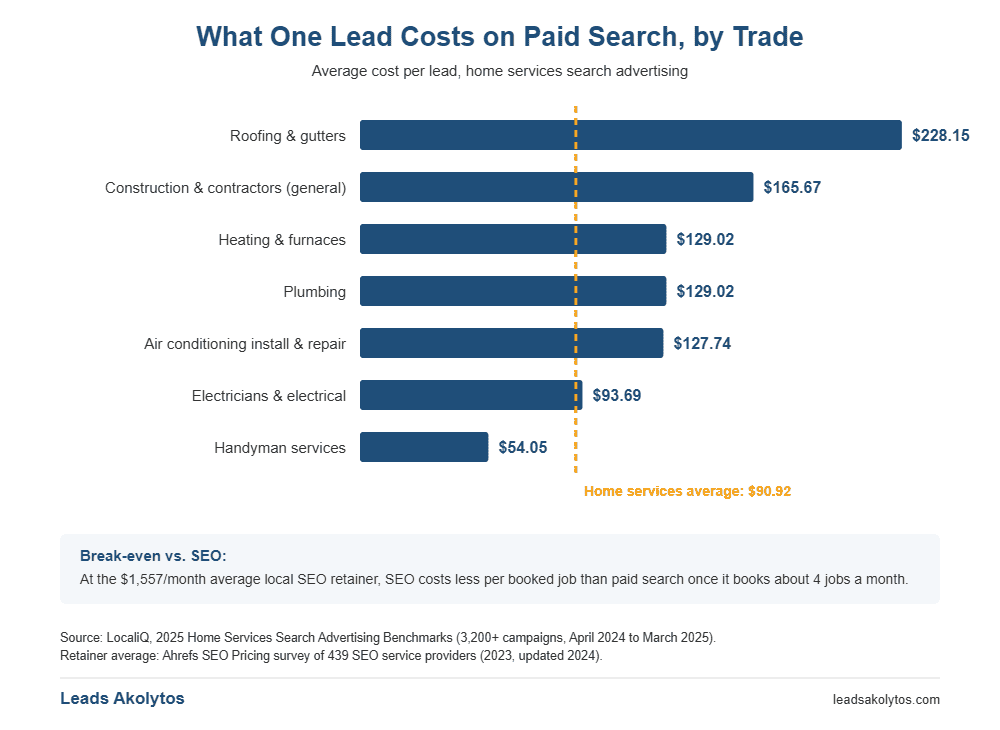
Use this graphic
You are welcome to republish this chart on your own site or in a presentation, free of charge, as long as you credit Leads Akolytos and link back to this article. Copy the snippet below:
<a href="https://leadsakolytos.com/blog/seo-vs-social-media-for-contractors/"><img src="https://leadsakolytos.com/blog/seo-vs-social-media-for-contractors.png" alt="Paid search cost per lead by trade for home service contractors" width="1000" /></a><p>Graphic by <a href="https://leadsakolytos.com/blog/seo-vs-social-media-for-contractors/">Leads Akolytos</a></p>
Two trend lines in that same report matter more than the headline numbers. Cost per lead rose for 69% of home services businesses, up an average of 10.51% year over year, while conversion rates fell in 10 of the 16 trades measured, down an average of 14.96%. Paid search is getting more expensive and slightly less effective at the same time. That is the strongest available argument for owning an organic asset that does not reset to zero the month you stop paying.
For social media, we will be straight with you: we could not find a single credibly published cost-per-lead benchmark for home service contractors. Anyone quoting one is estimating. That absence is itself useful information when you are deciding where the next dollar goes.
The Arithmetic Nobody Shows You
Here is the calculation that actually settles SEO vs social media for contractors in your own business, rather than in the abstract.
Take a plumbing company. LocaliQ puts the average paid-search cost per lead for plumbing at $129.02. Say you close one in three of the leads that turn into a quote — use your own close rate here, this is an assumption about your business, not an industry statistic — that puts your cost per booked job at roughly $387 through paid search. That number stays roughly flat forever. You are renting the leads.
Now run SEO at the Ahrefs local average of $1,557 a month. Cost per booked job depends entirely on volume:
- 4 booked jobs a month: about $389 per job — dead even with paid search
- 8 booked jobs a month: about $195 per job
- 12 booked jobs a month: about $130 per job
So the break-even sits at roughly four booked jobs a month. Below that, paid search is cheaper. Above it, SEO wins and the gap keeps widening, because the cost is fixed while the volume is not. The catch is the ramp: months one through four typically produce close to nothing, so your first-year average is dragged down by a quarter of dead months even if month twelve looks excellent. We work the full year-one numbers in our contractor SEO budget guide.
Run the same arithmetic for roofing, where LocaliQ’s paid cost per lead is $228.15, and the break-even drops to under three booked jobs a month. Run it for handyman work at $54.05 a lead and the break-even climbs to nearly ten. This is exactly why the honest answer on SEO vs social media for contractors is trade-specific rather than universal, and why a blanket “do both” recommendation is a dodge.
The Decision Tree: Where Your Next Dollar Goes
Work this top to bottom and stop at the first yes. It resolves SEO vs social media for contractors in about ninety seconds. It is deliberately ordered so the cheapest, most reversible spend comes first.
- Do you have fewer than 20 Google reviews? Then neither channel is your first spend — reviews are. BrightLocal’s 2026 Local Consumer Review Survey found 47% of consumers will not use a business with fewer than 20 reviews, and 31% will only use one rated 4.5 stars or higher. Traffic sent to a thin profile converts badly no matter which channel paid for it.
- Do you need booked work inside 60 days to cover payroll? Then paid search first, and only paid search. SEO cannot be rushed, and pretending otherwise is how contractors end up angry six months in.
- Is your work emergency or need-now (plumbing, HVAC, electrical)? SEO and your Google Business Profile first. Nobody scrolls social media at 11 PM with a burst pipe.
- Is your work visual and considered (remodeling, roofing, landscaping)? Still SEO first for the map pack and service pages, but move social up much sooner — these buyers research for weeks and want to see finished work before they call.
- Is your service area one small town with very little monthly search volume? Then the ceiling on organic search is low regardless of execution. Referrals, direct outreach and social presence are a better use of the money.
- None of the above? SEO first, social second, revisit the split in two quarters with real numbers rather than opinions.
When SEO Is the Wrong First Move for You
There are real situations where funding SEO first is the wrong call, and it does nobody any good to pretend otherwise:
- You are brand new with no completed jobs and no reviews. There is nothing for a Google Business Profile to stand on yet.
- Your runway is under three months. SEO spend inside a cash crunch is a bet you cannot afford to lose.
- Nobody answers the phone during business hours. More rankings simply means more missed calls. Fix the answering problem first.
- You are testing a brand-new service line. Paid search will tell you in three weeks whether the demand exists; SEO will take three quarters to tell you the same thing.
Worth adding: Google’s own SEO Starter Guide says outright that “If you run a small local business, you can probably do much of the work yourself.” That is not the sort of thing an agency usually volunteers, but it is true, and it changes the budget question for a lot of owners.
The Prerequisite Both Channels Depend On
Reviews sit underneath both answers. BrightLocal’s 2026 Local Consumer Review Survey found that 97% of consumers read reviews for local businesses, 41% now always read them when browsing (up sharply from 29% the previous year), and 74% only care about reviews written in the last three months. The average consumer checks six different review sites before choosing.
Two shifts in that same survey are worth planning around. Google’s share of review-reading fell from 83% in 2025 to 71% in 2026, and use of ChatGPT and similar AI tools for local recommendations rose from 6% to 45%, making AI the third most popular source of business recommendations. Neither of those changes the SEO vs social media for contractors answer, but both argue for the same thing: a consistent, well-reviewed, factually accurate presence that any system — Google, Apple Maps, or an AI assistant — can read and repeat correctly.
If you have already decided social media deserves a real budget line, the next question is whether to run it yourself or pay for management — see our revenue-based framework for when social media for contractors is worth paying someone to manage for a concrete way to decide.
Frequently Asked Questions About SEO vs. Social Media for Contractors
How much should a contractor spend on SEO vs social media each month?
There is no universal split, but a workable starting point for most trades is to fully fund search first and treat social as the second layer. The Ahrefs 2024 pricing survey puts the average local SEO retainer at $1,557 a month; if your total marketing budget is below that, fund search properly rather than splitting it and doing both badly.
How do I know if the social media budget I already spend is working?
Run a quarterly check using our 5-signal social media ROI scorecard rather than judging by follower count alone.
Is paid social advertising better than organic social for contractors?
Paid social buys reach to people who are not currently looking for you, which is demand creation rather than demand capture. It can work for considered purchases like remodels, but it competes for the same dollar as paid search, where LocaliQ measured an average home services cost per lead of $90.92 from people actively searching. For need-now trades, search almost always wins that comparison.
How do I know whether my SEO spend is actually working?
Track four numbers on the same day each month: Google Business Profile calls and direction requests, Search Console impressions and average position, form fills and tracked calls broken out by landing page, and booked jobs rather than raw leads. If those are flat at month six and the foundational work has genuinely been done, say so out loud and change the plan.
If you’re not sure where your business stands right now or which channel would move the needle fastest for your specific trade and market, a free 30-minute strategy call is a low-pressure way to get a second opinion before you commit next quarter’s budget.
Bottom line on SEO vs social media for contractors: fund the channel that matches how homeowners already look for your service, then layer the other one on top once that foundation is solid.
Want this handled for you?
We do this work for home service contractors every day, month-to-month, with no contracts. Book a free 30-minute call and we'll show you where you stand on Google.
Book my free call