If you are paying for social media management for contractors, or considering it, every week you post job-site photos, or pay someone else to, and every week you have no real idea whether any of it is turning into booked jobs. Followers went up. Maybe a few likes. But your crew didn’t get busier because your Instagram grid looks nicer, and if you’re paying a freelancer or agency $300 to $1,500 a month for this, “it feels like it’s doing something” isn’t good enough to keep spending on.

How Do You Know If Social Media Is Actually Working for Your Contractor Business?
You know social media is working when it produces at least one of three measurable outcomes: a rising share of new customers who mention seeing your Facebook or Instagram before calling, direct message or comment inquiries that convert into estimates, and a visible lift in branded searches (“[your company name] reviews” or “[your company name] near me”) in the weeks after you post consistently.
If none of those three are moving after 90 days of consistent posting, the channel isn’t working yet — either the content, the platform choice, or the person managing it needs to change, regardless of how the follower count looks.
Vanity numbers — likes, follower count, reach — measure attention, not revenue. For a contractor, social media’s real job is almost never to generate a cold lead the way a Google search does.
It’s a trust channel: homeowners find you through search or a referral, then check your social media management for contractors profiles before they call to confirm you’re a real, active, competent business. That means the right way to measure it isn’t “did this post go viral,” it’s “did this channel make it easier for someone who was already close to hiring us to actually pick up the phone.”
Why Likes and Followers Don’t Tell You Anything About ROI
Engagement rates across the platforms most contractors use are lower than most business owners assume, which is exactly why judging performance by “does this look popular” sets you up to either over-fire a channel that’s quietly working, or keep paying for one that isn’t.
Industry benchmark data compiled from platform-wide analysis puts average organic engagement in 2026 at roughly 0.3% to 0.5% on Instagram and as low as 0.15% on Facebook — meaning even a well-run small-business account will rarely see likes or comments on more than a tiny fraction of its followers on any given post, per Hootsuite’s 2026 social media benchmark data. A contractor account with 800 followers getting 4 likes on a job photo isn’t necessarily failing; that’s close to the industry median.
What actually correlates with revenue is different. Sprout Social’s 2026 consumer research found that a majority of shoppers research products and services on social platforms before buying, and a substantial share say social content directly influences a purchase decision — but that influence shows up in behavior (a saved post, a DM, a profile visit right before a phone call), not in a like count. If you’re only tracking likes and followers, you’re tracking the wrong layer of the funnel entirely.
The Original Contractor Social ROI Scorecard for Social Media Management for Contractors
Because “is this working” is usually answered with a gut feeling instead of a number, here is a simple scorecard built specifically for how contractors actually get business from social media — not the influencer-marketing metrics most generic social media advice is written around. Score each signal 0, 1, or 2 based on the last 90 days, add them up, and use the band at the bottom to decide your next move.
1. New-customer source mentions (0–2 points)
When you ask new customers how they heard about you (a simple intake-form question or verbal ask on the first call), do any mention checking your Facebook or Instagram? 0 = never comes up. 1 = mentioned occasionally, unprompted. 2 = comes up regularly enough that your office/intake person now expects it.
2. DM and comment inquiries that convert (0–2 points)
Are people messaging your business page or commenting “How much would this cost?” on job photos? 0 = zero inbound messages in 90 days. 1 = occasional messages, rarely convert to a booked estimate. 2 = a regular, trackable stream of messages, some converting to real jobs.
3. Branded search lift (0–2 points)
Check Google Search Console or Google Business Profile Insights for how many people search your exact business name in the weeks after a posting push, compared to a quiet stretch. 0 = flat or declining. 1 = a small, inconsistent bump. 2 = a visible, repeatable bump tied to posting activity.
4. Review-and-photo overlap (0–2 points)
Do new Google reviews or Google Business Profile photos ever reference something you posted about (a specific project, a promotion, a crew member by name)? 0 = no overlap ever noticed. 1 = happened once or twice. 2 = happens regularly enough that it’s a recognizable pattern.
5. Posting consistency and freshness (0–2 points)
This is the leading indicator, not a lagging one — inconsistent posting caps how high the other four can ever score. 0 = last real job-photo post was over 60 days ago. 1 = posting monthly but irregular. 2 = posting weekly or more, with real job photos (not just stock graphics).
| Total score | What it means | What to do next |
|---|---|---|
| 8–10 | Social is a genuine trust-and-conversion channel for you | Keep the current approach, and consider a modest paid boost ($300–$500/month) on your best-performing organic posts |
| 5–7 | Working, but under-leveraged | Fix the lowest-scoring signal first — usually consistency or the intake-form question — before spending more |
| 2–4 | Mostly a branding cost, not a revenue channel yet | Diagnose whether the problem is platform choice, content, or posting frequency before deciding to cut or keep spending |
| 0–1 | Not doing anything measurable for the business right now | Either commit to fixing the fundamentals or redirect that budget toward a channel with a shorter feedback loop, like local SEO or PPC |
This social media management for contractors scorecard is deliberately simple enough to run yourself in 20 minutes a quarter — no analytics dashboard subscription required, no vanity metric involved. The inputs are things you or your office staff already have access to: your intake process, your Google Business Profile dashboard, and Search Console.
Red Flags Your Social Media Management for Contractors Is Wasting Your Budget
If you’re paying for social media management for contractors and the scorecard above comes out low, these are the specific things to check before assuming the channel itself is the problem:
- No connection between what gets posted and what your customers actually search. Generic “tip of the day” graphics with no real job photos rarely move any of the five signals above. Real, recent project photos do the heavy lifting.
- No reporting beyond a follower-count screenshot. A vendor who can’t tell you inquiry volume, comment activity, or which posts get saved or shared isn’t tracking what matters to a contractor’s bottom line.
- Posting frequency that’s inconsistent or has quietly stopped. A feed that goes dark for two months and then resumes signals “maybe out of business” to a homeowner doing due diligence — the opposite of the trust effect social media is supposed to create.
- No mention of your Google Business Profile at all. Google has started surfacing recent social posts directly on Business Profiles in some markets, per Google’s own Business Profile documentation — a vendor who isn’t coordinating social content with your Business Profile is leaving a real, current visibility lever on the table.
- Platforms you don’t need. If your vendor is managing five platforms and none of the five signals above are moving, that’s effort spread too thin, not a five-platform problem — Facebook and Instagram carry almost all of the trust-check weight for home services.
Should You Manage This Yourself or Pay Someone for Social Media Management for Contractors?
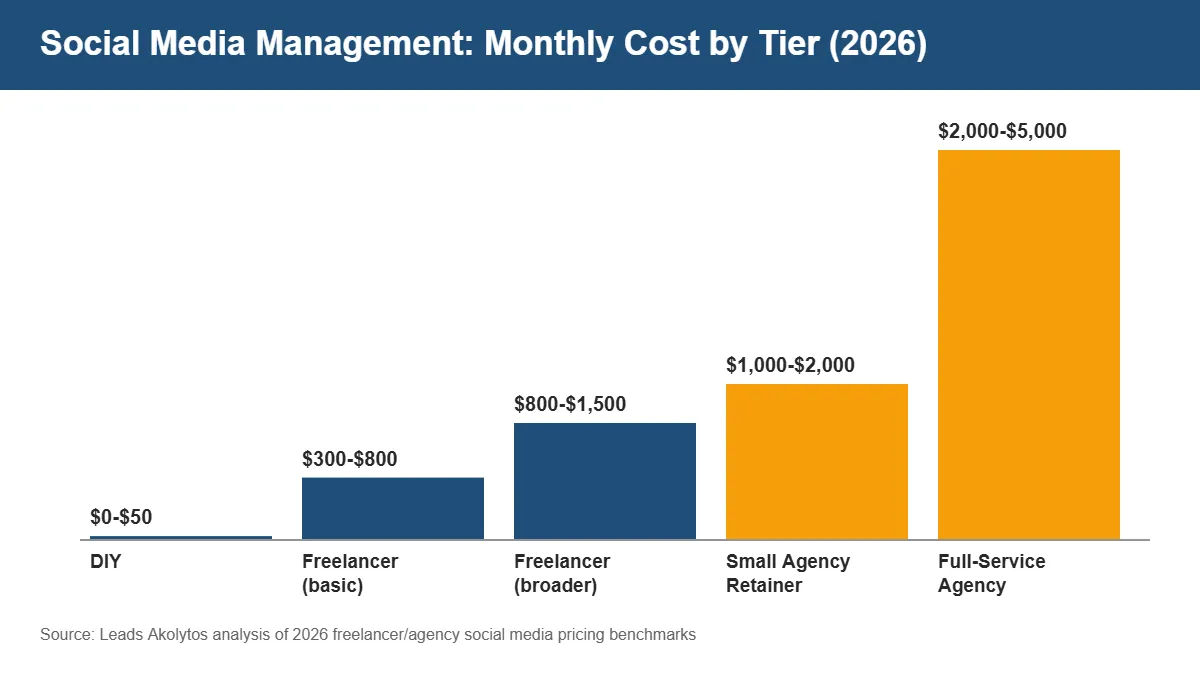
There’s no universal right answer, but the honest tradeoff comes down to two things: whether you have 3–5 hours a month of consistent time (not “whenever I remember”), and whether inconsistency has already been the problem historically.
DIY makes sense if: you or someone on your team already takes decent job-site photos as a matter of habit, you can commit to a fixed weekly posting slot, and your business is small enough that a handful of posts a month realistically covers your output. The cost is genuinely $0 in cash, but the real cost is the 3-5 hours a month it takes to shoot, edit, caption, and post consistently — hours that come out of estimating, following up on leads, or running crews.
Paying someone makes sense if: your calendar has already proven that “I’ll post when I have time” means posting stops after three weeks, you have volume of project photos but no time to turn them into a consistent cadence, or your scorecard above is stuck at 0-1 specifically because of the consistency signal. A managed service in the $300–$1,500/month range removes the consistency risk entirely, which is usually the single highest-leverage fix for a contractor’s social presence.
Either way, when it comes to social media management for contractors, the scorecard above is what tells you whether the money or the time you’re spending is actually buying anything — run it before deciding to increase, cut, or switch how you handle this.
A Worked Example: Running the Scorecard on a Real Account
Take a mid-size roofing contractor paying $500/month for social media management for contractors. Running the five-signal scorecard: new-customer mentions score a 1 (comes up occasionally, unprompted), DM inquiries score a 1 (a few messages, one converted to an estimate), branded search lift scores a 0 (flat in Search Console), review-and-photo overlap scores a 1, and posting consistency scores a 2 (weekly, real job photos). Total: 5 out of 10 — squarely in the “working, but under-leveraged” band.
The fix in that scenario isn’t cutting the budget for social media management for contractors — it’s adding the one missing piece: a simple intake-form question (“how did you hear about us?”) to actually capture the source-mention signal, and a habit of checking Search Console quarterly for branded search movement. Six months later, the same account re-ran the scorecard at 7 out of 10, without spending a dollar more on social media management for contractors — the money was already working, it just wasn’t being measured.
How Often Should You Actually Review Social Media Management for Contractors?
When you evaluate social media management for contractors, quarterly review is enough for most businesses. Reviewing weekly or monthly creates noise — a single slow week doesn’t mean the channel stopped working, and a single viral post doesn’t mean it suddenly did. Run the five-signal scorecard every 90 days, track the total over time, and only make a real decision (cut the channel, switch vendors, change platforms) if two consecutive quarters show no improvement.
These are the questions we hear most from contractors weighing social media management for contractors against other options.
One more scoring adjustment worth making before you run this on your own account: weight the five categories by what actually drives your specific business, not evenly. A remodeler whose jobs come from long-consideration research should weight branded search lift and review-and-photo overlap more heavily, since those signal genuine buying intent building over weeks; a same-day-service trade like plumbing or HVAC repair should weight DM and comment inquiries higher, since those convert to calls almost immediately. Running social media management for contractors through a generic, evenly-weighted scorecard can make a channel look like it is working when it is really just generating low-intent engagement.
Frequently Asked Questions
Is social media worth it for a small contractor business?
For most contractors, yes — but as a trust channel that supports search and referrals, not as a primary lead source on its own. It rarely replaces a Google search the way local SEO or PPC does, but a stale or inactive profile actively costs you jobs when homeowners check it before booking, so “doing nothing” carries a real cost even if posting doesn’t feel like it’s generating leads directly.
How much should a contractor spend on social media management?
Typical small-business social media management for contractors runs $300 to $1,500 per month depending on platforms and posting frequency. Before increasing that spend, run the scorecard above — if you’re scoring under 5, the fix is usually consistency or content quality, not a bigger budget.
How long does it take to see results from contractor social media management?
Give a consistent posting cadence at least 90 days before judging results, since the metrics that matter (branded search lift, DM inquiries, source mentions) build gradually rather than spiking. If nothing has moved after two full 90-day cycles with consistent posting, that’s a legitimate signal to change platform, content approach, or vendor.
Should I do SEO or social media first if I can only afford one?
For most contractors actively trying to grow, SEO and paid search typically come first because they target people actively searching for your service right now, with social media layered in afterward to build trust and stay visible between jobs. If you’re weighing that tradeoff directly, see our breakdown of where to put your marketing budget first. And if you haven’t decided whether to pay for management at all yet, see our revenue-based DIY-vs-hire framework for that first decision.
Whether your social media is worth the time or the invoice comes down to whether it’s moving any of the five signals above — not how the grid looks. If you run the scorecard and come out under a 5, book a free 30-minute strategy call and we’ll walk through your actual numbers with you and tell you honestly whether the fix is content, consistency, platform choice, or whether that budget is better spent somewhere else first.
A Quick Way to Audit Social Media Management for Contractors Yourself
Pull your last 90 days of posts and count how many generated an actual comment, DM, or share from someone who isn’t already a customer — not a like, a real interaction. If social media management for contractors on your account is producing mostly likes from your own crew and no outside engagement, that’s the clearest early sign the content isn’t reaching or resonating with real prospects, regardless of the follower count.
Good social media management for contractors ties every post back to a business reason: a completed job, a review, a seasonal service push, or a direct offer. If most of your posts don’t map to any of those, social media management for contractors on your account is likely running on autopilot rather than strategy — worth flagging before renewing any contract.
What Good Social Media Management for Contractors Costs
Professionally run social media management for contractors typically runs $300-$800/month for a single-location trade business, covering content creation, posting, and basic community engagement. At Leads Akolytos, social media management for contractors starts at $1200/month with no contract — enough evidence within 60-90 days to know whether it’s working before committing further.
When to Cut Social Media Management for Contractors Loose
If three straight months of social media management for contractors on your account produce no measurable increase in calls, form fills, or booked jobs, that’s the signal to pause and ask hard questions rather than renew on autopilot. Good social media management for contractors should be able to point to at least one attributable lead per month by month three — if it can’t, the platform, content, or provider needs to change.
Want this handled for you?
We do this work for home service contractors every day, month-to-month, with no contracts. Book a free 30-minute call and we'll show you where you stand on Google.
Book my free call