The Short Answer
Most contractor sites see the first real trickle of content-driven leads around month 3 to 4, with growth that compounds meaningfully by month 6 to 12 — not because Google is slow to notice new pages, but because ranking and compounding are two separate clocks running at different speeds. New pages are often indexed within days to a few weeks; earning enough trust and topical depth to actually rank and convert takes months of consistent publishing, not one article.
Why Content Marketing Timelines Get Boiled Down to One Wrong Number
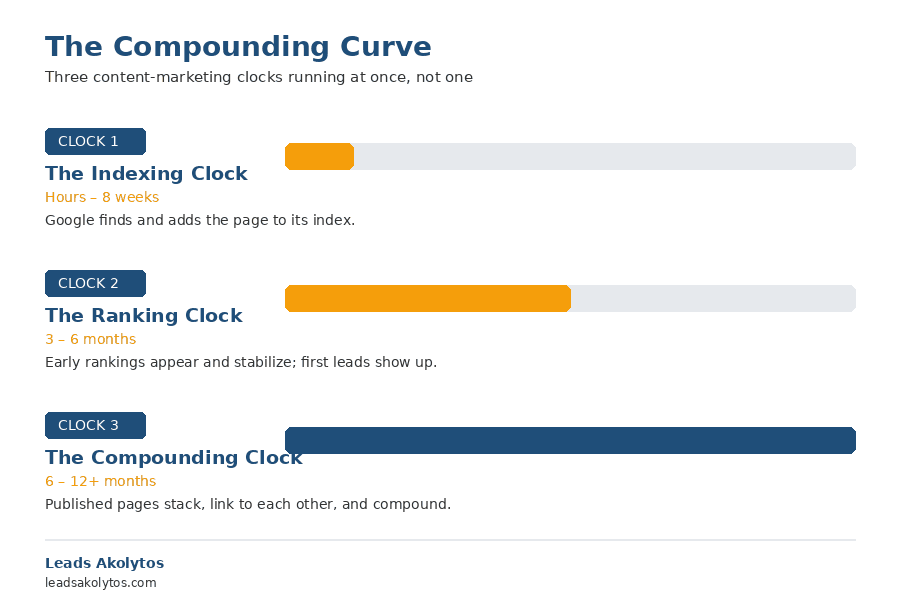
Ask five agencies “how long does content marketing take” and you will get five different answers — “three months,” “six months,” “a year.” None of them are lying. They are each answering a different question, because content marketing is not one clock, it is three clocks running at the same time, and most timeline claims quietly average all three into a single misleading number.
The Compounding Curve: Three Clocks, Not One
Separating these three clocks is the only way to set a realistic expectation with a client, or with yourself if you are handling content in-house.
Clock 1: The Indexing Clock (Hours to About 8 Weeks)
This is simply how long it takes Google to find and add a new page to its index at all. Google’s own John Mueller has said, in comments reported by Search Engine Journal, that indexing “can take anywhere from several hours to several weeks,” and he suspects most good content is picked up within about a week. Independent research from Onely found that roughly 83% of pages get indexed in their first week, though some pages wait up to eight weeks — and a meaningful share of low-value pages never get indexed at all. Being indexed is table stakes. It is not the same as ranking, and it is nowhere close to generating a lead.
Clock 2: The Ranking Clock (Roughly 3 to 6 Months for Early Traction)
This is where most of the frustration behind questions like how long does SEO take to work actually lives. A large Semrush study that tracked 28,000 brand-new domains over 13 months found that only about 19% of those domains had a page 1 (top 10) ranking that they were still holding onto by month 6 — and fewer than 5% managed to hold a first-page ranking for a full year straight. That is a sobering number if you read it as “content marketing rarely works.” Read correctly, it says something different: rankings are volatile early, and the sites that eventually win are the ones still publishing consistently when everyone else has already quit or gone quiet.
One important caveat for a contractor business specifically: that Semrush data is about brand-new domains starting from zero. Most contractor websites are not brand-new domains — they already have some age, some existing pages, and often some existing backlinks from directories, suppliers, or local press. That existing foundation typically means the ranking clock runs faster for an established local business site adding a content program than it does for a domain registered yesterday.
Clock 3: The Compounding Clock (6 to 12+ Months, and Then It Keeps Paying Off)
This is the clock nobody puts a clean number on, because it is not really a deadline — it is a curve. Article 1 alone rarely moves the needle. Article 20, sitting alongside articles 1 through 19 that are all still ranking, internally linked to each other, and covering every buyer question in your service area, is what actually starts generating a steady stream of leads. Each new piece makes the ones around it stronger. This is why a content program that looks flat for months can look completely different by month 9 or 12 — the earlier work never stopped working, it was just quietly accumulating.
Use This Graphic
You are welcome to republish The Compounding Curve diagram on your own site, free of charge, as long as you credit and link back to this article. Just copy the embed code below.
<a href="https://leadsakolytos.com/blog/how-long-does-content-marketing-take/"><img src="https://leadsakolytos.com/blog/content-marketing-three-clocks-small.png" alt="The Compounding Curve: three content-marketing clocks, by Leads Akolytos" style="max-width:100%;"></a><br>Graphic by <a href="https://leadsakolytos.com">Leads Akolytos</a>What Realistically Happens Month by Month
| Timeframe | What Is Actually Happening | What You Should NOT Expect Yet |
|---|---|---|
| Month 1 | Pages get published and indexed; Google Search Console starts showing impressions for a handful of long-tail terms. | Meaningful traffic, rankings on competitive terms, or booked jobs traced to a blog post. |
| Months 2 to 3 | Early rankings appear and move around a lot; some pages settle onto page 2 or 3. | Stable page 1 rankings across the board. |
| Months 3 to 4 | First real leads start showing up, usually from lower-competition, high-intent questions rather than broad head terms. | A high volume of leads, or leads from your most competitive keywords. |
| Months 6 to 9 | A growing cluster of pages holds page 1 rankings; internal linking between posts starts compounding their combined authority. | Results without continued publishing — momentum stalls quickly if output stops here. |
| Months 9 to 12+ | Content becomes a genuine, ongoing lead channel that keeps producing with less incremental effort per lead. | A “finished” state where you can stop entirely; trades and competitors change, so content needs refreshing. |
Should You Write This Yourself, or Hire an Authoritative Content Creation Service?
However you answer how long does content marketing take for your business, both paths can work. The honest tradeoff is time and consistency, not talent. A contractor who genuinely knows the trade can write a good, credible article — the problem is almost never the first article, it is the fifteenth one, written on a Tuesday night after a full week of jobs, with the same care as the first. Content marketing’s ROI depends entirely on that consistency (see Clock 3 above), which is exactly the part that becomes hardest to sustain in-house once the busy season hits.
A dedicated Authoritative Content Creation service earns its cost by treating publishing cadence as non-negotiable and by building the internal-linking structure that makes Clock 3 actually compound, rather than publishing pages that sit disconnected from each other. If cost is the open question before you decide either way, our Authoritative Content Creation pricing guide breaks down what that typically runs for a contractor business.
3 Mistakes That Quietly Reset the Compounding Clock
The most expensive mistake in content marketing is not writing a bad article. It is doing something that resets the clock on the good articles you already published, without realizing it.
1. Going Quiet for a Few Months and Then Restarting
Publishing 8 articles in month 1, then nothing for the next four months because the season got busy, does not just pause progress — it actively hurts it. Search engines and readers both read a stalled blog as a signal that the site is not being maintained, and the compounding effect described above depends on steady, ongoing signals, not a single burst. A slower, sustainable pace of 2 articles a month for a year consistently outperforms 8 articles in one month followed by silence.
2. Rewriting the Same Topic Instead of Building Around It
It is tempting to “redo” an underperforming article from scratch. Often the better move is to leave the original page alone, publish a genuinely different angle on a related question, and link the two together. Article count and internal linking density are two of the biggest levers behind Clock 3 — deleting and rewriting the same URL over and over forfeits both.
3. Switching Focus Keywords or URLs Mid-Stream
Every time a page’s target keyword or URL changes, any ranking progress that page had built up is at meaningful risk of resetting, because search engines have to re-evaluate the page against a new intent from scratch. If an article genuinely is not working, a better fix is usually to strengthen it in place — deepen the content, add real data, fix technical issues — rather than relaunching it under a new URL and target phrase.
How to Know If Your Content Program Is Actually On Track
- By month 2: new pages are showing up in Google Search Console with impressions, even if clicks are minimal.
- By month 4: at least a few long-tail, lower-competition pages are ranking on page 1 or high page 2.
- By month 6: you can point to at least one lead or booked job that started with someone reading a specific article.
- By month 9 to 12: content is a repeatable channel you can forecast against, not a one-off experiment you are still hoping pays off.
Answering how long does content marketing take for YOUR specific numbers starts with tracking these milestones, not guessing. If you are past month 6 with genuinely zero movement on any of these, the problem is rarely “content marketing doesn’t work” — it is almost always publishing cadence, weak topic selection that does not match what buyers actually search, or a technical issue keeping pages from being indexed in the first place. That is worth diagnosing directly rather than assuming the whole channel is a dead end.
Frequently Asked Questions
How long does content marketing take to start generating leads for a contractor business?
Most contractor sites see the first content-driven leads around month 3 to 4, with growth that compounds more noticeably from month 6 onward, provided publishing stays consistent through that period.
Is content marketing slower than PPC or paid ads?
Yes, in the sense that paid ads can generate a lead the same day a campaign launches, while content marketing builds toward results over months. The tradeoff is that content keeps generating leads long after a single article is published, while paid leads stop the moment you stop paying.
Why hasn’t my blog generated any leads after a few months?
Three months in is often still within the indexing-and-early-ranking window, especially for competitive terms. If it has been six months or more with no movement in Google Search Console impressions at all, check publishing consistency, whether the topics actually match buyer questions, and whether pages are being indexed correctly before concluding the channel is not working.
Does a brand-new website take longer to see content marketing results than an established one?
Generally yes. Research on new domains shows rankings are slower and less stable in the first year compared to sites that already have some age, existing pages, and backlinks — which describes most contractor websites adding a content program, rather than a domain registered from scratch.
How many blog posts does it take before content marketing starts working?
There is no fixed number, but a program built around roughly 2 to 4 well-targeted articles per month, each linked to related existing content, typically reaches a noticeable compounding effect somewhere between 15 and 25 published pieces.
If you want a realistic, honest read on how long a content program would take for your specific trade and market — not a generic “six months” answer — book a free strategy call. We will look at what is already ranking in your market and tell you plainly what a realistic timeline looks like before you spend a dollar.
Want this handled for you?
We do this work for home service contractors every day, month-to-month, with no contracts. Book a free 30-minute call and we'll show you where you stand on Google.
Book my free call