The Short Answer
There is no universal number of leads a contractor should expect from SEO — anyone who gives you one specific figure without asking about your market, your trade, or your competition is guessing. What you can do instead is build a realistic range for your own business using three numbers you can actually check: how many people search for your services in your service area each month, what share of clicks the top local results realistically capture, and what percentage of those clicks turn into an actual call or form fill. This article walks through how to build that range yourself, and what questions to ask an SEO provider who claims to know your number before doing that work.
How Many Leads Should a Contractor Expect From SEO in Different Markets?
A roofer in a metro area of two million people searching “roof replacement near me” is competing in a completely different market than a plumber in a town of twenty thousand. Search volume, local competition, how many other contractors are actively investing in SEO, and how established your own site already is all change the honest answer by an order of magnitude. Any provider who quotes you a specific lead number before looking at your actual market data is selling a script, not an estimate.
That doesn’t mean the question is unanswerable — it means the answer has to be built from your own numbers, not borrowed from someone else’s case study in a different city and a different trade.
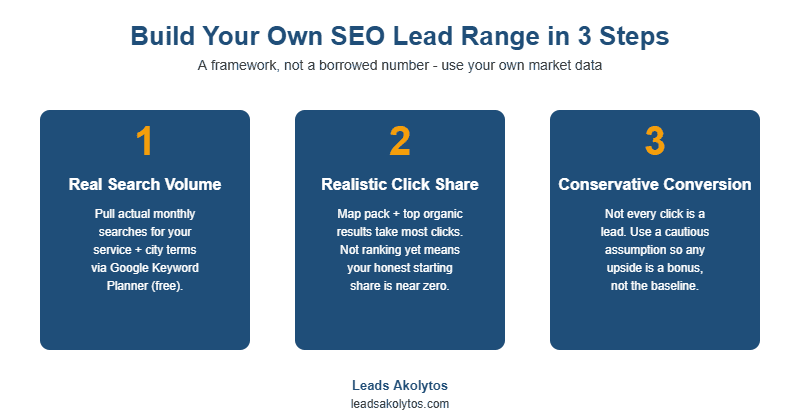
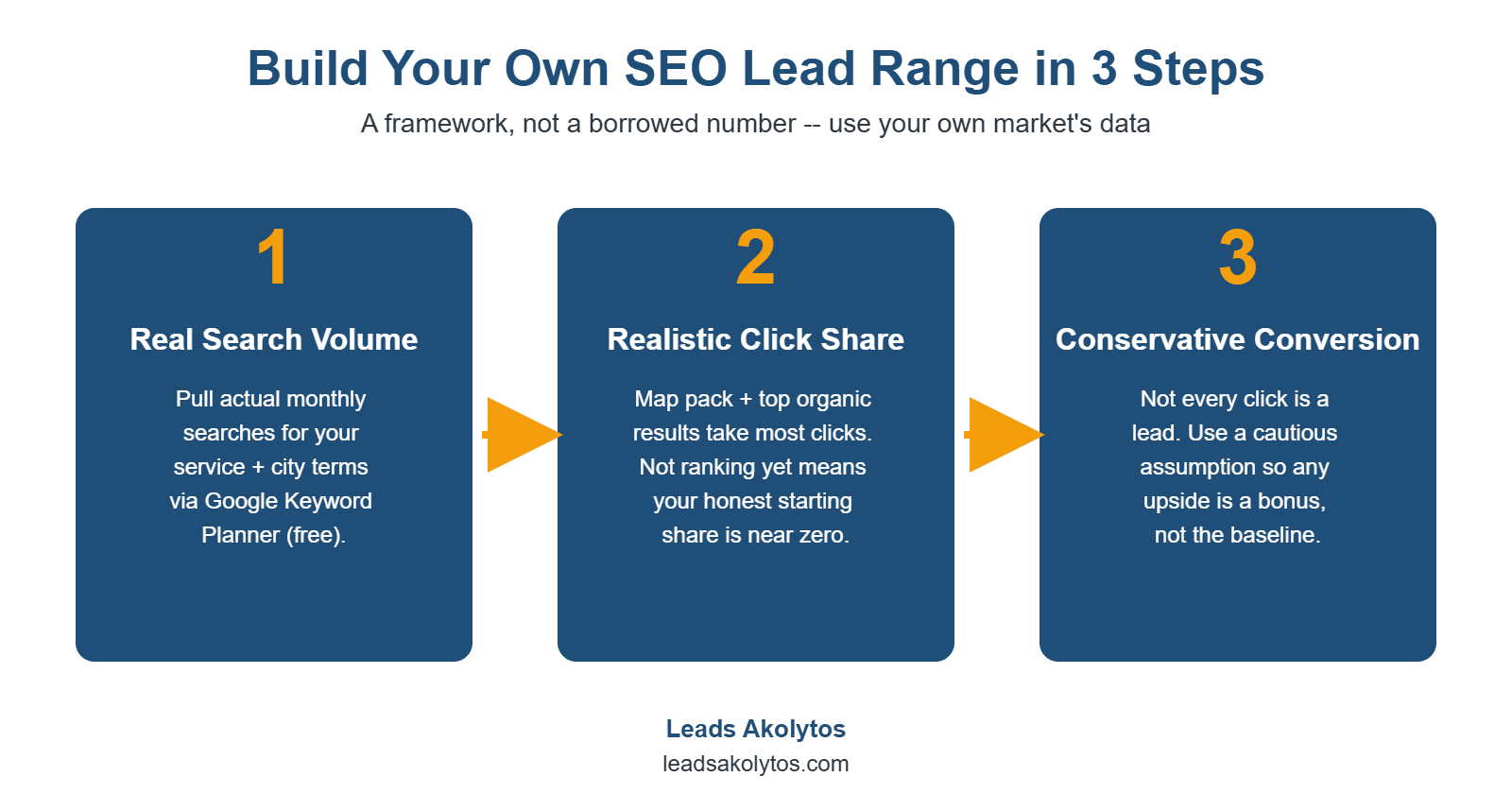
Build Your Own Realistic Range in Three Steps
Step 1: Find your real local search volume. Google’s own Keyword Planner (free with a Google Ads account, no ad spend required to use the research tool) shows actual monthly search volume for terms like “[your service] [your city]” and nearby variations. This is the ceiling on how many people are even looking — everything downstream is a fraction of this number.
Step 2: Estimate a realistic click share. The Google local 3-pack and the first few organic results capture the large majority of clicks on a local search, with click share dropping fast after that. If you’re not currently ranking in the map pack or on page one, your honest starting click share is close to zero — the leads only start showing up once you’re actually visible, which is the entire point of the work an SEO provider is doing in the first place.
Step 3: Apply a conservative conversion rate. Not every click becomes a lead. Some people are comparison shopping, some bounce immediately, some call a competitor instead. Building your range with a conservative assumption — and treating any number above that as a pleasant surprise rather than the baseline — keeps expectations honest instead of inflated by a sales pitch.
Multiplying a real search-volume number by a realistic click share and a conservative conversion rate gives you a defensible range specific to your own market, instead of a number pulled from somebody else’s marketing page.
Use this graphic on your own site or share it with attribution and a link back to this article: /blog/how-many-leads-should-a-contractor-expect-from-seo/
What This Means for Your Timeline
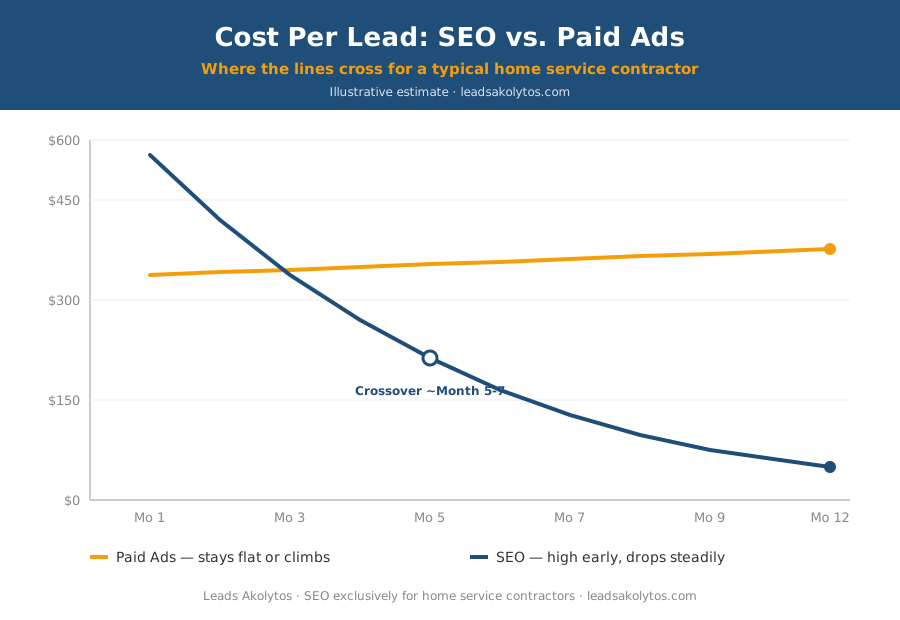
None of this happens on day one. Ranking improvements from SEO work compound over months, not weeks, which is why the honest range for month one looks nothing like the honest range for month nine. A provider who promises a flat lead number “starting immediately” is either not doing organic SEO at all (more likely paid ads dressed up as SEO) or setting an expectation they can’t actually meet. This timeline breakdown covers what a realistic month-by-month ramp actually looks like.
Questions to Ask Before You Trust Anyone’s Lead Number
If a provider gives you a specific lead-count promise before doing any research on your market, ask these directly:
- “What search volume data did you pull for my specific service area to get that number?”
- “What click-through and conversion assumptions are you using, and where do those come from?”
- “Is that a guarantee, or a projection — and what happens if it’s wrong?”
A provider doing this honestly will walk you through their math using your actual market data. A provider who can’t answer these is quoting a number designed to close the sale, not to set an accurate expectation. This vetting checklist covers the rest of what to ask before signing anything.
Should You Trust a Lead Guarantee?
Be specifically cautious of any SEO provider who guarantees a fixed lead count in a contract. Organic search rankings are not something any SEO provider directly controls — Google’s own algorithm decides rankings, and no legitimate provider can guarantee an outcome they don’t control. A provider offering a lead-volume guarantee is either padding the number with paid traffic without telling you, or setting up a contract loophole that lets them walk away with your money if the real number comes in low.
A provider building you a realistic, market-specific range — and explaining exactly how they got there — is doing the honest version of this work.
How Business Size Changes the Answer
A one-truck operation and a ten-crew regional company will get a different honest answer to how many leads a contractor should expect from SEO, even in the same city, because they are not really competing for the same slice of demand. A small operation with limited capacity may only want and be able to handle a fraction of the total local search volume — more leads than you can answer the phone for is not a win, it is wasted spend and frustrated callers.
A larger crew with more capacity can reasonably aim for a bigger share of the same markets search volume, but only once the underlying visibility — rankings, reviews, a complete Google Business Profile — actually supports it. How many leads a contractor should expect from SEO scales with capacity and visibility together, not with ambition alone.
What a Believable Month-by-Month Lead Curve Looks Like
How many leads should a contractor expect from SEO changes shape over the life of the campaign, not just by market. Early months typically show little to no measurable lift while the underlying visibility work — technical fixes, on-page content, review generation, citation cleanup — gets built out. The middle months show a gradual, sometimes lumpy increase as rankings start to move. Only once rankings stabilize does the lead flow become something closer to predictable month over month. Anyone projecting a flat, steady lead number from week one has not accounted for how organic search actually ramps.
Common Ways Lead Numbers Get Inflated
Understanding how many leads to expect also means knowing how the number can be quietly padded. A few patterns show up again and again in inflated reports: counting form-fill spam and bot submissions as real leads, counting phone calls that lasted under ten seconds as qualified contacts, blending paid search leads into an organic SEO report without disclosing the split, and counting the same lead twice across two different tracking tools that were never reconciled against each other.
Asking to see raw, unfiltered call and form data — not just a rolled-up monthly total — is the simplest way to check whether the how many leads to expect number you are being shown is real. A provider confident in their numbers will not hesitate to show the underlying data.
Build Your Own Range: A Worked Example
Use your own numbers here, not ours — this is a worksheet, not a benchmark. Pull your actual monthly organic search visits from Google Search Console or Google Analytics, then apply a realistic contact rate for your site to see what a plausible lead range looks like for your business.
| Input | Conservative Scenario | Strong Scenario |
|---|---|---|
| Monthly organic search visits (from your own Search Console data) | 150 | 500 |
| Visitors who call, fill a form, or use chat (typical contractor site range) | 3% | 5% |
| Resulting monthly leads from SEO | ~5 | ~25 |
Run this same math with your own Search Console numbers each month, and you will have a realistic, defensible range for how many leads you should expect from SEO — one built from your own site’s data instead of a number a vendor handed you.
Frequently Asked Questions
Is 10 leads a month from SEO good or bad?
It depends entirely on your market size, your trade, and your ad spend elsewhere — there’s no universal good or bad number. What matters is whether that number is trending up over time and whether the leads are converting into booked jobs at a rate that makes the investment worthwhile.
Why did my leads drop even though my rankings look the same?
Rankings and leads can diverge for several reasons: seasonal search volume changes, a competitor improving their listing’s photos or reviews and winning more of the click share at the same rank, or a change in how your Google Business Profile itself is presenting to searchers.
How do I know if my current SEO provider’s lead numbers are real?
Ask to see the source data — search volume by keyword, click-through data from Google Search Console (not the provider’s own dashboard alone), and where each lead in their reporting actually came from.
Get Your Own Estimate
We build every client’s lead expectations from their own market’s real search data, not a template pulled from a different city or trade — and we’ll show you the math. Book a Free 30-Minute Strategy Call →
Keep in mind that lead volume compounds over time rather than arriving all at once — see how long SEO actually takes to work for a contractor business for a realistic timeline to pair with the estimate above.
To sum up: how many leads to expect depends on your search volume, your click share, and your conversion rate — not on a number borrowed from someone else’s case study. If you’re weighing SEO against a faster-but-shared alternative, see our pay-per-lead vs. SEO cost comparison for how the two models stack up on cost per closed job over a full year.
One practical way to stress-test how many leads you should expect from SEO is to build a worst-case, base-case, and best-case version of the same range. Plug in a conservative search volume, a modest click share, and a low conversion rate for the worst case, then repeat with realistic and optimistic assumptions for the other two. Seeing how many leads each scenario produces, side by side, makes it much easier to spot an SEO provider who is quoting you a number that only holds up in the best-case column.
Want this handled for you?
We do this work for home service contractors every day, month-to-month, with no contracts. Book a free 30-minute call and we'll show you where you stand on Google.
Book my free call