
Technical SEO and site speed fixes typically start showing measurable movement in 2-4 weeks for the parts Google can re-crawl quickly (page speed scores, broken links, redirect chains), 6-10 weeks for ranking movement on pages that were being held back by a real technical issue, and 3-4 months before that ranking movement reliably turns into more phone calls and form fills.
A realistic technical SEO speed fix timeline is rarely one number. The range is wide because "technical SEO" is not one task with one timeline -- it is three different tracks that move at three different speeds, and most contractors only ever hear the slowest one quoted to them as if it applied to everything.
The Three Tracks, and Why They Move at Different Speeds
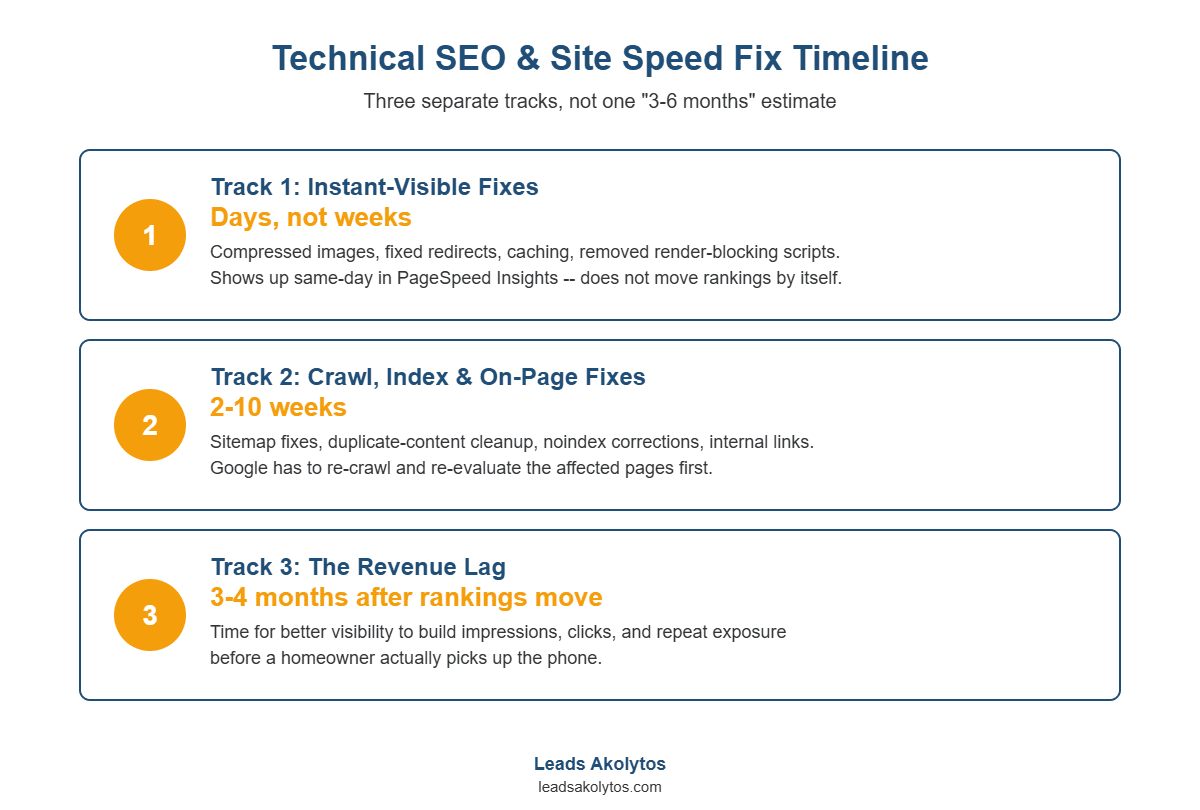
Lumping every technical and speed fix into a single "SEO takes 3-6 months" timeline is the single most common reason contractors feel misled by a technical SEO engagement. In reality there are three distinct tracks, and knowing which one a specific fix belongs to is the difference between a realistic expectation and a frustrating one. Most of the confusion around a technical SEO speed fix timeline comes from treating these three tracks as if they were one.
Use this graphic
You're welcome to republish this graphic on your own site, as long as you credit Leads Akolytos with a link back to this article. Copy the code below:<a href="https://leadsakolytos.com/blog/technical-seo-speed-fix-timeline/"><img src="https://leadsakolytos.com/blog/technical-seo-speed-fix-timeline-3-tracks.png" alt="Technical SEO speed fix timeline: 3 tracks" width="1200" /></a><br>Source: <a href="https://leadsakolytos.com/blog/technical-seo-speed-fix-timeline/">Leads Akolytos</a>Track 1: Instant-Visible Fixes (Days, Not Weeks)
Compressing oversized images, fixing a broken redirect chain, enabling browser caching, or removing a render-blocking script shows up immediately in a tool like Google PageSpeed Insights -- often the same day the fix goes live. These fixes do not move your rankings by themselves, but they remove friction that was actively working against every other fix on this list. If a provider shows you a "before and after" PageSpeed score within a week, that is this track, not a ranking result.
Track 2: Crawl, Index, and On-Page Technical Fixes (2-10 Weeks)
Fixing a broken sitemap, resolving duplicate-content issues, correcting a noindex tag that was accidentally left on a service page, or cleaning up a site's internal link structure requires Google to actually re-crawl and re-evaluate the affected pages before anything changes in the rankings. For a contractor site with moderate crawl frequency, that re-evaluation typically takes 2-4 weeks to begin and 6-10 weeks to fully settle, depending on how often Google already visits your site and how significant the fix was. A sitemap fix on a page Google rarely visits can take longer simply because the re-crawl itself is the bottleneck, not the fix.
Inside the technical SEO speed fix timeline, Track 2 is the one most contractors underestimate. Google's own guidance on how crawling and indexing works is a useful plain-language reference for understanding why this track cannot be rushed past a certain point, regardless of who is doing the fix.
Track 3: The Revenue Lag (3-4 Months After Ranking Movement)
This revenue-lag stage of the technical SEO speed fix timeline is the track almost no one quotes you, and it is the one that actually matters to your business.
Even once a page's ranking improves, it takes time for that improved visibility to accumulate enough impressions, clicks, and repeat exposure before a homeowner actually picks up the phone. For a seasonal or considered-purchase trade, that lag runs 3-4 months on top of the ranking movement itself -- which is why a technical fix made in January often does not show up as a measurably different call volume until April or May.
That full technical SEO speed fix timeline -- from the first PageSpeed fix to the revenue lag -- is why a provider who promises overnight rankings is not being straight with you. For the fuller picture of what a technical SEO and site speed engagement should include month to month, see our Technical & Speed Optimization service page.
What Actually Drives the Technical SEO Speed Fix Timeline Up or Down
- How often Google already crawls your site. A site with frequent crawl activity (newer content, regular updates, healthy backlink profile) sees Track 2 fixes reflected faster than a site Google visits infrequently.
- How severe the starting problem was. Fixing a site that was accidentally blocking Google from a handful of service pages produces a faster, more visible jump than incrementally shaving load time off a site that had no major technical blocker to begin with.
- Whether the fix is isolated or compounding. A single redirect fix moves one page. A site-wide template fix (say, correcting how every service-area page handles canonical tags) compounds across dozens of pages at once and tends to show a larger, if not necessarily faster, result.
- Competitive density in your market. In a market with several established competitors already well-optimized, the same technical fix produces a smaller ranking jump than it would in a market where competitors have obvious, uncorrected technical problems of their own.
3 Signs a Timeline Is Being Misrepresented to You
- A single number with no breakdown by track. "You'll see results in 90 days" with no distinction between a PageSpeed score, a ranking position, and a call volume change is a sales number, not a technical estimate.
- No mention of what happens in the first 2 weeks. A provider who cannot tell you what Track-1, same-day-visible work they will do in week one is likely planning to spend that time on discovery rather than on fixes you can already verify yourself.
- A guarantee with no conditions. No legitimate provider can guarantee a specific ranking timeline, because Google's crawl frequency and competitive movement are both outside anyone's control. An honest estimate comes with the conditions attached ("assuming no major algorithm update and a crawl frequency consistent with your current traffic") -- Search Engine Land's own guide to SEO timelines makes the same point: anyone promising a fixed date without caveats is selling confidence, not a technical estimate.
Is It Worth Paying Someone, or Should You Fix It Yourself?
Track 1 fixes are genuinely DIY-able for an owner comfortable in WordPress or their site's admin panel -- image compression plugins and basic caching settings are a few hours of work, not a specialized skill. Track 2 work is where DIY gets harder: diagnosing why a specific page isn't being indexed, or untangling a duplicate-content issue across service-area pages, requires reading Google Search Console's technical reports correctly, which is where most self-taught attempts either miss the real cause or fix a symptom instead of the underlying issue.
For a sense of typical costs either way, see our website speed optimization cost guide and our breakdown of whether to pay for technical SEO and site speed work or fix it yourself.
The honest rule of thumb: if you can read a Search Console "Coverage" report and know what each error actually means, DIY is realistic for most of Track 1 and some of Track 2. If that report reads like a foreign language, paying someone to interpret it correctly the first time is usually faster than a few months of trial-and-error guessing at Track 2 fixes that never fully resolve the underlying issue.
Get a Realistic Timeline for Your Site
Every site's starting point is different -- a site with a severe, isolated technical problem can see a bigger Track 2 jump than a site with no major blocker but lots of incremental Track 1 opportunity. Schedule a free strategy call and we will tell you honestly which track your site's biggest opportunities fall into, and a realistic timeline for each -- not a single number that blends all three together.
Frequently Asked Questions
How long until a technical SEO fix shows up in Google Search Console?
Track 1 fixes (speed, caching, compression) are visible in a PageSpeed-style tool immediately. Search Console's own reporting on crawl and coverage issues typically reflects a fix within 1-3 weeks, since it depends on Google re-crawling the affected pages.
Why did my rankings not move even though my PageSpeed score improved?
Page speed is one input among many ranking factors, and a Track 1 improvement alone rarely moves rankings on its own unless speed was severe enough to actively be suppressing the page. A faster site removes a potential drag; it does not automatically replace the need for strong on-page relevance and authority signals.
Should I expect faster results from a one-time technical audit or an ongoing retainer?
A one-time audit that fixes a severe, isolated issue (like an accidental noindex tag on key pages) can produce a faster, more visible jump than an ongoing retainer, simply because it corrects a specific blocker. An ongoing retainer tends to produce slower, more compounding gains since it is addressing smaller issues incrementally rather than one dramatic fix.
Does site speed matter more on mobile than desktop for contractor leads?
Yes -- most contractor site traffic from an urgent, high-intent search (an emergency repair, same-day service) happens on mobile, where slow load times cause visitors to abandon the page before it finishes loading, which never shows up as a ranking problem but shows up directly as a lost call.
Want this handled for you?
We do this work for home service contractors every day, month-to-month, with no contracts. Book a free 30-minute call and we'll show you where you stand on Google.
Book my free call