A lead company is offering to sell your HVAC company live phone calls at a set price per call, and you cannot tell from the pitch whether those calls will turn into installs or into tire-kickers you pay for anyway. Whether pay-per-call is worth it comes down to two things you can check before you sign: what the vendor counts as a billable call, and what one call is worth to your shop.
The Short Answer
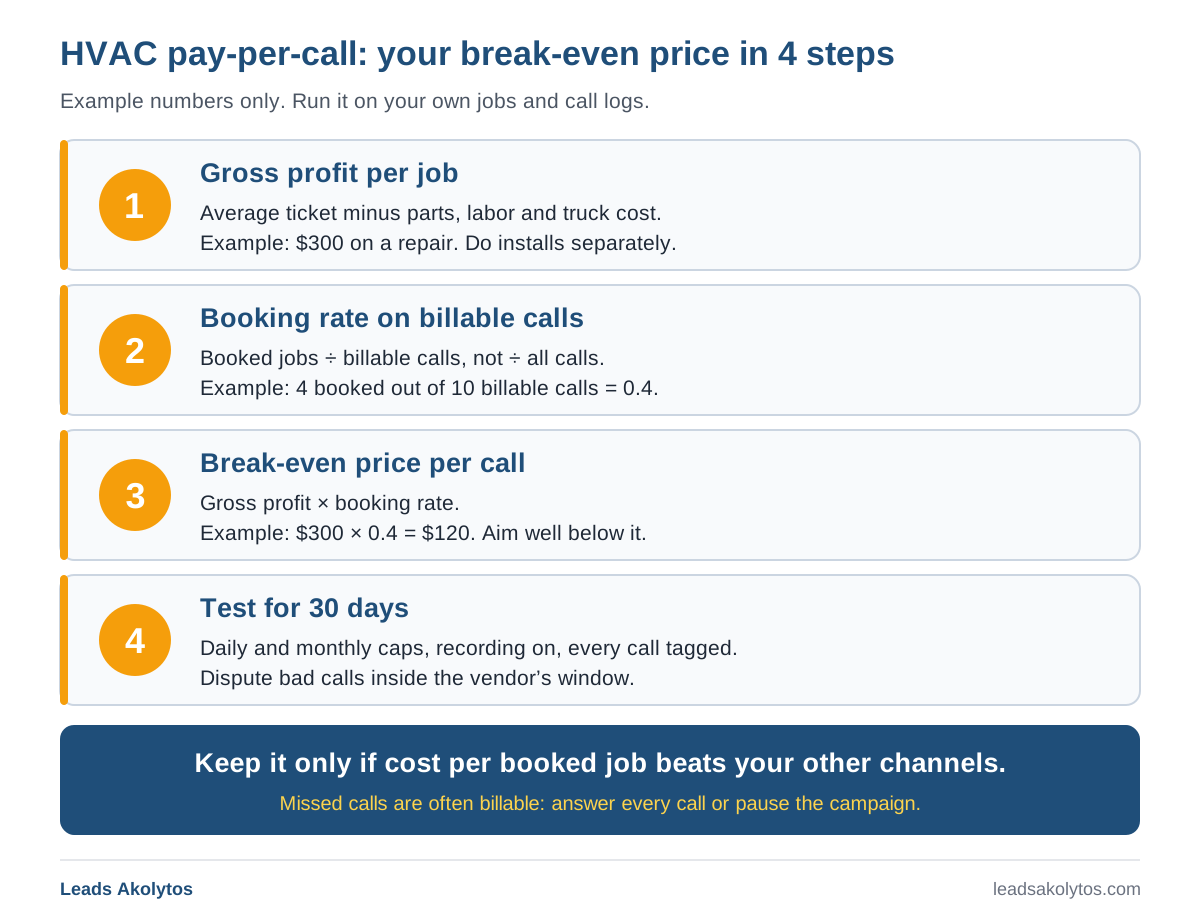
HVAC pay-per-call is worth it when your price per billable call is lower than your gross profit per job times the share of billable calls that book. If a repair call earns you $300 in gross profit and 4 in 10 billable calls book, you break even at $120 a call; pay less and you make money, pay more and you are buying revenue at a loss. Before you sign, read the billable-call definition line by line. At Service Direct, for example, missed calls are always billable and price shoppers are billable. At eLocal, an unanswered call is billable once it rings 10 seconds. So the program only works if someone answers every call, records it, and disputes the bad ones inside the vendor's window. Run a 30-day test with a capped budget and judge it on booked jobs, not on call count.
How HVAC Pay-Per-Call Works
Pay-per-call means a vendor runs the advertising and forwards live inbound calls to your phone, and you pay a fixed or bid price for each call that meets its billing rules. You do not pay for clicks or impressions. The vendor carries the ad cost and the risk of a bad campaign, and charges you a margin for it.
Three kinds of sellers use the label:
- Lead marketplaces such as Service Direct and eLocal run their own ads and route calls through a tracking number to contractors in the caller's area. At Service Direct you set the bid and the service area, and the company says a call your bid wins goes only to you.
- Pay-per-call networks buy calls from affiliates and media buyers who run ads you never see, then sell those calls to businesses. The source of the call is often a step removed from the seller.
- Google Local Services Ads are pay-per-lead, not marketed as pay-per-call, but the model is close: you pay for valid calls and messages, not clicks.
The difference that matters to an HVAC owner is where the call came from and who else got it. A homeowner who searched "AC not cooling" and tapped a call button is a different lead from someone who answered a generic home warranty ad.
What Counts as a Billable Call
The billable-call definition decides your real cost per job, and it varies by vendor. Read it before you look at the price.
Service Direct's support center lists what it bills and what it does not (checked November 2, 2026):
- Billable: any caller seeking a service your category provides, any call that books, missed calls, price shoppers, hang-ups, callers who book a competitor after talking to you, pricing disagreements and cancelled appointments.
- Not billable: calls under 20 seconds, spam, robocalls, wrong numbers, tenants or neighbors who are not the decision maker, job seekers, solicitors, services you do not offer, previous customers, callers outside your service area, and calls while your campaign was paused.
- Disputes: only for answered calls received less than 7 days ago with call recording on. Quality assurance typically decides in 2 to 3 business days. Duration-based campaigns get no review at all: time on the phone decides.
eLocal's help center bills an unanswered call once it rang 10 or more seconds, and treats repeat calls within 30 days of the first one as duplicates. It does not publish a single minimum talk time; that depends on your program.
Google Local Services Ads now bills a missed call during your business hours if the caller stays on the line more than 20 seconds, and a call that reaches voicemail counts as connected. Repeat contacts within 15 days are not charged again, and Google reassesses charged leads over 30 days and may credit poor-quality ones automatically.
Notice the pattern. Every program bills some calls you never talked to. That makes answering the phone the biggest cost lever you control.
What One Call Is Worth to Your HVAC Company
The most you can pay per call is your gross profit per job times the share of billable calls that book. Everything else is detail.
Run it on your own numbers. The example figures below are placeholders; swap in yours:
- Gross profit per job: your average ticket minus parts, labor and truck cost. Example: $300 on a repair.
- Booking rate on billable calls: booked jobs divided by billable calls, not by all calls. Example: 4 in 10.
- Break-even price per call: $300 × 0.4 = $120.
- Target price: well under break-even, because some booked jobs cancel and some quoted installs never close.
Split repair and replacement. A system replacement carries a much larger gross profit than a capacitor swap, so one install a month can justify a high per-call price, but only if the vendor sends install calls. Ask whether you can bid by service type. If you cannot, use your repair numbers, since most inbound HVAC calls are service calls.
Vendor figures help you sanity-check. Service Direct's own HVAC page (updated December 3, 2025) reports that 49% of its HVAC calls had a service need and that 59% of those booked on the first call, from client-reported data. Read that the other way round: by the vendor's own numbers, about half of the calls had no service need. Your booking rate is what counts.
For comparison, LocaliQ's home services benchmarks put the average Google search ads cost per lead for air conditioning installation and repair at $127.74 (campaigns from April 2024 to March 2025, page updated July 15, 2026). That is a cost per form fill or call from your own ads, not a booked job, but it tells you whether a per-call quote is in the normal range.
How to Check Whether the Calls Are Real
You check call quality by listening, tagging and comparing, not by trusting a dashboard. Do this from day one of any test:
- Turn on call recording in the vendor's portal before the first call. No recording, no dispute.
- Tag every call the same day: booked, quoted, price shopper, wrong service, outside area, spam, existing customer.
- Check caller ZIP codes and area codes against your service area map.
- Flag repeat numbers. A homeowner who calls back twice should be billed once.
- Dispute every non-billable call inside the window. Seven days goes fast during a heat wave.
- Compare the vendor's billed count with your own phone log every week.
Then ask the vendor four questions in writing: where the calls come from (search ads, Local Services Ads, directories, affiliates, TV), whether any call or caller's details are sold to another HVAC company, what the duplicate window is, and whether you can cap spend per day and per month. A vague answer on the source is a red flag. The FTC's January 2023 order against HomeAdvisor, which required it to pay up to $7.2 million, centered on claims about lead quality and source that the agency said HomeAdvisor could not back up. Our post on whether exclusive leads are actually exclusive covers the resale questions in detail.
Your Answer Rate Sets Your Real Price
A missed billable call is a call you paid full price for and earned nothing from. If you miss 2 in 10 calls and missed calls are billable, your real cost per answered call is 25% higher than the quote.
- Set a ring group so the office, the owner and a lead tech all ring at once.
- Route after-hours calls to a person or answering service, or pause the campaign at night.
- Match the vendor's call schedule to the hours you can actually answer.
- Call back every missed caller within 15 minutes.
Our guide to answering services for contractors shows how to price coverage against the jobs you lose.
Pay-Per-Call vs. Local Services Ads vs. Your Own Marketing
Pay-per-call is rented demand: it stops the day you stop paying, and the customer often found the vendor's number, not your brand. That is fine for filling the schedule, as long as you know what you are buying.
- Pay-per-call: fast to start, no ad management, price set per call. You do not control the ads, and billing rules vary.
- Local Services Ads: pay per valid lead with Google's billing rules, shown under your own name with the Google Verified badge. Google is moving these campaigns into Google Ads, starting with select HVAC advertisers in August 2026. See what the move to Google Ads changes.
- Your own search ads, Business Profile and website: slower to build, but every call is yours, under your name, and you can measure it with your own call tracking.
Compare them on one number: cost per booked job. Our post on the real cost per lead walks through that calculation for each channel.
When Pay-Per-Call Makes Sense for an HVAC Shop
Pay-per-call fits a shop with open technician hours, someone who answers every call, and the discipline to tag and dispute. It fits poorly when you are already booked out.
Capacity is the real limit. The BLS counts 440,900 HVAC mechanic and installer jobs in 2025, with 11% projected growth from 2025 to 2035 and about 40,600 openings a year (Occupational Outlook Handbook, updated October 29, 2026). Hiring techs is slow. Calls you cannot run in a reasonable time are calls you paid for and handed to a competitor.
- Good fit: a new or growing shop filling its schedule, shoulder seasons, a new service area.
- Poor fit: peak season with a two-week backlog, no one on the phones, or no way to record calls.
- Test it: 30 days, daily and monthly caps, repair and install calls tracked apart.
- Keep it or kill it on cost per booked job compared with your other channels.
Frequently Asked Questions
How much does HVAC pay-per-call cost?
There is no public price list. Most marketplaces let you bid, and price moves with your ZIP codes, the service type and the season. Work out your break-even price per call first, then judge any quote against it.
Are pay-per-call HVAC leads exclusive?
Some are. Service Direct says a call your bid wins goes only to you. A live call is easier to keep exclusive than a form lead, but ask in writing whether the caller's details are ever passed to another company.
Do I pay for missed calls?
Often, yes. Service Direct bills missed calls, eLocal bills an unanswered call that rang 10 seconds or more, and Google Local Services Ads bills missed calls over 20 seconds during business hours. Answer every call or pause the campaign when you cannot.
How do I dispute a bad call?
Keep call recording on, tag the call, and file inside the vendor's window. Service Direct accepts disputes on answered calls less than 7 days old with a recording. Duration-based campaigns usually cannot be disputed.
Is pay-per-call better than Local Services Ads for HVAC?
Neither wins on paper. Local Services Ads run under your own name with Google's published billing rules; pay-per-call can start faster in areas where you have no reviews yet. Run both on cost per booked job and keep the cheaper one.
Want a Second Opinion?
You can run the break-even check and the 30-day test on your own. If you would rather go through a vendor's terms and your call data with someone, Leads Akolytos offers a free 30-minute strategy call. We work only with home service contractors across 14 trades, with no setup fees and no long-term contracts. See our HVAC marketing page or book a time here.
Want this handled for you?
We do this work for home service contractors every day, month-to-month, with no contracts. Book a free 30-minute call and we'll show you where you stand on Google.
Book my free call