
Guest post by Alexander Rodriguez, SEO and Marketing Manager at Century Garage Door Repair Service.
Most of our service calls start with a loud crash in the garage, a car stuck inside and a very upset homeowner. They need to leave the house, so the choice of who fixes the door gets made very quickly.
For a garage door repair company, the marketing work is to track calls, the jobs those calls turn into, and the customers who call back a second and third time. This is what that work has taught us. None of it is particularly clever. It is basic work that has to be done every time.
How Garage Door Companies Win and Keep Local Customers: The Short Answer
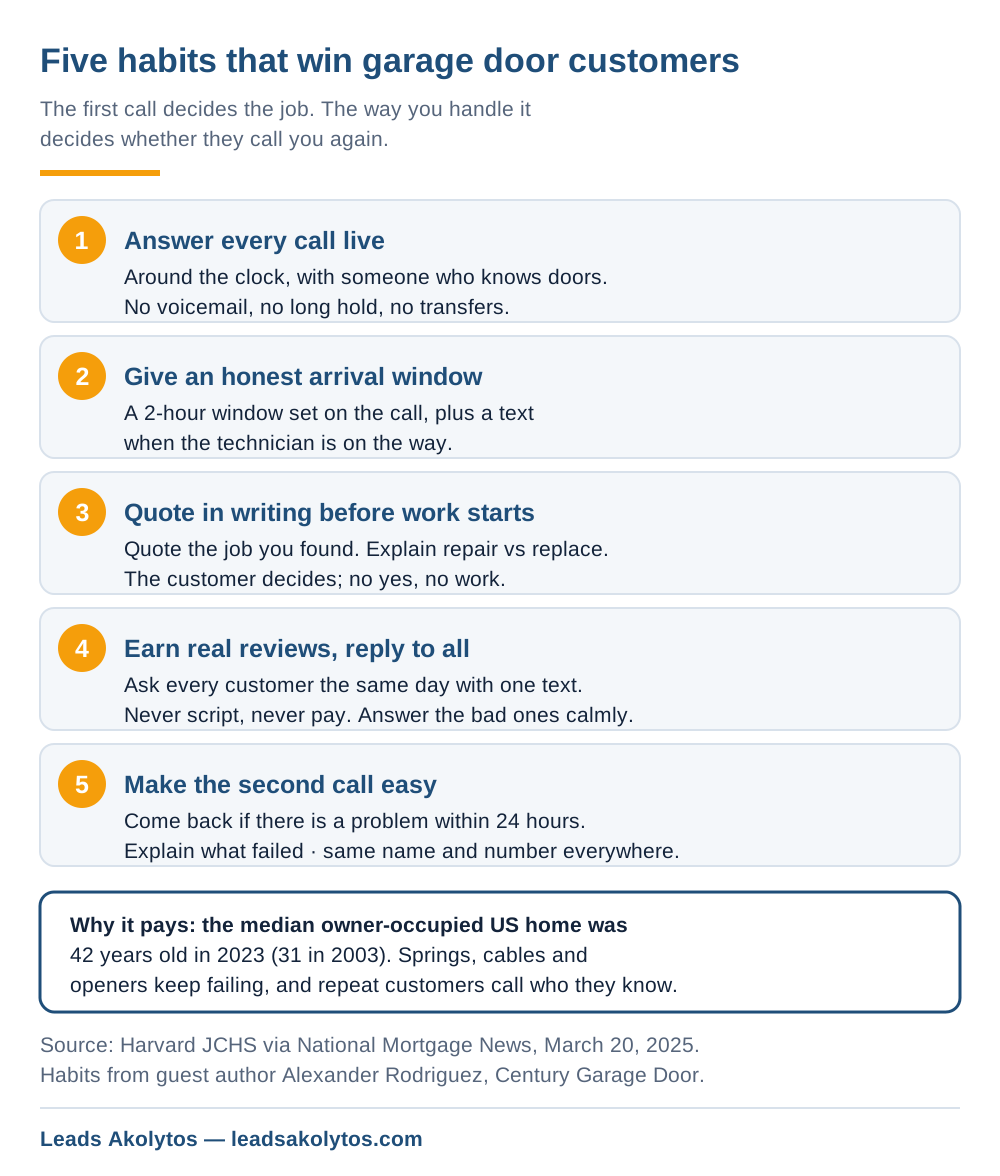
A garage door company wins local customers by being the business that answers, shows up when it said it would and charges what it quoted. In practice that means five habits: answer every call live with someone who knows doors, give an honest arrival window and keep it, put the quote in writing before any work starts, earn real reviews and reply to all of them, and make the second call easy. The housing stock is getting older, so the homeowner whose spring you replace this year will need an opener or cables later. Doing the first job well is how you get that next call without paying for it again.
The Phone Is Still the Front Door
For garage door repair, the phone call decides the job. Many trades have moved customers online with web forms and chat, but garage door repair has mostly stayed on the phone, largely because when a spring breaks, people need to talk to someone.
Outside research points the same way. In a 2021 Invoca study of 500 US consumers who had made a high-stakes purchase (home services among the categories), 68% said they find the human connection of calling a business attractive and prefer calling to any other channel. The same study found that three out of four consumers will hang up after being placed on hold.
Two takeaways: most customers would rather talk to a real person than use a chat window, and they have very little patience for waiting. Each missed call or long hold can hand that job to the next listing offering the same service.
What works for us:
- A live answer, around the clock. A garage door can break at any hour. If a call rolls to voicemail at 9 p.m., that customer will call another company before you even hear the message.
- People who know doors on the line. Can the person answering tell a broken spring from an opener that has lost its travel limits? The caller can hear the difference between someone reading a script and someone who understands the problem.
- No transfers if you can avoid them. Every handoff gives the caller another chance to give up.
If you are weighing whether to cover nights yourself or use a service, answering service or answer it yourself runs the numbers on missed calls.
Sell the Arrival Window, Not the Miracle
The fastest way to lose a customer for good is to promise something you cannot deliver. An exact arrival time sounds good on the phone, but an hour late is terrible.
We set an arrival window with the customer and hold to it. Typically it is a 2-hour window agreed on the call, and the customer gets a text when the technician is on the way. Customers can plan around a window they believe. A promise that slips is worth little to schedule around.
We carry the most failure-prone parts on the truck, so most jobs are done in one trip. We never promise every job, because an odd-sized panel or a discontinued opener part can mean a second trip. We say "most jobs" on the call, and customers handle a second trip fine when they heard that up front.
Honest expectations bring repeat business. Being straight about what you can deliver does more for it than any discount. People remember you for what you did, not for what you promised.
Quote in Writing Before Anyone Picks Up a Tool
Price is where trust in the trades breaks most often. Most homeowners have heard about a technician who quoted one price and charged more once the work was done.
Our main rule: we show a written quote before we start, and the customer decides whether to accept it. If they decline, we do no work. That removed the biggest cause of complaints we used to get, and it changed how technicians talk with customers. Instead of defending a number, the technician explains the problem and the options.
A few things make written quotes work in practice:
- Quote the job you found, not the job you hoped for. If the cables are frayed too, put it on the quote with the reason.
- Explain repair versus replace honestly. Some openers are worth fixing. Others aren't. Customers can tell when you are steering them toward an answer.
- Keep the paper trail. A written quote protects your company and the customer from misunderstandings later.
Reviews Are the New Word of Mouth, but People Read Them Closely
Nearly every customer reads reviews before contacting a local business. In BrightLocal's Local Consumer Review Survey 2025, which polled 1,026 US adults, only 4% of consumers said they never read online reviews of local businesses, and only 7% said they don't expect a business to respond to its reviews.
There's a catch. BrightLocal also found that the share of consumers who trust reviews as much as personal recommendations fell from 79% in 2020 to 42% in 2025. People still read reviews, but with a more skeptical eye.
Our aim is not a pile of 5-star ratings. We want reviews that sound like real jobs. Here's how:
- Ask every customer, the same day. The best moment is right after the door works again. One short text with a link is enough.
- Never script it and never pay for it. Readers spot copy-and-paste praise quickly, and it loses more trust than it earns. Google's review policy also bans incentives and asking for specific wording.
- Answer every review, good and bad. A calm, specific reply to a negative review often does more for the next reader than a pile of positive ones. Briefly explain what happened and what you did about it.
- Let customers tell it their way. When you ask right after the fix, people tend to mention the details on their own, like "They replaced both torsion springs and the door is quiet now." That reads far better than "Great service!!"
For the rules on asking, see how to ask for Google reviews without breaking the rules, and for replies, how to respond to negative Google reviews.
Older Homes Mean More Garage Door Repairs
One driver of garage door repair work is the age of US homes. According to National Mortgage News, reporting on Harvard's Joint Center for Housing Studies 2025 report Improving America's Housing, the median age of owner-occupied homes was 42 years in 2023, up from 31 years in 2003. Replacement projects such as roofs, windows and air conditioning systems made up 49% of home improvement spending in 2023.
Garage doors follow the same pattern. Springs last a set number of cycles. Openers from the early 2000s are failing. Rollers wear, cables break, weatherstripping cracks. An older housing stock means steady repair and replacement work, and the companies that capture it are the ones homeowners already have on their mental list of who to call when something breaks.
That is why the first job matters so much. The homeowner whose spring you replaced last spring is likely to need a new opener in a few years. Do the first call well and they call you for the next one.
Make the Second Call Easy
In garage door repair, a customer you already know doesn't have to be found again. A few habits keep us on the fridge door, so to speak:
- Stand behind the work. If there's a problem within 24 hours of a visit, we come back and check it. Customers remember that small promise, and it costs very little.
- Leave the homeowner smarter. A two-minute explanation of what went wrong and what to watch for builds more loyalty than a fridge magnet.
- Talk about safety plainly. Tell customers that spring and cable work belongs to a trained technician, never a homeowner. It is true, it protects them, and it reminds them to call you.
- Keep your local listings accurate. Your business name, phone number and address should match everywhere customers find you. If they don't, customers get confused and your local search presence can suffer. The Google Business Profile checklist is a good place to start.
What Winning Garage Door Customers Comes Down To
Winning local customers in garage door repair is simple, not easy:
- Answer the phone, every time, with someone who knows doors.
- Give honest arrival windows and keep them.
- Quote in writing before work starts, and let the customer decide.
- Earn real reviews and reply to all of them.
- Make the second call the easiest call the homeowner ever makes.
Companies that do these five things consistently don't need gimmicks. Their customers do the selling for them. For the marketing side of being found when a door breaks, see garage door company marketing and our garage door marketing page.
Frequently Asked Questions
Do garage door customers still prefer to call?
Mostly, yes. In Invoca's 2021 study of 500 US consumers who made a high-stakes purchase, including home services, 68% said they find the human connection of calling attractive and prefer it to other channels, and three out of four said they hang up when put on hold.
Should a garage door company answer calls 24 hours a day?
If you take emergency jobs, someone should answer live whenever you say you're open. A broken spring at 9 p.m. still needs a door that closes, and a call that goes to voicemail usually goes to the next company.
Why give an arrival window instead of an exact time?
Because a window you keep builds more trust than a time you miss. A 2-hour window set on the call, plus a text when the technician is on the way, lets the homeowner plan around you.
Do customers still trust online reviews?
They read them but trust them less. BrightLocal's 2025 survey found only 4% never read reviews of local businesses, but the share who trust reviews as much as personal recommendations fell from 79% in 2020 to 42% in 2025. Reviews that describe a real job, and replies from the owner, carry more weight.
How do garage door companies get repeat customers?
By doing the first job well and making the next call easy: stand behind the work, explain what failed and what to watch for, and keep your name and number the same everywhere so the homeowner can find you again.
Figures in this article were checked on their sources by Leads Akolytos on November 11, 2026: Invoca's June 7, 2021 press release, BrightLocal's Local Consumer Review Survey 2025 (published January 29, 2025) and National Mortgage News' March 20, 2025 report on Harvard's Joint Center for Housing Studies.
Want a Second Look?
If you'd rather go over how your calls get answered and how customers find you with someone, Leads Akolytos offers a free 30-minute strategy call. We work only with home service contractors, with no setup fees and no long-term contracts. You can book a time here.
If you'd like one practical idea like this in your inbox each month, get The Leads Akolytos Monthly: one email a month, unsubscribe any time.
About the Author
Alexander Rodriguez is the SEO and Marketing Manager at Century Garage Door Repair Service. He runs the company's garage door guides on repair costs, safety and maintenance for homeowners.
Want this handled for you?
We do this work for home service contractors every day, month-to-month, with no contracts. Book a free 30-minute call and we'll show you where you stand on Google.
Book my free call