The Short Answer
Knowing how to respond to negative Google reviews the right way protects both the customer relationship and your SEO. Respond to every negative Google review within 24-48 hours: thank the customer, acknowledge the specific issue without getting defensive, briefly explain what you’ll do about it (or already did), and take the details offline with a phone number or email.
Never argue in public, never mention private customer details, and never offer a refund or discount as a condition of removing the review — that crosses into territory the Federal Trade Commission has specifically gone after businesses for. A calm, professional public reply does more to win the next customer than the negative review does to lose one.
Is This a DIY Task or a Reason to Hire Help?
Before the framework below, answer the real question first: is responding to negative reviews something you should keep doing yourself, or a signal that your review strategy needs a professional hand? The short version — if you can commit to a fast, calm reply every single time, DIY is fine; if replies are already slipping, that gap is costing you bookings right now, not hypothetically.
The comparison later in this guide (with real cost numbers) walks through exactly how to decide.
Why This Actually Matters for Your Business
Most contractors treat a bad review like a wound to bandage and forget. That’s a mistake. The review itself is temporary content, but your response is permanent proof of how you handle problems — and it’s the first thing a homeowner reads when they’re trying to decide if you’re safe to hire. A well-handled negative review, sitting next to a professional, no-drama response, often does more to build trust with a prospect than five generic five-star reviews with no owner replies at all.
Google’s own guidance to business owners says as much: publicly replying to reviews “can show that you’re responsive to your customers” and that helpful, positive replies build trust with people reading your profile (Google Business Profile Community Guide). It’s not optional maintenance — it’s part of how your Google Business Profile earns trust signals from both customers and, indirectly, from Google.
If you’re still building out the rest of your profile, this ties directly into our Google Business Profile optimization checklist for contractors — review responses are one line item in a much bigger picture.
The Response Framework: What to Say, In What Order
Every solid response follows roughly the same structure, whether the review is about a missed appointment, a pricing dispute, or a genuine quality issue.
Here’s the order that works:
1. Thank them — even when it stings
Open with a genuine “thank you for the feedback” or “we appreciate you taking the time to share this.” It signals to every future reader that you don’t get rattled by criticism.
2. Acknowledge the specific issue, not a vague apology
“We’re sorry you had a bad experience” reads as boilerplate.
“We’re sorry the technician arrived two hours past the window we quoted” shows you actually read the review and take it seriously. Specificity is what separates a template response from a real one.
3. Explain — briefly — what happened or what you’re doing about it
You don’t need to write a paragraph defending yourself.
One or two sentences of context, or a note that you’ve already addressed it internally (retrained a crew, adjusted scheduling software, replaced a part at no charge), shows accountability without turning the reply into an argument.
4. Move the conversation offline
Give a direct phone number or email and invite them to call.
This does two things: it shows other readers you’re willing to make it right, and it gets the emotionally charged part of the conversation out of public view, where it can actually get resolved.
5. Keep it short
Three to five sentences is plenty. A wall of text reads as defensive, even if every word is reasonable.
What Never to Do
- Don’t argue or call the customer a liar in public. Even if the review is unfair, a public fight makes you look worse than a bad review ever could.
- Don’t share private details about the customer, the job, payment status, or anything that could identify them beyond what they already shared. Google’s content policies exist specifically to keep responses professional and non-retaliatory.
- Don’t offer money or a discount in exchange for removing or editing the review. Beyond being against Google’s policies, conditioning any benefit on a customer changing or deleting their honest review can run afoul of the FTC’s Consumer Review Fairness Act, which prohibits penalizing or pressuring customers over honest reviews and makes contract clauses that try to silence reviews unenforceable (Federal Trade Commission, Consumer Review Fairness Act guidance).
- Don’t ignore it. An unanswered one-star review sitting at the top of your profile for months tells every future customer that either you didn’t notice or you didn’t care.
- Don’t use a copy-paste template word for word on every review. Customers and prospects both notice when a response is obviously generic.
When a Review Crosses the Line: Flagging vs. Responding
Sometimes what you’re dealing with isn’t a legitimate unhappy customer — it’s a competitor, a scammer, someone who was never actually a customer, or a review containing content that violates Google’s policies (hate speech, spam, conflicts of interest, or content unrelated to an actual experience with your business). In those cases, respond professionally and briefly on the review itself, but also use Google’s flagging tool to report it for policy violations.
Google reviews flags and, per their own guidance, aims to review flagged content, though it can take time to process (Google Business Profile Community Guide). Flagging isn’t a substitute for responding — do both. A flag might get a fake review removed eventually; your public response is what protects your reputation in the meantime.
A Real Example, Broken Down
The review: “Waited 3 hours past the scheduled window and the tech was rude when he finally showed up. Won’t use again.”
A weak response: “We’re sorry to hear about your experience. We strive for 100% customer satisfaction. Please call our office.”
A strong response: “Thank you for the honest feedback, [Name]. A 3-hour wait outside our quoted window isn’t the standard we hold ourselves to, and we’re sorry that’s what happened on your job. We’re looking into the scheduling delay and the way our tech handled the situation once he arrived.
If you’re open to it, please call us directly at [phone] — we’d like to make this right.”
Notice the strong version names the specific problem, takes ownership without over-explaining, and gives a direct path to resolve it — all in under 60 words.
Does Responding to Reviews Actually Help Your Rankings?
Review responses aren’t a confirmed direct Google ranking factor the way your Business Profile categories or proximity are, but they contribute to the same trust and engagement signals that support local pack visibility — and they add fresh, keyword-relevant content to your profile on an ongoing basis.
More importantly, they influence the metric that actually drives revenue: conversion rate. A prospect scrolling through reviews is deciding whether to call you or the next contractor down the list, and an owner who visibly responds to problems is a strong tiebreaker.
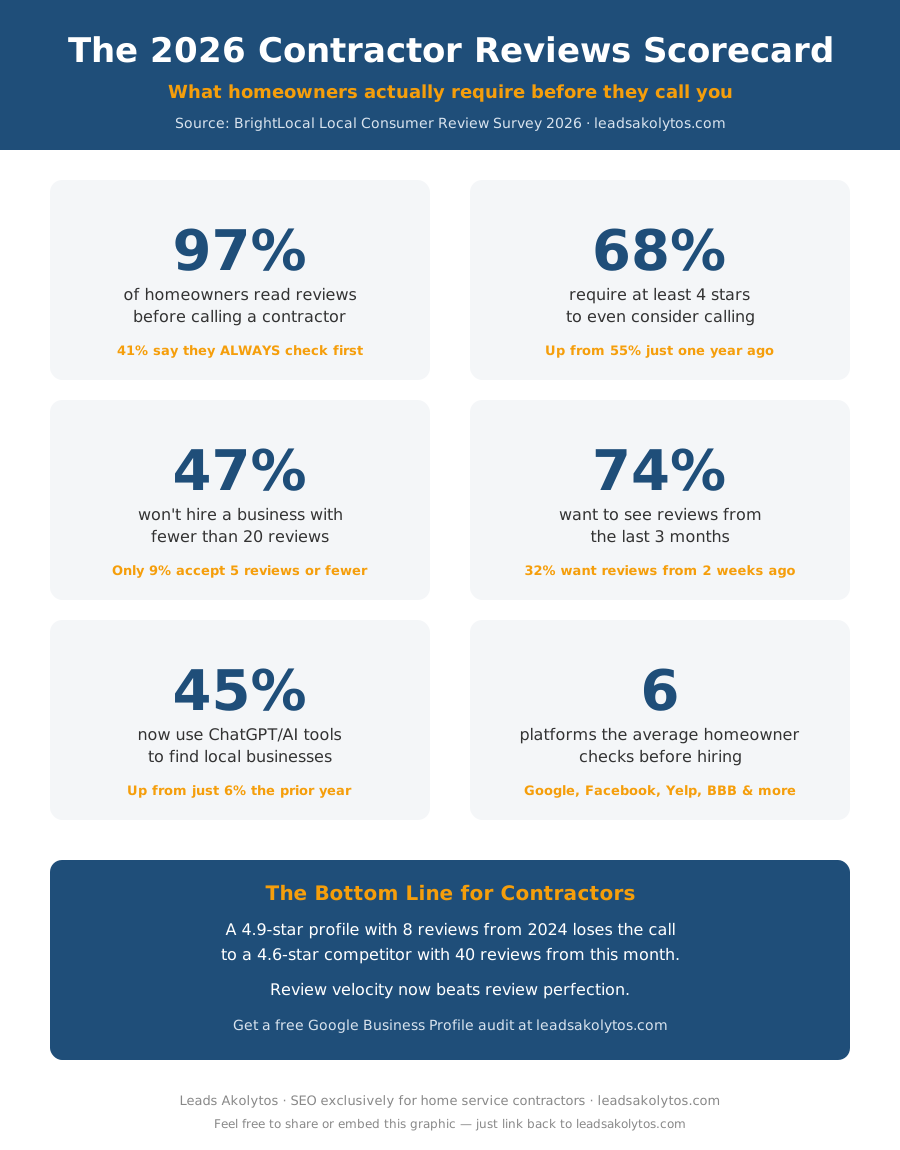
If you want the fuller picture on how reviews interact with local rankings, see our 2026 Contractor Reviews Scorecard on how many stars and reviews contractors actually need to win the call. The direct answer: yes, but indirectly — Google factors review recency and engagement into local ranking signals, so contractors who reliably respond to negative Google reviews (not just positive ones) tend to see steadier Local Pack visibility over time.
Building a Simple Response Habit
You don’t need software to stay on top of this. Turn on email or push notifications for new reviews in your Google Business Profile app, set a standing reminder to check weekly even if notifications fail, and keep a short internal note (not a public reply) of any pattern you spot — recurring complaints about scheduling, a specific crew, or communication are signals worth fixing at the source, not just smoothing over in a review reply.
Contractors who build this habit typically respond to negative Google reviews within a day, which is fast enough to blunt the damage and slow enough to write a reply you will not regret.
Should You Handle Review Responses Yourself, or Have Someone Do It For You?
Responding well to a negative review takes ten to fifteen minutes if you already know the framework above.
That time adds up fast once you’re fielding several reviews a week across a busy season, on top of running jobs.
A fair way to decide: if you can commit to responding to every new review within 24-48 hours, every week, indefinitely, doing it yourself is fine. Often it’s even better, since nobody knows the specific situation better than you do.
If reviews are piling up unanswered for days or weeks because there’s no time in the day for it, that’s the point where it’s honestly cheaper to have it handled as part of an ongoing marketing plan than to keep letting it slip.
Review management is included in every Leads Akolytos plan alongside the rest of your SEO and Google Business Profile work — responses are drafted for your approval, never posted without you seeing them first, starting at $1200/month with no long-term contract. Book a Free 30-Minute Strategy Call →
What to Ask Before You Pay Anyone to Handle Your Review Responses
If you decide to hire this out, not every provider is worth the money.
Ask these questions before you sign anything:
- Do you personally approve every response before it posts, or does it go out automatically? (It should always be the former — an agency posting unapproved responses in your name is a red flag.)
- How fast do you commit to responding, in writing — 24 hours, 48 hours, same week?
- Can you show me an example of how you’ve handled a genuinely bad review for another client, not just a template?
- Is review response bundled with a broader SEO/Google Business Profile plan, or is it a stand-alone line item, and what does it cost either way?
- What happens if I’m unhappy with a draft response — can I edit it before it goes live?
A provider who can’t answer these plainly, or who wants to post on your behalf without your sign-off, is selling automation, not reputation management.
Leads Akolytos drafts every response for your approval first — you can ask us the same five questions on a free strategy call.
Frequently Asked Questions
How fast should I respond to a negative Google review?
Within 24 to 48 hours is the standard to aim for. A fast response shows the reviewer — and everyone reading afterward — that you’re actively managing your business and take feedback seriously. Waiting weeks makes even a good response look like an afterthought.
Can I get a fake or unfair review removed from Google?
You can flag it through your Google Business Profile for violating Google’s content policies (fake experience, spam, conflict of interest, off-topic content, or prohibited language), and Google will review the flag. Google doesn’t remove reviews just because they’re negative or unfair in your opinion — only actual policy violations qualify.
Should I ever offer a refund or discount to get a bad review taken down?
No. Beyond violating Google’s own review policies, conditioning a payment, refund, or discount on a customer removing or changing an honest review can run into the FTC’s Consumer Review Fairness Act, which protects a customer’s right to leave honest feedback without being pressured or penalized.
What if the negative review is about a customer who was never actually a client?
Respond briefly and professionally noting you have no record of this job or customer, then flag the review for violating Google’s policies against fake or unverified experiences. Keep your public response calm even if the review itself is aggressive.
Is it worth responding to positive reviews too, or just negative ones?
Both. Responding to positive reviews reinforces the relationship and shows the same responsiveness pattern to anyone reading your profile. It doesn’t need to be as detailed as a negative-review response — a genuine thank-you naming something specific from the job works well.
Can one bad review actually hurt my business?
Rarely, on its own — especially if you have a healthy volume of reviews overall and you respond well. What actually hurts is a pattern of unanswered negative reviews with no visible effort to address them, which signals neglect rather than a single bad day.
Get This Handled for You
Responding to reviews is one piece of a bigger reputation and visibility system — and it’s easy to let it slide when you’re running jobs all day. Leads Akolytos includes Google Business Profile management, review strategy, and ongoing SEO in every plan, built specifically for contractors, not generic small businesses. Book a free 30-minute strategy call and we’ll look at your current profile and reviews together, no obligation, no contract required.
Knowing how to respond to negative Google reviews consistently, not just once when you happen to be in a good mood, is what separates contractors who protect their star rating from those who watch it slide. Contractors who respond to negative Google reviews within the same day, log the pattern behind each complaint, and fix the root cause turn a single one-star review into proof for the next fifty people who read the profile before calling.
How to Know If Your Response to Negative Google Reviews Actually Worked
A good way to respond to negative Google reviews isn’t complete once you hit post. Check back in a week: did the customer edit or remove the review, or reply again? Track how many one- and two-star reviews you respond to negative Google reviews on within 24 hours versus how many sit unanswered for weeks, since that response-time gap is what most prospective customers actually notice when they read your profile. If you consistently respond to negative Google reviews with a calm, specific, non-defensive reply, you should see fewer reviews escalating into back-and-forth arguments in the public thread over time.
The core skill is simple to name and hard to practice: respond to negative Google reviews the same way every time — acknowledge, clarify briefly, take it offline. Contractors who respond to negative Google reviews with a scripted, calm process rarely see one bad review turn into a pattern other prospects notice.
Build a Simple Template So You Respond to Negative Google Reviews Fast
The businesses that respond to negative Google reviews well almost always have a short internal template, not a blank page they write from scratch each time. A good template to respond to negative Google reviews covers three things: acknowledge the specific complaint, state what you’re doing about it, and invite the conversation offline. Keep it under 60 words so it reads as genuine, not corporate.
Whoever answers the phone or manages your Google Business Profile should know they’re allowed to respond to negative Google reviews within 24 hours without waiting for owner sign-off on routine cases. Speed matters as much as tone — a same-day reply to negative Google reviews signals to future customers that someone is actually paying attention.
Want this handled for you?
We do this work for home service contractors every day, month-to-month, with no contracts. Book a free 30-minute call and we'll show you where you stand on Google.
Book my free call