Guest post by Hemant Madaan, founder and CEO of AptaBook.
A plumbing or HVAC company doesn't really buy an answering service for the calls. It buys one for the jobs those calls turn into. That makes price a tricky question. A cheap plan that fumbles a no-heat call at 11 p.m. is expensive, and a premium plan that spends its minutes on robocalls and wrong numbers is money you didn't need to spend.
The phone gap in the trades is real. In Invoca's 2026 Home Services Lead Conversion Benchmarks Report, 52% of calls to home services businesses reached a person. The rate rose to 65% for calls longer than 15 seconds, which filters out misdials and quick hang-ups. By trade, Invoca reports plumbing at 74% and HVAC at 34%. Whatever your own number is, the calls that slip through tend to be the ones that ring while everyone is on a job or after the office closes.
This guide covers how answering services bill, what published prices look like, where AI fits, and how to price your own month before you sign anything. If you're still deciding whether you need outside answering at all, start with Leads Akolytos' guide to what missed calls cost a contractor.
The Short Answer: What Published Prices Look Like
Live (human) answering is usually sold as a monthly bundle of minutes or calls, plus an overage rate. Fit Small Business found that most small businesses pay $175 to $400 a month for about 100 minutes of live answering, plus $1.28 to $2.29 a minute in overage on bundled plans.
Per call, the spread is wide. An October 2026 review of published plans from 18 U.S. live answering services by Upcision put a 100-call month at $2.69 to $9.10 per call, with a median of $3.98. That assumes two billed minutes per call.
AI receptionists are priced differently. GetVoIP modeled 250 two-minute calls a month on eight AI offers documented to handle FAQs, lead capture, live transfers and direct calendar booking. Monthly costs ran from $129 to $500.
These are list prices, not quotes. What you actually pay comes down to three things: how the service counts usage, how many calls you send it, and what you ask it to do on each call.
The Four Pricing Models, Explained
Per-minute billing
You buy a block of minutes each month and pay an overage rate for anything above it. Upcision's review found that most live services bill this way, and it usually works out cheapest when most of your calls are short: messages, scheduling and "are you open Saturday?"
The rate matters less than the rules behind it. Ask what starts the clock (ring time, greeting, the agent picking up), what stops it, and whether each call is rounded up. Fit Small Business gives a simple example: 200 calls averaging 45 seconds come to 150 minutes billed by the second, but 200 minutes if each call rounds up to a full minute. That's a third more for the same work.
Per-call billing
You pay a flat amount per call regardless of length. A 40-second "what's your service area?" costs the same as a 10-minute intake for a water heater replacement. Per-call pricing tends to favor shops with long, detailed calls and to penalize shops with lots of short ones. Before you sign, get in writing what counts as a call: spam, wrong numbers and callers who hang up during the greeting shouldn't.
Flat monthly pricing
One fee covers a set allowance of calls or minutes, or "unlimited" use under a fair-use policy. The appeal is a predictable bill, which matters in a business where a heat wave or a cold snap can double call volume overnight. The catch is what happens when you go over: some plans charge overage, others move you to the next tier automatically.
AI, human, or hybrid
AI receptionists bill using the same three models (per minute, per call or flat monthly). In the published figures above, they come out well below live agents on cost per call. A human agent brings judgment, empathy and the ability to calm down a homeowner standing in an inch of water. A hybrid setup has AI answer first and hand off to a person, either your on-call tech or a live service, when the call needs one. For many shops, the hybrid is where the math and the customer experience meet. Before you pay for any AI option, run it through the test calls in Leads Akolytos' guide to vetting an AI receptionist. For the call flow and the US disclosure rules on the AI side, Fleurant AI's guide to AI receptionists for small business walks through both.
Which Calls AI Can Handle, and Which Need a Person
Treat this as a starting point and adjust it to your own call mix. Calls that AI generally handles well:
- Booking and rescheduling maintenance visits and tune-ups
- Quote and estimate requests, with your own intake questions (equipment age, fuel type, access, photos by text)
- Questions about hours, service area, financing and trip charges
- After-hours intake for non-urgent jobs, so the office can call back first thing
- Routing vendors, suppliers and job applicants away from your dispatch line
Calls that should reach a person quickly:
- Active leaks, flooding and sewer backups
- No heat in freezing weather or no cooling in extreme heat, especially with elderly occupants, infants or medical needs in the home
- Upset customers, callbacks and warranty disputes
- Commercial accounts with response-time commitments
Gas smells and carbon monoxide alarms are a separate category. Whoever answers, human or AI, should follow a script you've written that tells the caller to leave the building and contact the gas utility or 911 first. The emergency script is your responsibility, not the vendor's.
What Moves the Price
Two shops with the same truck count can get very different quotes. These factors drive most of the difference:
- Call volume and average call length. Pull them from your phone system rather than guessing.
- Your after-hours share. Overflow-only coverage during the day costs less than 24/7 coverage.
- Emergency dispatch. Paging an on-call tech, waiting for a callback and patching the call through all add billable time.
- Booking into your field service software. Direct scheduling can be an add-on or a higher tier.
- Bilingual coverage, which some services price as an add-on.
- Spam and robocall filtering. If junk calls count toward your bundle, filtering pays for itself.
- Seasonality. A plan sized for April can blow through its allowance during the first heat wave.
Red Flags in an Answering Service Proposal
Most surprises on the first invoice trace back to the fine print. Ask about each of these before you sign:
- Per-call rounding. Upcision notes that rounding a 63-second call up to two minutes bills about 90% more time than was used.
- Setup, onboarding or script-change fees.
- An overage rate that's higher than your plan rate, or not published at all.
- Annual contracts, auto-renewal and long cancellation notice periods.
- Billing for spam, wrong numbers and hang-ups.
- Charging for after-call work, such as writing notes or sending messages.
- Per-call add-on fees for booking, patching or texting a summary.
- Holiday or overnight surcharges that only appear in the terms of service.
A Worked Example: A Three-Truck Plumbing Company
To show how the models compare, here's a hypothetical shop. The rates are illustrative round numbers chosen to sit inside the published ranges cited above. They aren't quotes from any provider.
- 250 calls a month go to the service (after-hours calls plus daytime overflow).
- Calls average two billed minutes, so about 500 minutes a month.
- About 40 of those calls are emergencies that need a person.
| Model | Illustrative rate | Monthly cost |
|---|---|---|
| Per-minute, billed by the second | $1.75 per minute | $875 |
| Per-minute, each call rounded up (about 2.5 billed minutes per call) | $1.75 per minute | About $1,094 |
| Per-call | $4 per call | $1,000 |
| AI, flat monthly | $200 for 250 calls | $200 |
| Hybrid: AI plus live handling of 40 emergency calls at 3 minutes each | $200 + $1.75 per minute | $410 |
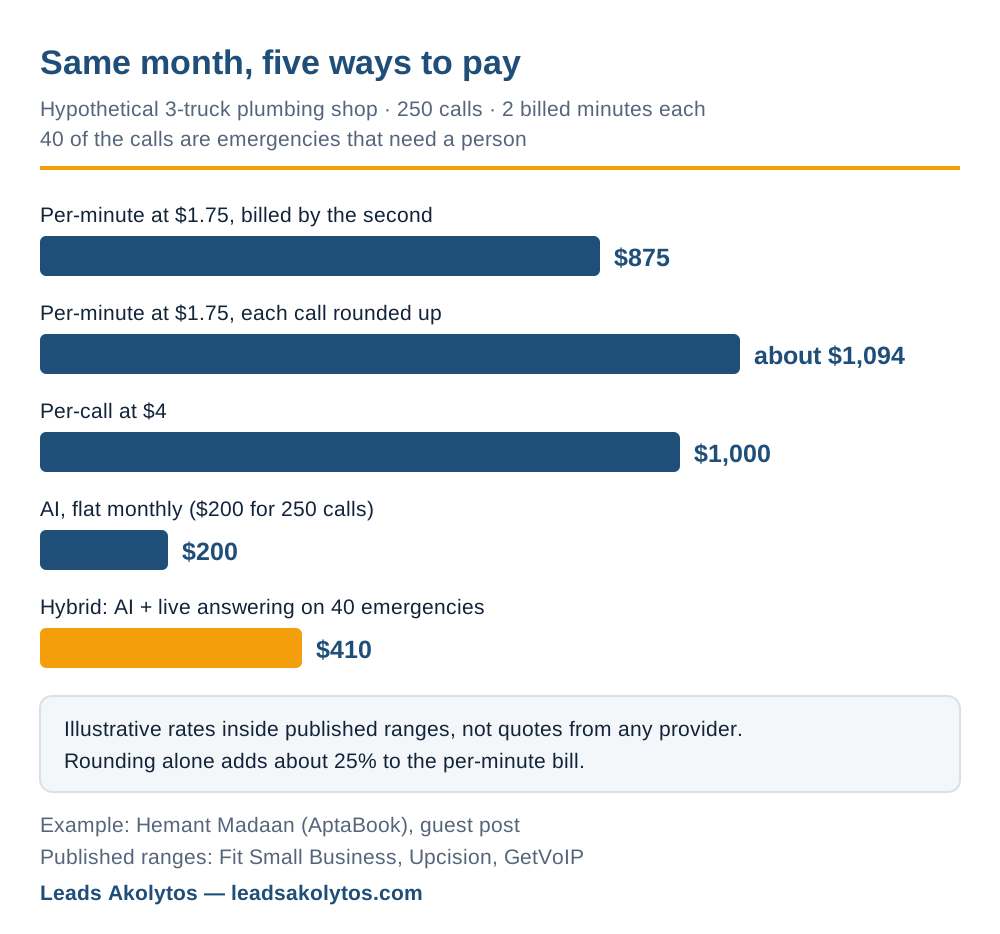
Three things stand out. First, the rounding rule alone moves the per-minute bill by about 25%. Second, per-call pricing doesn't help a shop whose calls are short. Third, the hybrid costs more than AI alone, but it buys a human voice on the calls where one matters most.
For context, the Bureau of Labor Statistics puts the median hourly wage for receptionists at $18.27 in May 2025. At 40 hours a week, that's roughly $3,170 a month before payroll taxes and benefits, and it covers only 40 of the 168 hours in a week. An in-house hire often makes sense for daytime calls. It's rarely the cheapest way to cover nights and weekends.
How to Price Your Own Month
- Pull 60 to 90 days of call logs from your phone system, including missed calls. If you don't have clean logs yet, Leads Akolytos' call tracking guide shows how to get them.
- Split the calls by time: business hours, evenings, overnight and weekends.
- Tag a sample by type: new jobs, existing customers, emergencies, vendors and spam.
- Work out billed minutes using each vendor's rounding rule, not just total talk time.
- Price the same month under per-minute, per-call and flat pricing, including overage.
- Run a trial and test it yourself: call at 2 a.m. with a burst-pipe scenario and see what happens.
Frequently Asked Questions
How much should a small plumbing or HVAC company budget for an answering service?
Start with your own call volume. As a reference point, Fit Small Business found most small businesses pay $175 to $400 a month for about 100 minutes of live answering. Shops that send hundreds of calls a month will pay more for live coverage, and AI or hybrid setups can bring that down.
Is per-minute or per-call billing cheaper?
If most of your calls are short (messages, scheduling, quick questions), per-minute billing with fair rounding is usually cheaper. Per-call billing can win when calls are long and detailed. Price both against your own call log.
Can an AI receptionist handle emergency calls?
It can answer them, collect the address and details, and transfer or page your on-call tech. Whether it should be the last stop for an emergency is your call. Most shops route true emergencies to a person, and safety calls should always follow your written script.
Do I need 24/7 coverage or just after-hours?
Check your logs. If daytime calls go unanswered because techs are on jobs and the office is stretched thin, overflow coverage during the day can matter as much as nights and weekends.
Figures in this article were checked on their sources by Leads Akolytos on November 5, 2026: Invoca's 2026 Home Services Lead Conversion Benchmarks Report (July 2026) and its September 10, 2026 blog post, Fit Small Business (October 8, 2026), Upcision (published October 26, 2026), GetVoIP (updated October 29, 2026) and the BLS Occupational Outlook Handbook. Prices change often, so check them again before you buy.
Want a Second Opinion?
If you would rather look at your missed calls and call handling with someone, Leads Akolytos offers a free 30-minute strategy call. We work only with home service contractors across 14 trades, with no setup fees and no long-term contracts. See our plumbing and HVAC pages or book a time here.
About the Author
Hemant Madaan is the founder and CEO of AptaBook, an AI receptionist for small businesses and enterprises. A Dallas AI75 2026 honoree based in Dallas, he works across agentic AI, AI consulting and Microsoft solutions.
Want this handled for you?
We do this work for home service contractors every day, month-to-month, with no contracts. Book a free 30-minute call and we'll show you where you stand on Google.
Book my free call