The contractor reviews scorecard starts with one question: how many Google reviews do contractors need before homeowners actually pick up the phone? New 2026 data gives a clear answer. A homeowner searching for a plumber, electrician, or roofer this week will look at three or four options side by side. They are not reading your “About Us” page.
They are scanning stars, review counts, and dates — and they are making a decision in under thirty seconds. If you are still wondering how many Google reviews do contractors need to win the call, the honest answer is: more than your closest competitor, and fresher.
New data from BrightLocal’s 2026 Local Consumer Review Survey shows exactly what homeowners now require before they’ll pick up the phone. If your Google Business Profile hasn’t kept pace, you are losing calls to contractors who are not necessarily better than you — just better reviewed, and more recently.
The short version: 97% of homeowners read reviews before hiring a contractor, 68% require at least 4 stars, 47% won’t call a business with fewer than 20 reviews, and nearly a third want to see a review from the last two weeks. Review recency now matters almost as much as review count.
The 2026 Contractor Reviews Scorecard
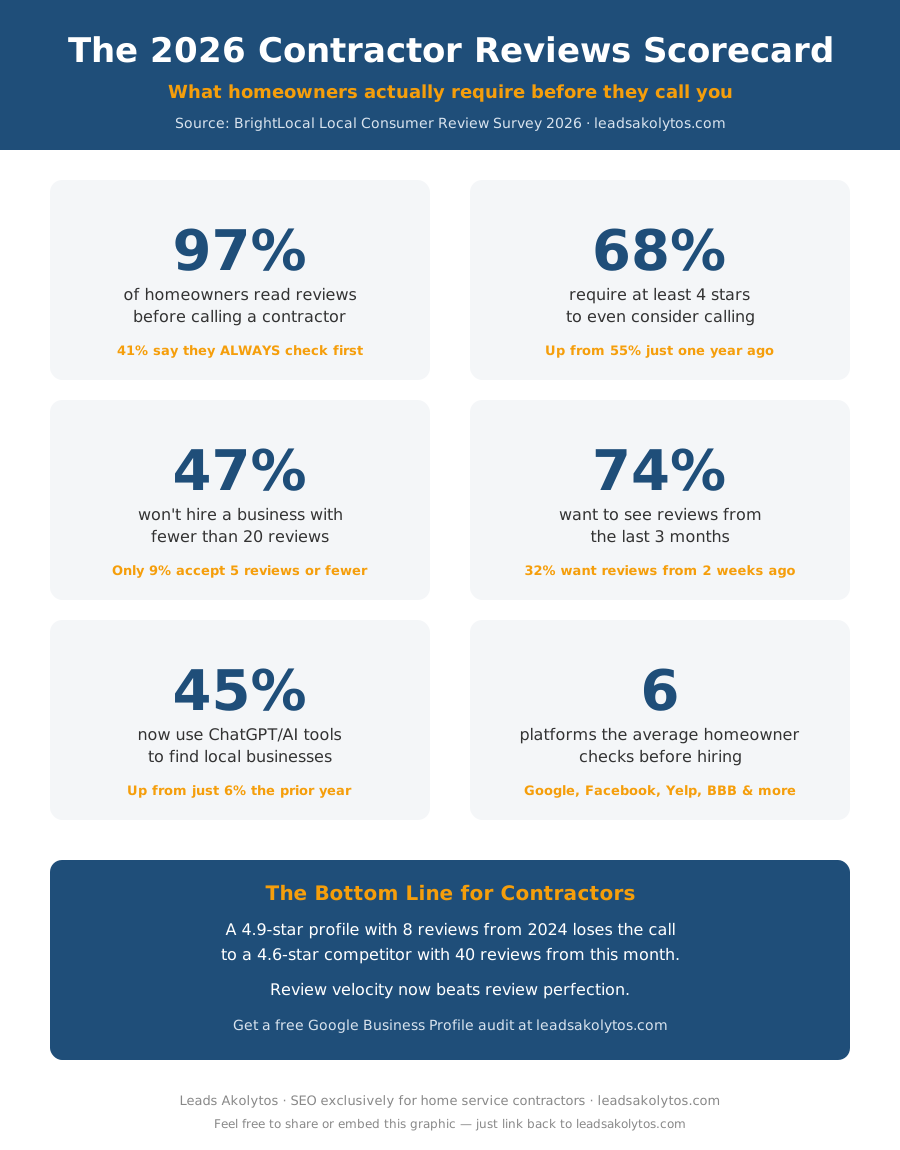
The 2026 Contractor Reviews Scorecard — what homeowners require before they call. Source: BrightLocal Local Consumer Review Survey 2026.
Want to use this scorecard on your own site? Go ahead — just credit us. Copy this embed code:
<a href="https://leadsakolytos.com/blog/2026-contractor-reviews-scorecard/"><img src="https://leadsakolytos.com/blog/contractor-reviews-scorecard-2026.svg" alt="2026 Contractor Reviews Scorecard by Leads Akolytos" /></a>
Every site that republishes this graphic links back to this article — which is exactly why we built it.
Why Review Recency Beats Review Perfection
The biggest shift in this year’s data isn’t the star threshold — it’s the clock. Seventy-four percent of homeowners want to see feedback from the last three months, and 32% want something from the last two weeks, nearly double last year’s number. A contractor sitting on 60 reviews from three years ago is losing to a competitor with 20 reviews, half of them from this month — a contractor with fewer, fresher reviews can out-book one sitting on old ones is exactly why.
That means review generation can’t be a one-time push after a slow month. It has to be a habit built into every closed job: ask while the work is still fresh, make it a two-tap process from a text message, and don’t stop once you hit an arbitrary number.
Every contractor asking how many Google reviews do contractors need should treat this scorecard as a floor, not a ceiling.
What This Means for Your Google Business Profile
- Below 20 reviews: you are invisible to nearly half of homeowners before they even read what the reviews say. This is priority one.
- Below 4 stars: you are filtered out by two-thirds of searchers, regardless of price or availability.
- No reviews in the last 90 days: homeowners assume you’ve gone quiet, are overbooked and unresponsive, or worse — out of business.
None of this requires being the flashiest contractor in your market. It requires a system: consistent requests, fast responses to every review (good or bad), and a Google Business Profile that’s treated as a living asset instead of something you set up once and forgot.
The AI Search Layer Changes the Stakes Further
The survey also found that 45% of consumers now use ChatGPT or similar AI tools to find local businesses, up from just 6% the year before. These tools pull from the same signals — your review count, your rating, and how current your feedback is — when they answer a homeowner’s question about who to call. A thin, stale review profile doesn’t just cost you the Google searchers anymore; it costs you the AI-assisted ones too.
Before you dive into the FAQ, it helps to know how this contractor reviews scorecard should actually be used month to month. Most contractors check their star rating once and forget about it, but the scorecard is meant to be revisited on a set cadence, ideally every 4 to 6 weeks, so you can catch a slow decline in review velocity before it shows up as a ranking drop.
A single bad month rarely tanks your local pack visibility on its own, but three or four consecutive months of near-zero new reviews next to an active competitor almost always does. Treat the contractor reviews scorecard as a recurring check-in rather than a one-time diagnosis, and you will catch problems while they are still cheap to fix.
Contractor Reviews Scorecard: Frequently Asked Questions
How Many Google Reviews Do Contractors Need in 2026?
At minimum 20, based on current homeowner expectations — that’s the point where 47% of consumers stop filtering you out automatically. Contractors competing in busy metro markets should aim higher, since competitors are often sitting on 50-100+.
Does review recency really matter more than total count?
Both matter, but recency is now the faster-moving requirement. A large volume of old reviews signals a business that used to be active. A steady trickle of recent reviews signals a business that’s thriving right now — which is what homeowners are actually trying to verify.
What’s a realistic system for getting more reviews without being pushy?
Ask at the moment of highest satisfaction — right after the job is done and the homeowner has seen the result — using a text message with a direct link. Avoid email alone; response rates are far lower. Follow up once if there’s no response within a few days, then let it go.
Want Your Google Business Profile Audited Against This Scorecard?
At Leads Akolytos, we work exclusively with home service contractors — electricians, HVAC, plumbers, roofers, remodelers, and more — and Google Business Profile management is included in every plan, with no contracts.
Book a Free 30-Minute Strategy Call →
How to Read Your Own Contractor Reviews Scorecard
Pull your last 90 days of reviews and score yourself the same way this contractor reviews scorecard does: count total reviews, average rating, and how many came in the last 30 days specifically. A contractor reviews scorecard that shows a healthy star average but zero reviews in the last month is the most common blind spot — recency is what Google and buyers both weight most, not your lifetime total.
Getting reviews is half the job — knowing how to handle the negative ones publicly is the other half. See our guide on how to respond to negative Google reviews for a word-for-word framework.
How Many Google Reviews Do Contractors Need Compared to Local Competitors
How many Google reviews do contractors need is really a relative question, not an absolute one — the honest benchmark is beating your top 3 local competitors on both review count and average rating, since homeowners scanning the map pack compare businesses side by side, not against a universal target number.
Frequently Asked Questions About the Contractor Reviews Scorecard
What if a competitor has far more reviews than I can catch up on?
Review recency matters as much as total count — a steady stream of recent 5-star reviews from the last 90 days often outperforms a competitor’s larger but stale, years-old review pile, so how many Google reviews do contractors need also depends on how fresh yours are.
Should I respond to every review, good and bad?
Yes — responding to both positive and negative reviews signals an active, attentive business to both Google’s algorithm and to homeowners reading the reviews before they call.
For a broader look at how review signals factor into local pack ranking, Google’s own guide to local ranking factors confirms relevance, distance, and prominence — prominence being where review count and rating do most of the work — as the three pillars Google uses, which is exactly why how many Google reviews do contractors need keeps coming up as a practical, answerable question rather than guesswork.
Should You Manage Your Review Strategy Yourself, or Hire It Out?
Hitting the review-count and recency benchmarks in this scorecard is a real, ongoing job, not a one-time fix — and contractors evaluating whether to handle it in-house or bring in outside help usually land on one of two answers. Doing it yourself costs no cash outlay but does cost time: building a review-request habit into every completed job, following up with customers, and monitoring your Google Business Profile weekly typically eats 2-4 hours a month once it’s running smoothly, more at the start while you build the system.
Hiring it out (either as a standalone review-management service or as part of a broader contractor SEO engagement) shifts that time cost to a monthly fee, but only pays off if the provider actually builds a consistent request rhythm rather than a one-time push — see our guide to vetting an SEO or marketing vendor before signing anything.
A Quick Way to Decide
If you already have a simple, repeatable way to ask every customer for a review right after the job (a text, an email, a QR code on the invoice) and you’re consistently hitting it, doing it yourself is often the more cost-effective path. If review requests keep falling through the cracks because there’s no system, or you don’t have the time to monitor and respond to reviews weekly, that’s usually the sign it’s worth pricing out a managed option.
How to Read This Contractor Reviews Scorecard for Your Own Trade
The numbers on this contractor reviews scorecard are averages across home service categories, not a single fixed target — a roofer competing on emergency storm response needs a different review velocity than a remodeler whose jobs close over months of quotes and site visits.
Before you treat any number on this contractor reviews scorecard as your goal, check it against your own trade’s typical sales cycle: shorter-cycle trades (plumbing, HVAC repair, electrical) live or die on review recency because buyers are comparing options this week, while longer-cycle trades (remodeling, roofing replacements, residential construction) can carry a slightly older review base as long as the star rating itself holds up.
Use this contractor reviews scorecard as a monthly check-in, not a one-time audit: pull your current star rating and review count, compare them against the bands above for your trade, and note which band you are in. If you are below the top band, the fastest lever is almost always response rate and recency, not raw count — a contractor reviews scorecard reading of 4.6 stars with reviews from the last 30 days consistently outperforms a higher raw count with a stale review history.
Want this handled for you?
We do this work for home service contractors every day, month-to-month, with no contracts. Book a free 30-minute call and we'll show you where you stand on Google.
Book my free call