Contractors with fewer reviews book more jobs than higher-rated competitors more often than you’d think. It doesn’t seem like it should be possible. You’ve got a 4.9-star rating, glowing feedback, years of happy customers — and a competitor with a 4.6 average is out-booking you two to one. Once you look at how homeowners actually evaluate contractors, it makes complete sense.
A high star rating with too few or too old reviews loses to a slightly lower rating with more, more recent reviews, because homeowners weigh review volume and recency alongside the star average — not the star average alone. A thin, stale profile reads as small or inactive, regardless of how positive it is.
Why Fewer Reviews Book More Jobs: The Math Homeowners Are Actually Doing
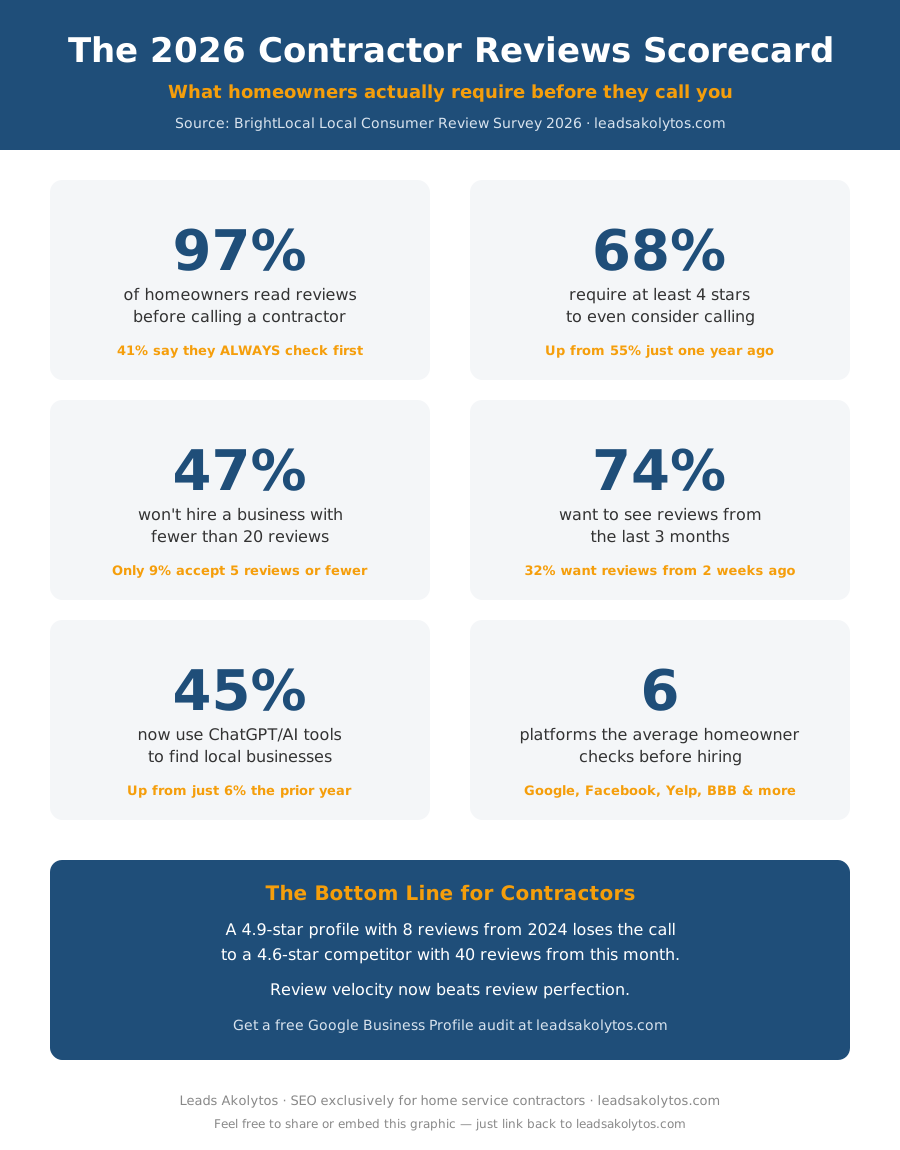
According to BrightLocal’s 2026 Local Consumer Review Survey, 47% of homeowners won’t call a business with fewer than 20 reviews, and 74% specifically want to see feedback from the last three months. A contractor with a 4.9-star average built from 12 reviews, the newest one from eight months ago, fails both filters — even though the rating itself is excellent.
Meanwhile, a competitor sitting at 4.6 stars with 65 reviews, several from the last two weeks, passes every filter a homeowner runs. The perfect rating never even gets weighed against the good-enough one, because the perfect rating gets filtered out before the comparison happens.
Three Ways Fewer Reviews Book More Jobs in Real Search Results
The “just started” trap
New or newly-listed businesses often chase a perfect rating out of the gate and stop asking for reviews once they hit a comfortable number like 15 or 20. That’s precisely the volume where competitors with hundreds of reviews start pulling away, even if their average rating is a few tenths of a point lower.
The “burned out” plateau
Established contractors sometimes build a strong review base early, then let the habit slip once the business feels secure. Eighteen months later, that once-strong profile looks stale next to a newer competitor generating five reviews a week.
The single bad month
One rough month — a scheduling issue, a subcontractor mistake, a string of negative reviews — can drag the average down temporarily. Contractors sometimes respond by going quiet on review requests, worried about surfacing more criticism. That’s the opposite of what recovers the average: a steady stream of new positive reviews dilutes a handful of bad ones far faster than silence does.
Fewer Reviews Book More Jobs When You Build a Rhythm, Not Chase a Number
- Ask for a review the same day, or the same visit, every single time — not just when you remember or when a job goes especially well
- Text a direct link rather than relying on email, which has meaningfully lower response rates
- Respond to every review within a few days, which signals an active business to both homeowners and Google, part of a fully optimized Google Business Profile
- Don’t stop once you cross 20 or 50 — competitors keep generating reviews, and standing still means falling behind on recency even if your count stays ahead
This is exactly why contractors with fewer reviews book more jobs than rivals sitting on a higher star average but a stagnant count: a steady cadence of fresh reviews reads as an active, in-demand business, while a frozen profile — even a glowing one — reads as slow.
Your First 30 Days: Building the Rhythm From a Standing Start
If your review count has been flat for a while, the fix is not a campaign. It is a small habit installed in the one place where it will actually stick: the end of a job, while the customer is still standing in front of you and still pleased.
Week one, decide who asks and when. Pick one person and one moment. For most trades the moment is the walkthrough, not the invoice, because the invoice arrives when the customer is thinking about money rather than about the work. Write the ask down as one sentence and use the same sentence every time, so it stops feeling like a favour and starts feeling like part of the job.
Week two, remove the friction. Most review requests fail because the customer has to go and find you. Send the direct link by text while you are still on site. If a homeowner has to search your business name, scroll past two competitors, and remember what they wanted to say, you have lost most of them before they start typing.
Week three, start replying to everything. Every review, good or bad, gets a short reply within a few days. This is the part contractors skip and the part homeowners read. A wall of unanswered five-star reviews looks automated; a mix of reviews with thoughtful replies underneath looks like a business somebody is running.
Week four, look at the dates rather than the average. Open your listing and read it the way a homeowner would. Is the newest review from this month or from two summers ago? Recency is the signal you are building here, and it is the reason fewer reviews book more jobs than a larger pile of five stars collected years ago. It also decays on its own if nobody keeps it topped up.
Four weeks of that will not transform your rating, and it is not supposed to. What it produces is a steady trickle of recent, specific reviews, which is the pattern that quietly outperforms a higher average built years ago. The contractors for whom fewer reviews book more jobs are not doing anything cleverer than this. They are just doing it every week instead of every once in a while.
The trap to avoid is treating month one as a push. A burst of twenty reviews in a fortnight followed by silence reads worse to a homeowner than a handful arriving steadily, and it is the single most common way this effort gets wasted.
Should You Build the Review System Yourself, or Pay Someone to Run It?
Almost every contractor reading this could do this work themselves. The real question is not capability, it is whether the rhythm survives a busy month, because fewer reviews book more jobs only while those reviews keep arriving. Here is the honest comparison before you decide either way.
Doing it yourself. The cost is time, not money. You need a fixed moment in the job where someone asks for the review, a short script so the ask sounds the same every time, and one person responsible for chasing it and replying to what comes back. Realistically that is a couple of hours of somebody’s attention every week, indefinitely. The risk is not that you will do it badly. The risk is that you will do it well for six weeks, hit a busy stretch, and stop, which is exactly how the plateau described above gets built in the first place.
Paying someone to run it. What you are buying is not skill, it is continuity: the ask still happens during the week you are short two crews and behind on invoicing. Our own plans start at $1200 a month with no contract, so the honest comparison is a couple of hours a week of your team’s time against that figure. If your average job is worth more than a few hundred dollars, one recovered booking a month settles the arithmetic on its own.
Three questions that decide it. Does anyone in your business currently own this task by name? Has a review-request habit already survived one of your busy seasons? Would you rather spend your own attention on reviews or on quoting? If the answers are no, no, and quoting, then paying for it is probably the cheaper option even though it is the one with a price tag attached.
What to ask before you pay anyone. Ask who writes the responses and whether you approve them before they post. Ask how they request reviews, and walk away from anyone who offers to write or buy reviews, which violates Google’s review policies and can get your listing suppressed. Ask what month one looks like compared with month six. A provider who cannot answer those three questions plainly is selling you activity rather than a system. If you want that conversation without a pitch attached, book a free strategy call and ask us the same three questions.
Signs Your Review Numbers Are Actually Costing You the Job
Fewer reviews book more jobs when the reviews that exist are recent, specific, and honestly responded to — but there are a handful of warning signs that flip that pattern into a real problem instead of a strength.
Your last review is more than 60 days old. A homeowner comparing three contractors will notice a stale review stream faster than a low count. Fewer reviews book more jobs only when the ones you have look active, not abandoned.
Every review reads like it was written by the same person. Templated ask scripts produce templated-sounding reviews, and readers notice the pattern within a few. Genuine variation in wording, length, and detail does more for trust than volume does.
You have zero one-star or two-star reviews at all. Counterintuitively, an absolutely perfect record can read as curated or incomplete rather than trustworthy — most real service businesses have at least one bad day somewhere in their history, and a single honestly-handled negative review with a professional response often builds more trust than a suspiciously flawless page.
Nobody on your team ever responds to reviews. An unanswered review, positive or negative, is a missed chance to reinforce why fewer reviews book more jobs in the first place — a thoughtful owner response signals someone is actually running the business, which is exactly the signal a bare star rating can’t send on its own.
Checking your own profile against these four signs takes five minutes and tells you honestly whether your current review pattern is helping you the way it should, or just coasting on a number that used to be enough.
How to Ask for Reviews Without Sounding Like Every Other Contractor
Most review requests fail because they arrive as a generic mass text sent to every customer with the same wording, and customers can tell. Fewer reviews book more jobs when the ones you collect come from a request that actually references the job that was done — naming the specific repair, the technician’s first name, or the exact issue that got fixed. That small bit of specificity is also what makes the resulting review readable and persuasive to the next homeowner comparing options, rather than a generic five-star rating with no context behind it.
Timing matters as much as wording. A request sent the same day the job wraps up, while the relief of a fixed problem is still fresh, converts at a meaningfully higher rate than one sent a week later as a batch follow-up. Building that immediate-ask habit into the technician’s end-of-job routine — not a separate marketing task someone gets to eventually — is a bigger factor in whether fewer reviews book more jobs for a given business than almost any tool or software used to send the request.
Finally, never incentivize the review itself, only the act of leaving feedback — offering a discount specifically for a five-star review violates most platforms’ terms of service and, more importantly, produces reviews that read as bought rather than earned, which sophisticated homeowners increasingly notice and discount accordingly.
Which Review Signal Actually Moves the Phone: A Quick Reference
Not every review signal carries equal weight with a buyer scanning results in a hurry. Here is how the three most common signals stack up against each other for actually winning the call, based on the buying-behavior patterns covered above.
| Review Signal | What It Tells a Buyer | How Much It Actually Moves Bookings |
|---|---|---|
| Total review count | “This company has been around and done volume” | Lower than most contractors assume once a business clears roughly 20-30 reviews |
| Star rating average | “Most people who hired this company were satisfied” | Matters, but a 4.9 with reviews from three years ago reads as risky, not reassuring |
| Review recency (dates of the most recent reviews) | “This company is active, reliable, and still doing good work right now” | The strongest single signal covered in this guide — it is the difference between “was good” and “is good” |
The practical takeaway: a steady drip of recent reviews will usually out-book a large stockpile of old ones, which is exactly the fewer-reviews-book-more-jobs pattern this guide is built around.
This is the core mechanism behind why fewer reviews book more jobs than a large stale pile of them: buyers are not counting your reviews, they are checking whether you are still active. Keep the dates recent and the volume takes care of itself over time.
Frequently Asked Questions: Why Fewer Reviews Book More Jobs
Is a 4.6 rating with more reviews really better than a 4.9 with fewer?
For visibility and initial trust, often yes. Homeowners filter on volume and recency before they weigh the exact decimal of the star average, so a thin, stale high rating can lose to a more active, slightly lower one.
How many reviews should I be generating per month?
There’s no universal number, but the goal is consistency: enough that a homeowner searching today finds feedback from the last few weeks, not just the last few months. See our 2026 Contractor Reviews Scorecard for exact benchmarks by trade.
Should I worry about occasional negative reviews?
Less than most contractors think. A response that’s professional and shows you took the feedback seriously often reassures homeowners more than a spotless record with no reviews at all to prove it.
Is it worth paying someone to manage reviews, or should I just do it myself?
Do it yourself if one named person in your business will still be asking for reviews during your busiest month. Pay someone if that has already failed once. The work is simple either way; what you are actually buying is continuity. Our plans start at $1200 a month with no contract, so weigh that against a couple of hours a week of your team’s time and the bookings you lose whenever the habit lapses.
Let Us Build a Review System That Actually Keeps Pace
Leads Akolytos includes Google Business Profile management in every plan — we help you build the rhythm, not just chase a number. No contracts, plans start at $1200/month.
Book a Free 30-Minute Strategy Call →
A steady flow of new reviews matters more than any single bad one — but when a negative review does land, how you respond publicly affects whether the next homeowner trusts you. Our guide on how to respond to negative Google reviews without losing the customer walks through exactly what to say.
The pattern holds across trades: fewer reviews book more jobs when those reviews are recent and consistently answered, because a searcher scanning results in a hurry reads recency as reliability. A contractor chasing volume alone is optimizing for the wrong number — fewer reviews book more jobs than a bigger, staler pile every time recency and response rate are factored in.
Why Fewer Reviews Book More Jobs
A contractor with fewer reviews books more jobs than a competitor with a bigger, stale count when the fewer reviews are recent and specific. Homeowners scan for freshness first — fewer reviews book more jobs when they read as current proof, not a wall of old five-star ratings.
The pattern holds across trades: fewer reviews book more jobs when those reviews are recent, specific, and easy to scan on a phone screen.
The pattern holds because fewer reviews book more jobs when the reviews that do exist are recent, specific, and answered — not because review volume stops mattering entirely. A contractor with 20 reviews from the last two months, each one responded to, reads as more active and more trustworthy than a competitor with 200 reviews that stopped coming in a year ago. That is the real mechanism behind why fewer reviews book more jobs: recency and responsiveness are doing the work that raw count used to do.
If you only remember one thing from this piece, remember this: fewer reviews book more jobs is not an argument against collecting reviews, it is an argument against treating review count as a vanity metric. Contractors who internalize that fewer reviews book more jobs stop chasing a big round number and start building a system — ask after every completed job, respond within 48 hours, and let the recency and the responses do the persuading instead of the total.
The Takeaway
It keeps coming back to the same pattern: fewer reviews book more jobs than a competitor sitting on a bigger, staler pile of star ratings, as long as those newer reviews are recent and get a visible response. If you only fix one thing this month, fix your response rate, since that’s the single lever behind why fewer reviews book more jobs than the account that never replies.
Why Fewer Reviews Book More Jobs Even in Competitive Trades
The pattern holds even when a competitor has three times your review count: fewer reviews book more jobs when the ones you have are recent, specific, and answered. A homeowner scanning profiles skims dates and content before they skim totals, and a thin but current profile with real detail beats a stale wall of five-star ratings from three years ago.
This is the practical reason fewer reviews book more jobs for contractors who ask consistently instead of in occasional bursts: a steady trickle of new reviews signals an active business, while a pile of old reviews followed by silence signals the opposite, even if the star average is identical. Fewer reviews book more jobs precisely because recency reads as proof the business is still doing good work right now, not just that it once did.
None of this means review count stops mattering entirely — it means fewer reviews book more jobs only up to a point, and after that point, response rate and recency carry more weight than adding another dozen ratings to an already-large total.
Want this handled for you?
We do this work for home service contractors every day, month-to-month, with no contracts. Book a free 30-minute call and we'll show you where you stand on Google.
Book my free call