
Turn Online Searches Into Booked Residential Jobs

Before you invest more time or budget into residential contractor lead generation, it helps to answer one question first: should you build this system yourself, or is it worth paying a contractor SEO agency to do it for you? The short answer, and the full breakdown with real cost and time-investment numbers, is in the “Should You Handle Residential SEO Yourself or Hire an Agency?” section below — but first, here is what actually goes into a working system.
Residential contractor lead generation works best when the website, the reviews, and the follow-up process are all pulling in the same direction — residential contractor lead generation is a system, not a single tactic.
Residential contractor lead generation is tougher now than it has ever been. More remodelers, HVAC techs, plumbers, roofers, and builders are fighting for the same homeowners. Paid ads keep getting more expensive. At the same time, homeowners have more choices and higher expectations.
Most people now go online first. They scroll reviews, compare photos, and read service pages before they ever pick up the phone. Your online presence is often the make-or-break factor in who gets the call and who gets ignored.
That is where SEO comes in. When it is done right, SEO helps you show up when local homeowners are actually searching for help, like before school starts or when that late-summer storm rolls through. In this article, we are going to walk through how you can show up in those searches, turn seasonal demand into real leads, and move more of those clicks into booked estimates for your crew.
Why SEO Is a Lead Generation Engine for Contractors
Paid ads can work, but they are like a faucet. The second you stop paying, the water shuts off. SEO works more like a well that you keep building. Over time, you earn long-term visibility in your service area and build trust with search engines and homeowners.
SEO helps you show up when people are already looking for what you do, for example:
- “AC repair” when their unit stops blowing cold air
- “bathroom remodel before school starts” when the family needs more space
- “roof leak after storm” when water is coming through the ceiling
Those are high-intent searches. The person is not just “browsing.” They have a problem and want it fixed soon. When your site appears in those results, you are not chasing people. They are coming to you.
Strong SEO also supports everything else you are doing. When your website is easy to find and well written:
- Your Google Ads usually perform better
- Your social posts feel more credible
- Homeowners recognize your name when they see it in more than one place
The goal is not just traffic. It is the right traffic. Good SEO filters out random visitors and zeroes in on homeowners in your area who actually need help, which means better ROI on every marketing dollar you put in.
Build a Revenue-Ready SEO Foundation for Your Trade
Before you think about keywords or blog posts, your website needs to work like a clean, well-organized job site. If it is slow, confusing, or hard to use on a phone, people leave fast.
Make sure you cover the basics:
- Mobile-friendly design that is easy to tap through
- Fast load times so pages open quickly, even on weak Wi-Fi
- Simple navigation with clear labels for each service
- Phone number and “Request Estimate” form visible on every key page
Next, avoid the one giant “Services” page problem. If you do HVAC, you should have different pages for AC repair, furnace replacement, heat pump installation, and so on. Same idea for:
- “Kitchen Remodeling” and “Bathroom Remodeling”
- “Emergency Plumbing Repair” and “Water Heater Replacement”
- “Storm Damage Roof Repair” and “Roof Replacement”
Each service deserves its own page with clear details. That helps search engines understand what you offer and gives homeowners the answers they are looking for.
Local SEO basics are just as important. Make sure your name, address, and phone are consistent everywhere. Add an embedded Google Map on your contact page. If you serve several nearby cities or neighborhoods, add location pages that talk directly about work in those areas.
Finally, think about trust. Homeowners want proof that you are real and reliable. Add:
- Licenses and certifications where appropriate
- Before-and-after photos
- Clear testimonials
- Review widgets that show recent feedback
These small items help turn clicks into phone calls.
Turn Seasonal Demand Into Search Traffic and Leads
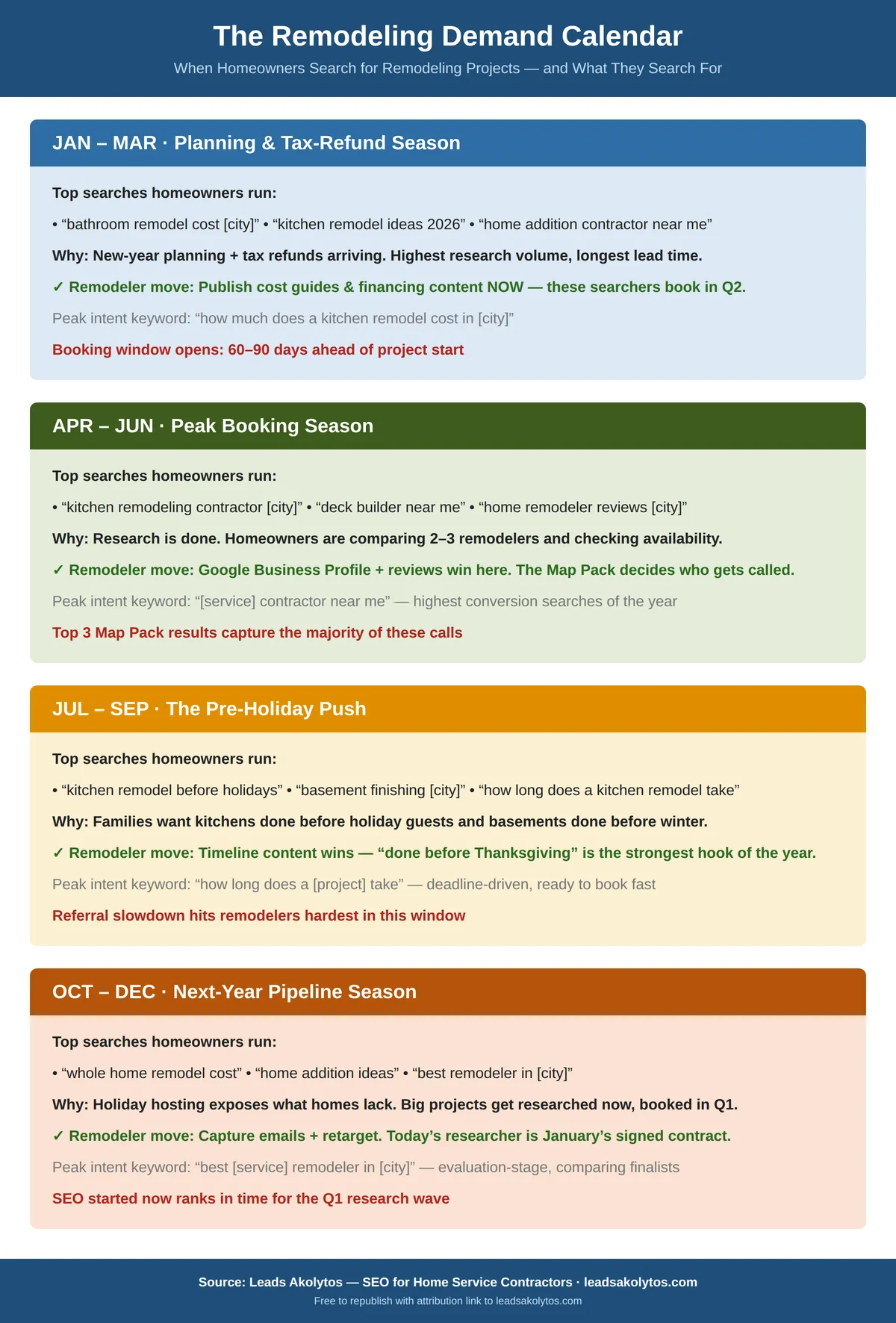
Residential contractor lead generation lives and dies by the seasons. When the weather warms up, HVAC and roofing searches climb. Late summer and early fall bring a rush of interior remodeling and home office updates before school and the holidays. As nights get cooler, people start thinking about insulation, heating, and buttoning up the house.
SEO does not work overnight, so you want to plan your content 60 to 90 days before the rush. That way, your pages and blog posts have time to show up in search results before homeowners start shopping.
Some strong seasonal content ideas are:
- “Late-Summer AC Tune-Up Checklist for a Cooler Home”
- “Back-to-School Home Office Remodel Ideas for Busy Families”
- “How to Prepare Your Roof Before Fall Storms Hit”
Tools like Google Search Console and keyword research tools can show you which terms are beginning to rise in your area. When you spot patterns, answer those questions on your site. Over time, this builds a steady stream of traffic that matches the natural ups and downs of your trade.
Local SEO Tactics That Put You on the Map
Your Google Business Profile is one of the strongest local SEO tools you have. Many homeowners never get past that Map Pack. So you want your profile to be complete, accurate, and active.
Focus on:
- Choosing the right main and secondary categories
- Listing out your key services
- Defining your service areas
- Writing a clear business description that uses natural phrases your customers use
- Keeping hours correct, including holiday changes
Reviews also play a big role. A simple review process can help:
- Ask for a review after each successful job
- Send a direct review link by text or email
- Respond to every review, good or bad, with a short, professional note
Use Google Posts to share timely offers and updates, like “Late-Summer HVAC Tune-Up Specials” or “Storm Damage Roof Inspections Available.” This keeps your profile fresh and shows homeowners you are active.
Local citations also matter. Make sure your business is listed in relevant directories, trade sites, and local groups such as chambers of commerce. The key is consistency. Same name, same address, same phone everywhere.
Content That Converts Homeowners Into Project Inquiries
Homeowners are not just looking for a sales pitch. They want simple, honest answers. When your site teaches instead of just selling, you build trust before they ever speak with you.
Good content types for residential contractor lead generation include:
- Project spotlights with short overviews and photos
- Cost breakdown posts that explain what affects pricing
- “What to expect” guides for jobs like full remodels or system replacements
- Seasonal maintenance checklists for HVAC, roofing, or plumbing
Throughout your content, use clear calls-to-action, such as “Schedule a Free Estimate,” “Book a Same-Day HVAC Appointment,” or “Request a Roof Inspection Before the Next Storm.” Make it easy for someone to know the next step.
You should also show local knowledge. Mention city names or neighborhoods you serve, common climate issues in your region, and basic notes about permits or local code expectations. This signals that you understand the specific conditions in their area, not just generic work.
When you mix search visibility with real-world proof and helpful education, you turn random clicks into qualified project inquiries, which is exactly what we focus on at Leads Akolytos.
Should You Handle Residential SEO Yourself or Hire an Agency?
Short answer: if you can commit 5-8 hours a week for at least 4-6 months to service pages, Google Business Profile upkeep, and review follow-up, DIY can work for a single-location trade business. If your time is worth more booking jobs than writing meta descriptions, or you serve more than one city, hiring an SEO company that specializes in home service contractors typically pays back faster.
| Factor | Doing It Yourself | Hiring a Contractor SEO Agency |
|---|---|---|
| Time investment | 5-8 hrs/week, ongoing | 1-2 hrs/month for reviews and approvals |
| Typical cost | $0 cash, but real opportunity cost of your time | Commonly a few hundred to a few thousand dollars per month depending on scope |
| Learning curve | Steep if you’ve never done technical SEO or service-page structure before | None on your end; the agency already knows the trade-specific patterns |
| Risk of mistakes | Higher; duplicate content, broken schema, or a botched Google Business Profile edit can cost rankings | Lower, assuming you vet the agency first (see our audit checklist below) |
| Best fit | Single-location contractor with slow season capacity and patience | Multi-location, fast-growing, or time-starved owners |
Whichever path you choose, before you sign anything with an outside provider, run them through our 7-point checklist to audit a contractor SEO company so you know exactly what you’re buying.
Bottom line: if you run a single-location trade business with slow-season capacity, DIY residential SEO is realistic and can save real cash. If you are multi-location, growing fast, or your time books more jobs than it saves in software subscriptions, hiring a contractor-specific SEO agency (commonly a few hundred to a few thousand dollars a month, per the cost table above) typically pays for itself faster than the DIY route — just vet them with the audit checklist linked above before you sign.
Get More High-Value Residential Projects Starting This Month
If you are ready to consistently fill your pipeline with qualified local homeowners, our tailored residential contractor lead generation strategies can help you get there. At Leads Akolytos, we focus on practical systems that turn real online interest into booked estimates and signed contracts. Tell us about your goals and current challenges, and we will map out a clear action plan for you. To start the conversation, simply contact us today.
Roofing companies in particular should also read our dedicated guide on why roofing leads are slowing and how SEO fixes it.
Frequently Asked Questions
Is residential contractor SEO worth it if I already run Google Ads?
Yes, for most contractors the two work best together. Paid ads stop the moment you stop paying; SEO keeps generating calls in the background and usually lowers your blended cost per lead over 6-12 months.
How much does residential contractor lead generation SEO typically cost?
Monthly retainers for home service contractor SEO commonly range from a few hundred to a few thousand dollars depending on how many locations and services you need covered. DIY has no cash cost but a real time cost.
Should I hire a generalist marketing agency or one that specializes in contractors?
A contractor-specific agency already understands service-area pages, seasonal demand, and review velocity for trades, which usually means less time spent educating them before you see results.
How do I know if my current SEO provider is actually working?
Ask for call and form-fill numbers tied to specific keywords, not just traffic screenshots. If a provider can’t show you booked estimates or named ranking improvements after 90 days, that’s a red flag worth revisiting.
Wondering how much to actually budget? See our realistic contractor SEO budget and year-one ROI timeline.
Where Residential Contractor Lead Generation Efforts Usually Stall
Most residential contractor lead generation programs don’t fail from lack of traffic — they fail at the handoff between a click and a booked estimate. Before adding more residential contractor lead generation spend, check how fast someone answers the phone or replies to a form, since a slow response can waste half of what you’re already generating.
Residential contractor lead generation also benefits from matching the offer to the season: gutter and roofing leads spike after storms, kitchen and bath leads spike in January. Aligning your residential contractor lead generation content and ad spend with those windows, rather than running flat year-round, is one of the cheapest wins available.
Keeping Residential Contractor Lead Generation Consistent Quarter to Quarter
Residential contractor lead generation tends to slow the moment a business owner stops paying attention to it, which is why the strongest programs treat residential contractor lead generation as an ongoing habit rather than a one-time project. A quarterly check-in on your Google Business Profile activity, review volume, and top service-area pages keeps residential contractor lead generation compounding instead of plateauing, and it takes far less time than rebuilding momentum after a slow stretch.
If you are not sure where your own residential contractor lead generation program currently stands, a short audit of your last 90 days of leads by source is usually enough to show whether SEO, referrals, or paid ads are actually doing the heavy lifting.
DIY vs. Hiring It Out: What Residential contractor lead generation Actually Costs You
Before you decide whether to tackle residential contractor lead generation yourself or bring in help, weigh it honestly: doing it in-house costs your time (often 5-10+ hours a month once you factor in research, execution, and tracking results) plus the risk of trial-and-error mistakes that a specialist would avoid. Working with a dedicated team like ours starts at $1200/month with no long-term contracts, so the downside of trying it is small and the ramp-up is fast. You’ll work directly with the person handling your account, not a rotating manager, before you commit either way.
FAQ: Is it worth paying someone for residential contractor lead generation?
If you have the hours to spend learning and iterating, DIY can work. If your time is better spent running jobs and managing crews, a $1200/month, no-contract engagement typically pays for itself within a couple of closed jobs. Schedule a free strategy call to get a straight answer for your specific business before you decide.
Want this handled for you?
We do this work for home service contractors every day, month-to-month, with no contracts. Book a free 30-minute call and we'll show you where you stand on Google.
Book my free call