What Should You Ask a Content Writer or Content Agency Before You Hire Them?
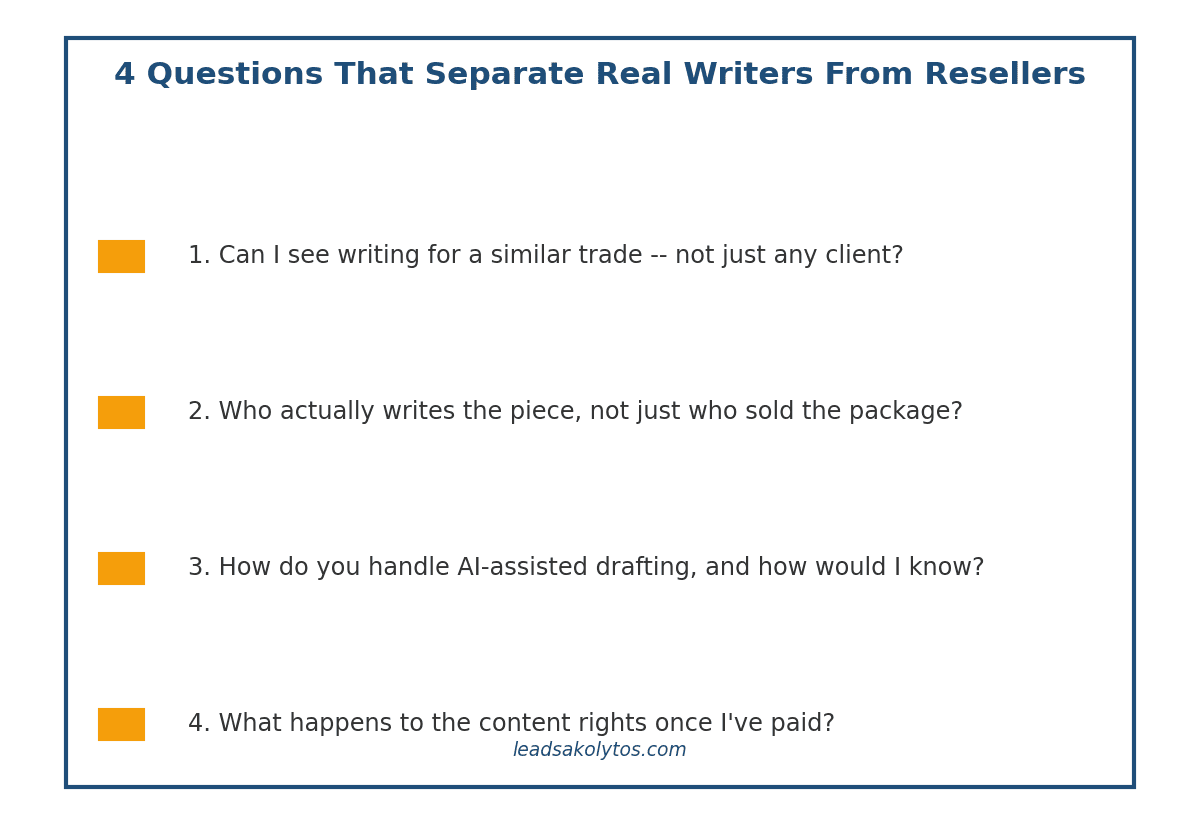
Before you pay anyone to write for your contractor business, ask to see work for a similar trade, ask who actually writes the piece (not just who sold you the package), ask how they handle AI-assisted drafting, and ask what happens to the content rights once you’ve paid. A provider that hesitates on any of those four is telling you something about the other work you haven’t seen yet.
Most guides to hiring a content writer or content agency are written for general small businesses or SaaS marketing teams. Almost none of them are written for a contractor trying to tell the difference between a writer who understands a jobsite and one who is producing generic, search-engine-shaped filler about “the importance of quality service.” That gap is what this guide is for — see our Authoritative Content Creation service page for the fuller picture of what this work involves.
7 Questions to Ask Before You Sign
- 1. Can I see content you’ve written for a similar trade, not just any client? Writing convincingly about plumbing, roofing, or HVAC requires knowing the difference between a service call and an estimate, a permit and an inspection. Generic “content marketing” samples from unrelated industries do not prove that.
- 2. Who actually writes the piece? The person who sold you the package is often not the person producing the draft. Ask directly whether your account will be handled by a senior strategist, a junior writer, or a rotating pool of freelancers — and ask to know before you sign, not after the first draft disappoints you.
- 3. How do you handle AI-assisted writing, and how would I know? Plenty of legitimate writers use AI tools for research or a first pass. The problem is unlabeled, unedited AI output sold as original work — generic phrasing, invented statistics, and a complete absence of first-hand detail about your trade. Ask directly, and ask to see a sample you can compare against what currently ranks for one of your target topics.
- 4. What does your research and fact-checking process look like? A writer who cannot describe how they verify a pricing figure, a code requirement, or a seasonal claim before publishing it under your business’s name is a liability, not an asset — a wrong number in a blog post with your name on it is your problem, not theirs.
- 5. What does the revision process look like? Ask how many rounds of revision are included, and what happens if the first draft misses your voice or gets a detail about your trade wrong. Unlimited revisions sound generous but often signal a first draft nobody expected to be usable.
- 6. What happens to the content and the rights once I’ve paid? You should own the piece outright once it is delivered and paid for. If a provider retains any ongoing rights, licensing terms, or a “we can reuse this for other clients” clause, get it in writing before you sign, not after you find your paid content on a competitor’s site.
- 7. What’s actually included in the price? Ask whether the quote covers research, a featured image, internal linking, an SEO pass, and revisions, or just a raw draft. Two quotes that look similar on price can represent very different amounts of actual work.
5 Red Flags in a Content Writer or Agency Pitch
Most of these show up before you ever sign a contract with a content writer or content agency, if you know where to look.
- Guaranteed rankings from content alone. No legitimate writer can guarantee where a page ranks — that depends on technical SEO, competition, and links too. A guarantee is a sales tactic, not a fact.
- Suspiciously low per-piece pricing with no process description. A price far below typical contractor content pricing with no explanation of research, editing, or revisions usually means AI output with no human editing pass, not a bargain.
- No sample specific to your trade or a closely adjacent one. If every sample they show you is generic small-business content, that is what you should expect to receive too.
- Locked long-term contracts with no exit. Reputable content providers do not need to lock you in for a year to prove the work is worth continuing.
- A pitch focused entirely on volume (“4 posts a month!”) with no mention of what those posts are supposed to accomplish. Content is a means to leads and rankings, not an end in itself — a provider selling you a quantity of posts instead of an outcome is selling deliverables, not results.
DIY vs. Hiring: What Actually Changes
Writing occasional posts yourself is realistic if you genuinely enjoy explaining your trade and can commit a few consistent hours a month — some of the most convincing contractor content reads that way precisely because it comes from someone who has actually done the work. The same tradeoff applies to your core website pages — see our breakdown of whether you should write your own website copy or hire a professional copywriter for that specific decision. Where DIY typically breaks down is consistency and research overhead: fact-checking a claim, structuring a post so it actually targets a specific buying-intent keyword, and keeping up a publishing cadence once the job calendar fills up. If you want the fuller comparison of time, cost, and realistic output either way, see our breakdown of whether you need a professional content writer or can write it yourself.
What This Should Cost
Contractor-focused content typically runs from roughly $150-$400 per blog post for a freelance writer with trade experience, up to $800-$2,000/month for a fuller content program including strategy, editing, and publishing through an agency. For the complete pricing breakdown by tier and what drives cost up or down, see our full authoritative content creation cost guide. The point of this guide is different: it is not about what it costs, it is about how to tell whether the person or agency you are about to pay for it is actually going to deliver.
A Worked Example: Two Vetting Conversations, Two Different Outcomes
A roofing contractor gets a pitch promising “10 SEO-optimized blog posts a month” at a flat low rate. Asking the seven questions above surfaces that the writer cannot describe their fact-checking process, cannot show a roofing-specific sample, and cannot say who on their team actually writes the drafts. That is a pass, regardless of price.
A different contractor gets a quote from a solo freelancer at a higher per-post rate, but the writer answers every vetting question directly: shows two roofing samples from a past client, describes a specific research step (checking current material pricing before writing a cost-comparison post), and confirms full content ownership transfers on payment. Higher price, clearer answers — and a much lower chance of publishing something that damages credibility with an actual roofer reading it.
What a Good Onboarding Process Looks Like
A writer or agency who has done this before should be able to describe roughly the same sequence, regardless of price point:
- A short call or questionnaire about your trade specifics — your service area, your typical job types, and the details that make your business different from a competitor offering the “same” service.
- A first draft with a stated turnaround time, not an open-ended “we’ll get to it.”
- A defined revision window where you can flag anything that reads generic or gets a trade detail wrong.
- A final piece with sourced claims, meaning any statistic or pricing figure traces back to something real, not an invented number that sounds plausible.
If a provider cannot describe this sequence when you ask “walk me through what happens after I pay for the first post,” that is worth treating as its own answer.
How to Spot Recycled or Templated Content Before You Publish It
One practical check before you publish anything you did not write yourself: take a distinctive sentence or an unusual phrase from the draft and search for it in quotes. If it turns up on another business’s site, or on multiple low-quality content-mill pages, you are looking at recycled or lightly reworded content, not original work — a real risk with cut-rate providers who reuse the same base article across many clients in the same trade with the city name swapped out.
Frequently Asked Questions
How do I know if content I received was written by AI without disclosure?
Watch for generic phrasing that could apply to any trade, an absence of specific numbers or first-hand detail, and claims or statistics with no traceable source. Ask the writer directly how the piece was researched and be wary of vague answers. Google’s own guidance on creating helpful, people-first content is a useful independent benchmark for what unedited AI output typically fails to do — it is written for search quality, not for vetting vendors, but the same gaps (no first-hand experience, no real expertise) tend to show up in both.
Should I ask for writing samples before I pay for anything?
Yes, always, and specifically ask for samples in your trade or a closely adjacent one. Generic content-marketing samples from unrelated industries do not tell you how the writer will handle your subject matter.
What’s a reasonable number of revisions to expect?
One to two rounds of revision is standard for a single blog post. Unlimited revisions sound generous but can signal a rushed first draft; ask what happens if the first draft misses the mark before you sign.
Is it a red flag if a writer uses AI tools at all?
Not by itself — many good writers use AI for research or outlining. The issue is unlabeled, unedited AI output sold as fully original work, or an inability to explain what human editing happened before delivery.
The Bottom Line
The questions that separate a genuine contractor content writer from a volume mill are the same regardless of price: can they show trade-specific work, will they tell you who actually writes it, how do they handle AI-assisted drafting honestly, and do you own what you pay for. Ask all four before you sign anything. Whether you end up hiring a content writer or a full content agency, these are the questions that actually protect the money you spend.
Book a free 20-minute strategy call and we’ll walk through a content sample together — yours, a competitor’s, or a piece you’re considering paying for — and tell you honestly what we’d flag before you sign anything.
Want this handled for you?
We do this work for home service contractors every day, month-to-month, with no contracts. Book a free 30-minute call and we'll show you where you stand on Google.
Book my free call